
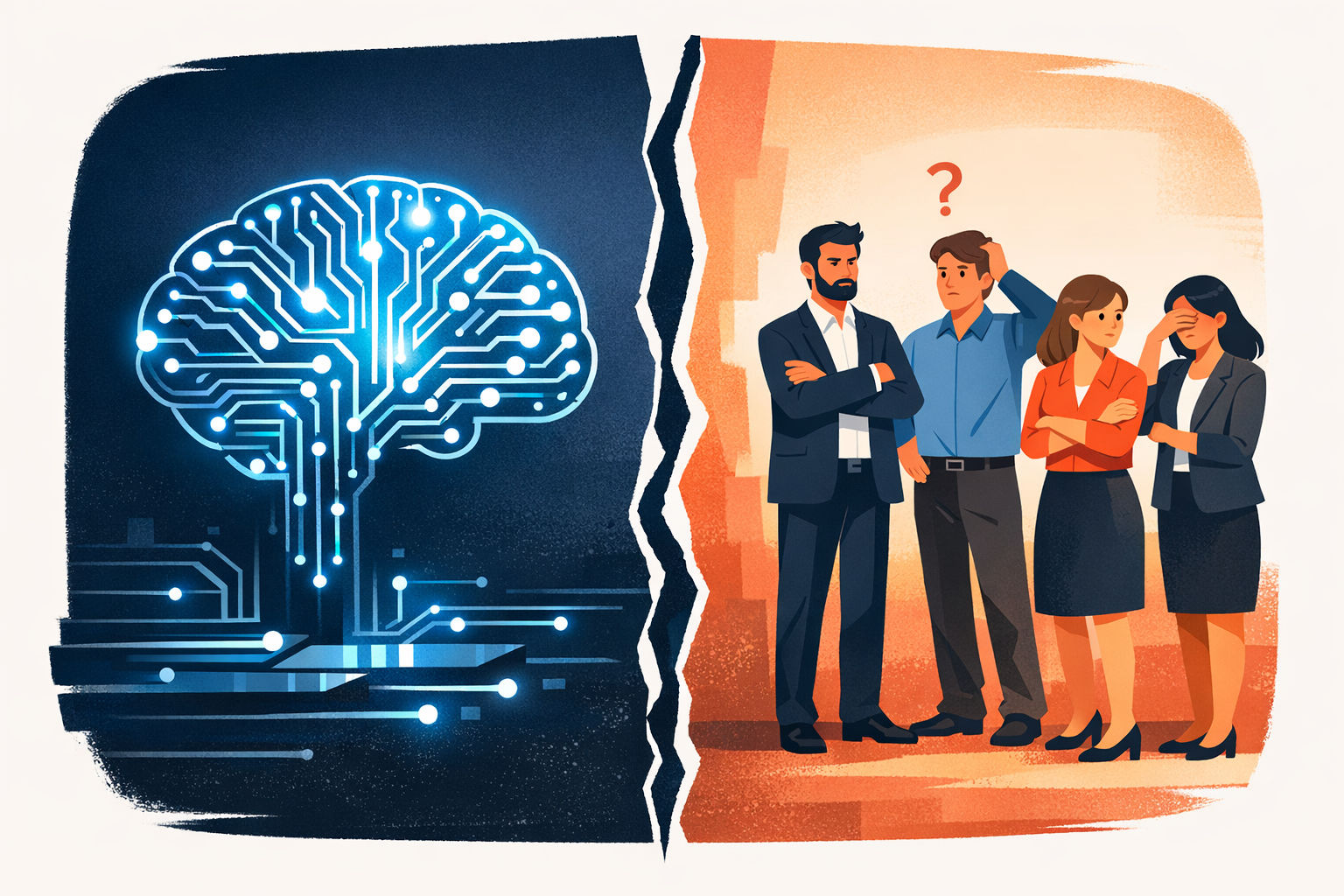
Here's a stat that should reframe how you scope every AI engagement: 70% of large-scale transformations fail, and the root cause is rarely the technology. It's the people.
McKinsey has confirmed this number repeatedly — most recently in their 2023 book Rewired. Prosci's research across 1,107 professionals found that 63% of AI implementation challenges stem from human factors, not technical limitations. And MIT's 2025 study dropped an even sharper finding: 95% of generative AI pilots fail to deliver measurable business impact.
The models work. The APIs connect. The dashboards render. And then the client's team quietly reverts to spreadsheets, ignores the AI recommendations, and your project becomes another expensive pilot that "didn't stick."
If you've delivered two or three AI projects and keep hitting adoption walls, this is probably why. You've been solving the technology problem. The actual problem is ai change management — and it's the biggest billable opportunity most consultants are leaving on the table.
Organizations that invest in cultural change alongside technology see 5.3× higher success rates than those that focus on tech alone (BCG/McKinsey synthesis). Projects with strong change management are 6× more likely to meet objectives (Prosci). If you're not billing for the people layer, you're setting your own projects up to underperform.
The 3 Failure Modes at the People Layer
Every AI adoption failure you've experienced — or will experience — fits into one of three buckets. Recognizing them is the first step to billing for fixing them.
1. Employee Resistance (The Silent Killer)
This is the one that looks like a technology problem but isn't. The AI tool works. Usage is low. People build workarounds.
It shows up as:
- Front-line staff who "forget" to use the new system
- Managers who keep making decisions based on gut feel, ignoring AI recommendations
- Teams that run the old process in parallel "just in case"
The driver is almost always fear — fear of job loss, fear of being surveilled, fear of looking incompetent with new tools. Aberdeen research found that 70% of Boomers and 57% of Millennials/Gen Z believe AI will put jobs at risk. When you don't address that fear directly, you get passive non-adoption.
2. Unclear Ownership (The Org Chart Problem)
RAND Corporation analyzed dozens of failed AI projects and found that 84% of failures were leadership-driven. The most common pattern: nobody actually owns the AI initiative's success at the operational level.
The executive sponsor signed the check, IT built the integration, and the data team trained the model. But who owns adoption in the customer service team? Who's accountable when the ops team isn't using it? Who decides if the AI recommendation overrides a human judgment call?
When ownership sits in the gap between IT and operations, AI projects die there.
3. No Training Plan (The "We'll Figure It Out" Problem)
This is the most common and most preventable failure mode. The client assumes that because the tool is "intuitive," people will just use it. They won't.
Prosci's research shows a trust gap by role: executives report significantly higher trust in AI tools than frontline workers. The people who approved the project are not the people who have to change how they work every day. Without role-specific training, hands-on practice, and a feedback loop, you get a spike in usage during launch week followed by a cliff.
How to Spot AI Implementation Resistance During Discovery
The best consultants don't wait until post-launch to discover people-layer risk. They surface it during discovery — and use it to expand the scope of work.
Here are the red flags to listen for in stakeholder interviews:
In conversations with executives:
- "We just need the team to adopt it" (translation: no change plan exists)
- "Our people will get on board once they see the results" (translation: no one has addressed fear of displacement)
- "IT is handling the rollout" (translation: no operational ownership)
In conversations with middle management:
- Managers who can't articulate how their team's daily workflow will change
- Vague answers about who approved the AI initiative vs. who will enforce adoption
- No mention of training, timelines, or success metrics for their specific team
In the org chart itself:
- No named "AI owner" below the C-suite
- The project sits entirely within IT with no business-side co-lead
- RAND found that 56% of failed AI projects lost executive sponsorship within six months — if the sponsor is already distant, flag it early
Every one of these red flags is a signal that this engagement needs a change management workstream. And every one of them is a conversation that moves you upmarket — from "vendor who builds AI tools" to "consultant who ensures AI actually delivers ROI."
Ask this during every discovery call: "Who in the organization will be responsible for ensuring the people who use this system every day actually change how they work?" If the answer is vague or defaults to "IT" or "we'll handle that internally" — you've just found the gap that justifies a change management workstream.
What a Billable AI Change Management Workstream Looks Like
This is where most consultants leave money on the table. They know adoption is a problem. They might even mention change management in passing during the project. But they don't scope it, name it, or price it as a standalone deliverable.
Here's what a proper ai adoption consulting workstream includes:
Stakeholder Mapping & Influence Analysis
Change Impact Assessment by Role
Communications Cadence & Narrative
Role-Specific Training Program
Feedback Loops & Adoption Dashboard
Practitioner benchmarks suggest that ai change management work typically accounts for 15–30% of the total AI program budget. On a $200K AI implementation, that's $30K–$60K in change management fees. On an enterprise rollout, it can be six figures.
The key: this is a separate line item with its own deliverables, milestones, and staffing. Not a bullet point buried in the implementation SOW.
How to Price and Package Change Management for AI Projects
If you've been giving change management away for free — folded into implementation, included in "training" that's really just a 45-minute walkthrough — stop.
Here's how to structure it as a named, priced deliverable:
| Package | Scope | Typical Price Range | Best For |
|---|---|---|---|
| AI Adoption Readiness & Roadmap | Stakeholder mapping, change readiness assessment, communications strategy, training roadmap (3-4 weeks) | $7,500 – $25,000 | Pre-implementation or add-on to discovery |
| Pilot Change Enablement | Impact assessment, comms plan, role-specific training (2-4 sessions), adoption metrics, 30-day hypercare (8-12 weeks) | $30,000 – $80,000 | Single-team or department AI rollout |
| Enterprise Adoption Program | Full stakeholder analysis, org-wide comms, multi-role training curriculum, change champion network, 90-day feedback loops, adoption dashboard (3-6 months) | $80,000 – $250,000 | Multi-department or company-wide AI transformation |
| Ongoing Adoption Retainer | Monthly adoption reviews, quarterly training refreshers, new-hire onboarding for AI tools, continuous improvement (monthly) | $5,000 – $20,000/month | Post-launch sustained adoption |
Change management packaging tiers for AI consulting engagements
The pricing math works because you're tying fees to adoption outcomes, not hours. If your AI implementation saves the client $120K/year in labor costs but only 25% of the team actually uses it, that's $90K in unrealized value. Your change management workstream — priced at $30K-$60K — is the multiplier that takes adoption from 25% to 75%+ and unlocks the full ROI.
For detailed guidance on structuring your rates, see our AI consulting pricing guide.
Three pricing rules:
- Never bundle it invisibly — if change management doesn't have its own line item, the client won't value it and you won't staff it properly
- Tie it to adoption metrics — usage rates, workflow completion, and time savings give you hard proof of delivery
- Use milestone billing — 30% at kickoff, 40% at deliverable completion (training + comms assets), 30% after hypercare period
The Frameworks That Actually Work (Simplified)
You don't need a change management certification to deliver this. You need two mental models and the discipline to apply them.
Prosci ADKAR Model
ADKAR gives you a diagnostic checklist for every individual who needs to adopt the AI solution:
- Awareness — Do they understand why the change is happening?
- Desire — Do they want to participate? (Have you addressed fear?)
- Knowledge — Do they know how to use the new tools and processes?
- Ability — Can they actually perform the new way of working?
- Reinforcement — Are there systems in place to sustain the change?
When adoption stalls, ADKAR tells you exactly where the breakdown is. Most AI projects over-invest in Knowledge (training) while skipping Awareness and Desire entirely. That's why people attend the training and then never open the tool again.
Lewin's Change Model (Unfreeze → Change → Refreeze)
Lewin gives you a project timeline:
- Unfreeze — Before you deploy anything, build the case for change. Surface fears. Get stakeholder buy-in. This is your discovery and readiness phase.
- Change — Deploy the AI solution with structured support: piloting, training, champion networks, active communication.
- Refreeze — Lock in the new way of working. Update SOPs. Align incentives. Make AI-enabled workflows the default, not the experiment.
The mistake most consultants make: they jump straight to "Change" (deployment) without "Unfreezing" the organization first. No amount of good technology overcomes a workforce that was never prepared for the shift.
Most firms struggle to capture real value from AI not because the technology fails — but because their people, processes, and politics do.
— Sam Ransbotham & Shervin Khodabandeh, Harvard Business Review, summarizing a decade of MIT Sloan Management Review / BCG research on AI
Before You Can Sell Change Management, You Need to Diagnose the Risk
Here's the practical bridge: you can't pitch a change management workstream in a vacuum. The client doesn't wake up thinking "I need someone to manage my AI change." They think "I need AI implemented."
The way you surface the people-layer risk — and earn the right to scope that workstream — is through a structured AI readiness assessment. Not a generic questionnaire. A diagnostic that evaluates the organization across technology, data, process, and people/culture dimensions.
When the readiness assessment reveals that the org has solid data infrastructure but weak executive sponsorship, no training budget, and a middle management layer that's never been consulted — that's when you present the change management workstream as the fix. It's not an upsell. It's a direct response to what the data surfaced.
This is exactly why readiness assessments are the highest-leverage tool in an AI consultant's kit. They let you diagnose before you prescribe — and they give you the evidence to scope the full engagement, people layer included.
The Bottom Line
The AI consultants who keep hitting adoption walls aren't bad at technology. They're underscoping the engagement. The people layer isn't a "nice to have" — it's where 70% of the failure risk lives, and it's where the most defensible, recurring consulting revenue comes from.
Name the workstream. Price it explicitly. Deliver it with frameworks. And start every engagement with a readiness assessment that surfaces the risk before you build anything.
The technology was never the hard part. The organizations using it — that's where you earn your fee.
