

Manufacturing is probably the single highest-ROI vertical for AI consulting — and most consultants won't touch it.
The reasons are predictable: they don't know the language, they've never walked a factory floor, and they assume they need an engineering degree to have the conversation. Meanwhile, U.S. manufacturers lose $50 billion per year to unplanned downtime alone (Siemens, 2024). The average cost of one hour of unplanned downtime? $260,000 (Aberdeen). And the sector is staring down a projected 1.9 million worker shortfall by 2033 (NAM/Manufacturing Institute).
These aren't abstract numbers. They're the reason a plant manager will take your call — if you know what to say.
This post is the playbook for AI consultants who want to sell into manufacturing. No prior manufacturing experience required. We'll cover the pain points that open doors, the use cases with proven ROI, what to avoid pitching, how to price engagements, and exactly who to target at a manufacturing company.
The Pain Points That Actually Open Doors
Manufacturing operators don't buy AI because it sounds cool. They buy it because their current process is causing downtime, quality defects, or safety incidents. Your job as a consultant is to speak to the pain they already feel — not educate them about AI.
Here's what keeps manufacturing leaders up at night:
| Pain Point | The Real Cost | Source |
|---|---|---|
| Unplanned downtime | $260K/hour average; 25 incidents per month at a typical plant | Aberdeen; Neobram 2026 |
| Quality defects & escapes | Manual inspection misses 1 in 3 critical flaws; one manufacturer lost $6.3M/year to escaped defects | Oxmaint case study |
| Labor shortage | 1.9M worker shortfall by 2033; 409,000 unfilled positions today | NAM; Deloitte 2025 |
| Maintenance costs | Reactive maintenance costs 3-10x more than planned; 42% of downtime comes from equipment failure | InfoDeck; ReliaMag 2026 |
| Demand planning errors | Poor forecasting drives 15-30% excess inventory carrying costs | Customertimes 2025 |
The five manufacturing pain points most likely to get you a meeting
Notice what's not on this list: "We need AI." Manufacturing buyers don't think in those terms. They think in downtime hours, scrap rates, overtime costs, and missed shipments. When you reach out, lead with their vocabulary, not yours.
The labor shortage is an especially powerful wedge right now. Deloitte reports that manufacturers rank workforce availability as a bigger concern than tariffs, taxes, or regulations. AI doesn't replace workers — it makes the workers they can't hire unnecessary for the tasks they shouldn't be doing manually in the first place.
The Four Use Cases With Undeniable ROI
Not all AI use cases are created equal. In manufacturing, four specific applications have the clearest ROI, the most case studies, and the easiest path to a signed deal. These are your go-to offerings for ai for manufacturing companies.
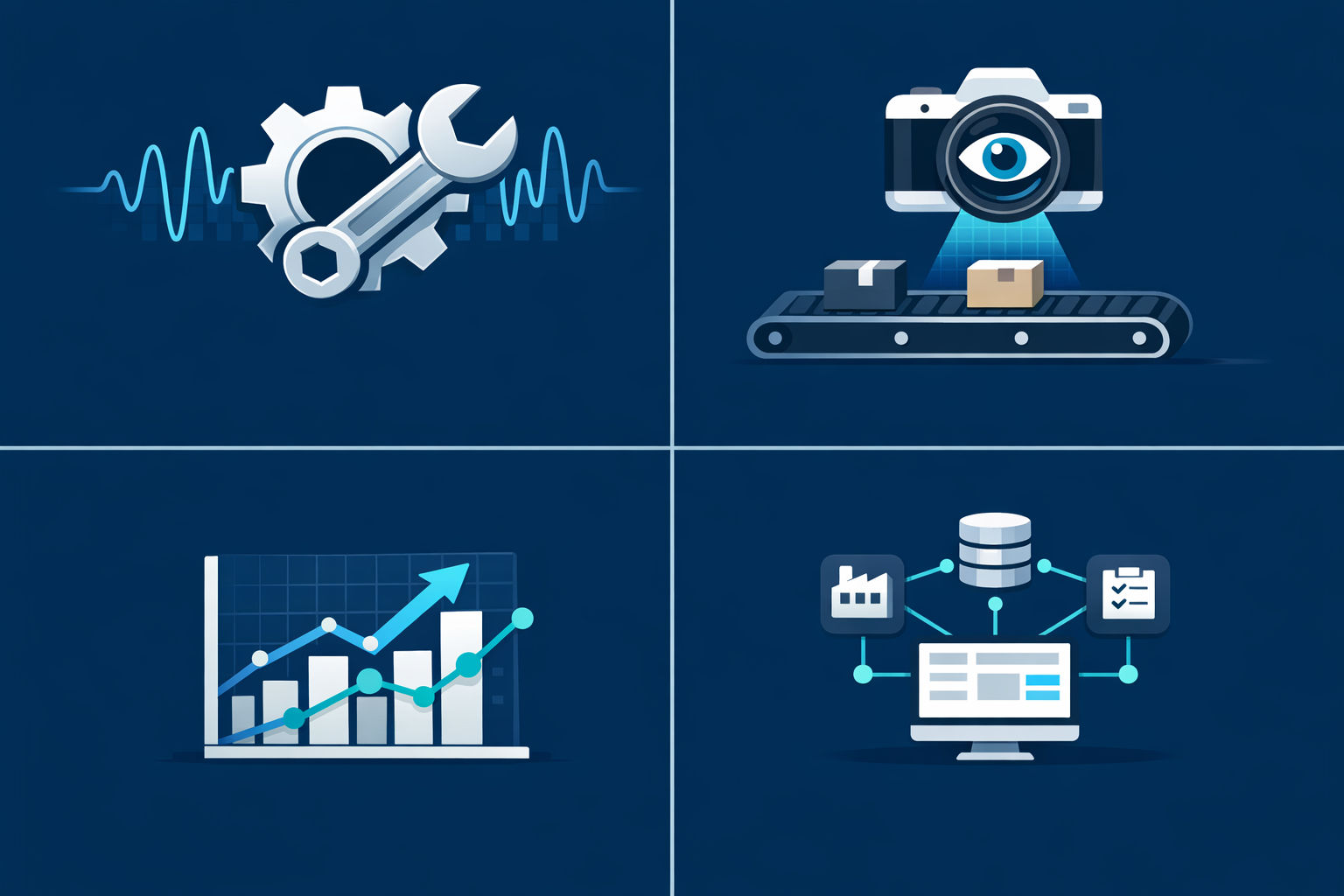
1. Predictive Maintenance
Why it sells: This is the single strongest ROI use case in industrial AI. Period.
Most factories still run on run-to-failure or time-based maintenance — equipment either breaks unexpectedly, or gets serviced on a fixed calendar regardless of actual condition. Both are expensive.
AI-based predictive maintenance analyzes sensor data (vibration, temperature, power consumption, acoustics) to predict failures 2-14 days before they happen (AISuccessful, 2025). This means maintenance happens in planned windows, not at 2 AM when a hydraulic press bearing fails and takes out a production line feeding three OEM plants.
The numbers:
- 30-50% reduction in unplanned downtime (IBM, 2024; McKinsey)
- 10-40% cut in maintenance costs (McKinsey, Deloitte)
- 25% longer equipment life on average (McKinsey via SupaLabs)
- 12-18 month payback (SKF customer results)
- One Fortune 500 manufacturer achieved $96M in annual savings across 14 production lines with a 42% downtime reduction (AI Advisory Practice case study)
What you actually deliver: Sensor data integration, anomaly detection models, alert dashboards for maintenance teams, and — critically — the change management to get operators to trust the system. Maintenance teams that participate in model calibration have 40-60% higher alert compliance than those handed a black box (Opsio, 2026).
2. Visual Quality Inspection
Why it sells: Every manufacturer has a quality problem. Most just don't know how bad it is.
Computer vision quality inspection reduces defect escape rates by up to 90% (Deloitte, 2024). One case study: a manufacturer processing 62,000 units/day deployed AI vision across 9 production lines, cut their defect escape rate to 0.2%, and prevented $8M in recalls (Oxmaint case study). Deployment took 18 days.
What you actually deliver: Camera-based inspection systems, defect classification models, integration with existing MES/quality systems, and reporting dashboards. The beauty of this use case is that results are immediately visible — you can show a side-by-side comparison of what the AI catches versus what humans miss.
3. Demand Forecasting
Why it sells: Bad demand planning bleeds money quietly.
AI demand forecasting improves forecast accuracy by 15-40% and reduces inventory holding costs by 20-35% on average (Customertimes; Opsio). For a mid-market manufacturer carrying $10M in inventory, a 20% reduction frees up $2M in working capital.
What you actually deliver: Historical sales data analysis, multi-variable forecasting models (factoring in seasonality, supplier lead times, market signals), and integration with their ERP/planning systems.
4. ERP and Workflow Integration
Why it sells: This is the unsexy use case that prints money.
Most manufacturers run on a patchwork of disconnected systems — ERP, MES, spreadsheets, paper forms, and tribal knowledge. AI-powered integration and workflow automation eliminates manual data entry, surfaces insights trapped in silos, and connects planning to execution.
What you actually deliver: Automated data flows between systems, AI-powered reporting, natural language interfaces for querying production data, and process automation for repetitive tasks like purchase order generation or scheduling. This is often the fastest win because it doesn't require sensor infrastructure or computer vision hardware — just data access.
Custom ML model training from scratch. Most manufacturers don't have the data infrastructure, and you'll burn months on data preparation before delivering any value. Up to 87% of AI projects never reach production due to data quality issues (Gartner, 2024). Start with pre-built tools and off-the-shelf models.
Full digital twin deployments on day one. Digital twins are powerful but complex. The market is growing fast ($8B in 2025), but as a first engagement, they require too much upfront investment and too long a timeline to show ROI.
"Moonshot" generative AI projects. Only 24% of manufacturers have deployed generative AI at facility level (Deloitte, 2025). Pitching cutting-edge GenAI to a plant that still runs on paper work orders is a credibility killer.
The rule: Start with the problem that costs them the most money and can show measurable results within 90 days. Everything else is Phase 2.
How to Price a Manufacturing AI Engagement
Pricing AI manufacturing consulting follows a predictable pattern: start small and strategic, prove value, then expand. Here's what the market actually looks like — not aspirational numbers, but what practitioners are charging right now.
If you need a deeper dive on structuring consulting fees, our guide on fractional CTO pricing and engagement models covers the retainer math in detail.
| Engagement Type | Typical Price Range | Timeline | What's Included |
|---|---|---|---|
| AI Readiness Assessment | $10,000 – $30,000 | 2-4 weeks | Data audit, system mapping, pain point prioritization, AI roadmap, ROI projections |
| Single Use Case POC | $20,000 – $60,000 | 6-10 weeks | One predictive maintenance, vision inspection, or forecasting pilot on one line or asset type |
| Production Deployment | $50,000 – $150,000 | 3-6 months | Full deployment with integrations, operator training, dashboards, and monitoring |
| Ongoing Retainer | $5,000 – $15,000/month | Ongoing | Model monitoring, drift detection, incremental improvements, new use case scoping |
| Multi-Plant Rollout | $150,000 – $500,000+ | 6-12 months | Standardization across sites, governance framework, MLOps, change management |
Manufacturing AI consulting pricing benchmarks — based on 2025-2026 market data
The Land-and-Expand Model
The smartest play for ai manufacturing consulting is a phased approach:
Phase 1: Paid Discovery ($10K-$30K). Run an AI readiness assessment. Map their systems, data, and pain points. Deliver a prioritized roadmap with ROI projections. This is low-risk for the client and positions you as a strategic advisor, not a vendor. Tools like ConsultKit's AI readiness assessment framework can help you structure this engagement and deliver a professional, data-backed report that earns trust fast.
Phase 2: POC on Highest-ROI Use Case ($20K-$60K). Pick the use case with the most measurable impact — usually predictive maintenance or quality inspection. Deliver results within 8-10 weeks.
Phase 3: Scale to Production + Retainer ($50K+ project, $5K-$15K/month ongoing). Once the POC proves value, expand to full production deployment and lock in a monthly retainer for continuous optimization.
This progression typically turns a $10K discovery into a $100K-$200K first-year engagement — and manufacturing clients tend to stay for years, not months. As we've covered in our guide to moving upmarket with AI consulting, manufacturing is the kind of vertical where bigger deals and longer relationships are the norm, not the exception.
Manufacturing is one of the few verticals where outcome-based pricing actually works. When you can measure downtime reduction, scrap rate improvement, or inventory savings in hard dollars, consider a hybrid model: a base project fee plus 10-25% of documented savings in the first 12 months. One practitioner in this space charges a $100K project floor with a $1,000/hr rate — and manufacturers pay it because the ROI math is obvious (Paul Okhrem, AI consulting for industrial operations).
Getting in the Room: Who to Target and What They'll Say
The hardest part of selling ai to manufacturers isn't the pitch — it's reaching the right person. Manufacturing sales cycles run 6-18 months with buying committees of 5-11 stakeholders (Salesmotion, 2026). You need to be strategic about who you approach first.
Your Ideal First Contact
For mid-market manufacturers (50-500 employees, $5M-$100M revenue), target:
- Operations Manager or Plant Manager — Owns the pain directly. Feels downtime and quality issues personally. Usually has authority to approve a $10K-$30K discovery engagement without board approval.
- VP of Operations / VP of Manufacturing — Controls larger budgets. Thinking about multi-plant strategy. More likely to sponsor $50K+ projects.
- Quality Manager — Great secondary contact. They live and breathe defect rates and can champion visual inspection use cases internally.
Don't start with IT. In manufacturing, IT supports the plant — they don't drive operational strategy. IT gets involved later to validate integration and security.
Don't start with the CEO (unless it's an owner-operated shop under 100 employees). You want the person who feels the problem, not the person three levels above it.
The Outreach That Works
Manufacturing buyers complete about 70% of their research before contacting a supplier (Sagefrog, 2026). They also ignore generic "efficiency" pitches. Your outreach needs to demonstrate that you understand their specific production challenges.
A cold email that works:
"Hi [Name], I noticed [Company] runs [specific process/equipment]. We've been helping similar [industry] manufacturers reduce unplanned downtime by 30-40% using predictive maintenance on [relevant equipment type]. Most of our clients see payback within 12 months. Would a 20-minute call make sense to see if there's a fit?"
A cold email that doesn't:
"Hi, we're an AI consulting firm that helps companies leverage artificial intelligence to drive digital transformation..."
Plant managers are on factory floors, not sitting in email all day. Phone still works in manufacturing. Multi-touch sequences (phone + email + LinkedIn) outperform cold email alone.
"We tried AI before and it didn't work."
"Our equipment is too old for AI."
"We can't afford any production disruption during implementation."
"Our data is a mess."
"I need to get IT and finance involved."
Building Your Manufacturing Pipeline
Manufacturing isn't a one-call-close vertical. But the deals are bigger, the relationships are stickier, and the ROI math is more defensible than almost any other sector you could sell into.
Here's how to build momentum:
-
Pick a sub-vertical. Don't try to sell to "manufacturing." Pick one: automotive parts, food & beverage, metal fabrication, electronics assembly, plastics. Each has different pain points and different regulatory environments. Specialization gives you credibility.
-
Build one case study. Your first manufacturing client is the hardest to get. Consider doing a discounted readiness assessment for a company in your network to build the reference. One real case study with real numbers is worth more than a hundred cold emails.
-
Learn the language. OEE, MTTR, MTBF, first-pass yield, scrap rate, changeover time. You don't need an engineering degree, but you need to know these terms cold. A plant manager will test you in the first five minutes.
-
Work your existing sales process. The fundamentals of qualifying, discovering, and closing AI consulting deals don't change. Manufacturing just requires more patience and more stakeholders.
-
Time your outreach. CapEx budgets are planned in Q3/Q4 for the following fiscal year. Start conversations in June-September to get into next year's budget. OpEx decisions (software, consulting) can happen year-round but are easier when tied to a specific incident or problem.
AI for manufacturing companies is a $34 billion market growing at 35%+ annually (MarketsandMarkets). 72% of manufacturers already use AI in at least one function, but most are stuck in pilot purgatory. They don't need more technology — they need a consultant who can scope properly, deliver fast wins, and expand from there. That's the gap you fill.
