

Here's the fastest way to kill a medical practice deal: walk into a conversation with a practice owner and say the words "machine learning," "large language model," or "natural language processing."
Their eyes will glaze. They'll nod politely. And you'll never hear from them again.
Learning how to sell AI to medical practices isn't a technology problem — it's a translation problem. The doctor sitting across from you doesn't care about your tech stack. They care about getting home before 8pm, keeping their staff from quitting, and figuring out why 15% of their appointments are no-shows.
If you can talk about those problems — and show how your solutions fix them — you'll close deals that other consultants lose by leading with buzzwords.
43% of medical groups added or expanded AI in 2024, up from just 21% in 2023, according to MGMA. Healthcare AI procurement cycles have compressed 22% for outpatient providers. The window is open. But 80% of the market is still untapped.
This post breaks down exactly how to have the sales conversation — what to say, what to skip, and how to frame the ROI so a practice owner gets it in 30 seconds flat. For the regulatory landscape and compliance requirements you need to know before this conversation, read AI for Healthcare: What Consultants Need to Know Before Selling In first.

Understand the Doctor's World Before You Open Your Mouth
Before you learn how to sell AI to medical practices, you need to understand what medical practice owners actually think about every day. Spoiler: it's not artificial intelligence.
Here's the reality of running a medical practice in 2025:
- Operating expenses are up 11.1% year-over-year, and 90% of medical groups report costs rising faster than revenue (MGMA)
- Labor accounts for 84% of total medical group expenses — and they can't find enough staff
- Physicians spend 15.6 to 19.1 hours per week on administrative tasks — that's 40% of their working time spent not seeing patients (AAFP)
- Over 60% of healthcare workers report burnout, with nearly half of departing physicians citing it as the primary reason they left (Health of Health Report)
The doctor you're pitching isn't thinking about "digital transformation." They're thinking about how to see two more patients per day without their best MA quitting.
As one industry analysis put it: health system buyers aren't buying "AI" — they're buying margin protection, staff relief, and help hitting quality targets. If your pitch doesn't map to those priorities, it won't get far.
If you haven't already, read our deep dive on AI for Healthcare: What Consultants Need to Know Before Selling In for the full regulatory and use case landscape. What follows here is the tactical sales conversation.
The Three Pain Points That Sell AI for Doctors
Forget the 47 things AI can theoretically do for a medical practice. In the initial sales conversation, you need exactly three. These are the pain points that practice owners feel in their bones — and the ones with data-backed ROI you can quantify on a napkin.
1. Documentation Is Eating Their Life
This is your number-one wedge into any medical practice. Physicians spend over 50% of their workday in their EHR — averaging 4.5 hours during clinic and another 1.4 hours after-hours, according to the AAFP. They spend twice as much time on paperwork as they do with patients.
Every doctor knows this. Every doctor hates it. Very few know there's a practical solution.
What you say: "Your doctors are spending 4-5 hours a day on documentation. What if we could cut that in half and give them an extra hour with patients — or an extra hour at home?"
What you don't say: "We'll implement an ambient AI scribe using a large language model that performs real-time speech-to-text transcription and generates structured SOAP notes."
The data backs you up: A UCSF study of 1,565 physicians found that those using AI documentation tools generated 5.8% higher weekly productivity and 2.8% more patient encounters, translating to $3,044 in additional annual revenue per physician. And a Yale multicenter study showed AI documentation tools reduced burnout odds by 74%.
2. No-Shows Are Bleeding Revenue
Patient no-shows cost the U.S. healthcare system $150 billion annually. For an individual practice, the damage is more personal: the average practice loses approximately $150,000 per year to missed appointments, at roughly $200 per empty slot (MGMA).
Primary care no-show rates sit around 18-20%. That means nearly one in five scheduled appointments generates zero revenue while the overhead — the room, the staff, the blocked schedule — keeps running.
What you say: "If your no-show rate is 15%, that's roughly $150K in lost revenue every year. I can show you how practices are cutting that by a third with smarter scheduling and automated patient outreach."
What you don't say: "We'll deploy predictive analytics and automated multi-channel communication workflows."
3. Admin Overhead Is Crushing the Front Desk
Administrative inefficiency costs the U.S. healthcare system an estimated $265 billion annually, with admin spending comprising nearly 30% of total healthcare costs (Health of Health Report). At the practice level, front-desk staff spend hours each week on eligibility verification, prior authorizations, patient intake, and inbox management.
Case in point: Valley Diabetes & Obesity, a small specialty practice in California, was logging into 10-15 payer portals daily just for eligibility verification. After implementing AI-powered automation, they achieved 90% automation of eligibility workflows, recovered 8+ hours per staff member per week, and projected $107K-$149K in annual savings per physician — all within 12 weeks (Agentman case study).
What you say: "How many hours a week does your front desk spend on insurance verification and prior auths? What if 80% of that was handled automatically?"
What you don't say: "We'll implement an agentic AI system with RPA capabilities for payer portal integration."
| Pain Point | The Problem (Data) | What Practice Owners Hear | Potential Annual Impact |
|---|---|---|---|
| Documentation | 4.5+ hours/day in EHR per physician | "Your doctors get 1-2 hours back every day" | $3,000-$104,000 per physician (revenue + time) |
| No-Shows | 15-20% missed appointments | "Cut your empty slots by a third" | $50,000-$150,000 recovered revenue |
| Admin Overhead | 8+ hours/week per staff on manual tasks | "Your front desk focuses on patients, not portals" | $107,000-$149,000 in savings per physician |
The three AI pain points that resonate with medical practice owners — framed in their language, not yours
The Jargon-Free Translation Guide
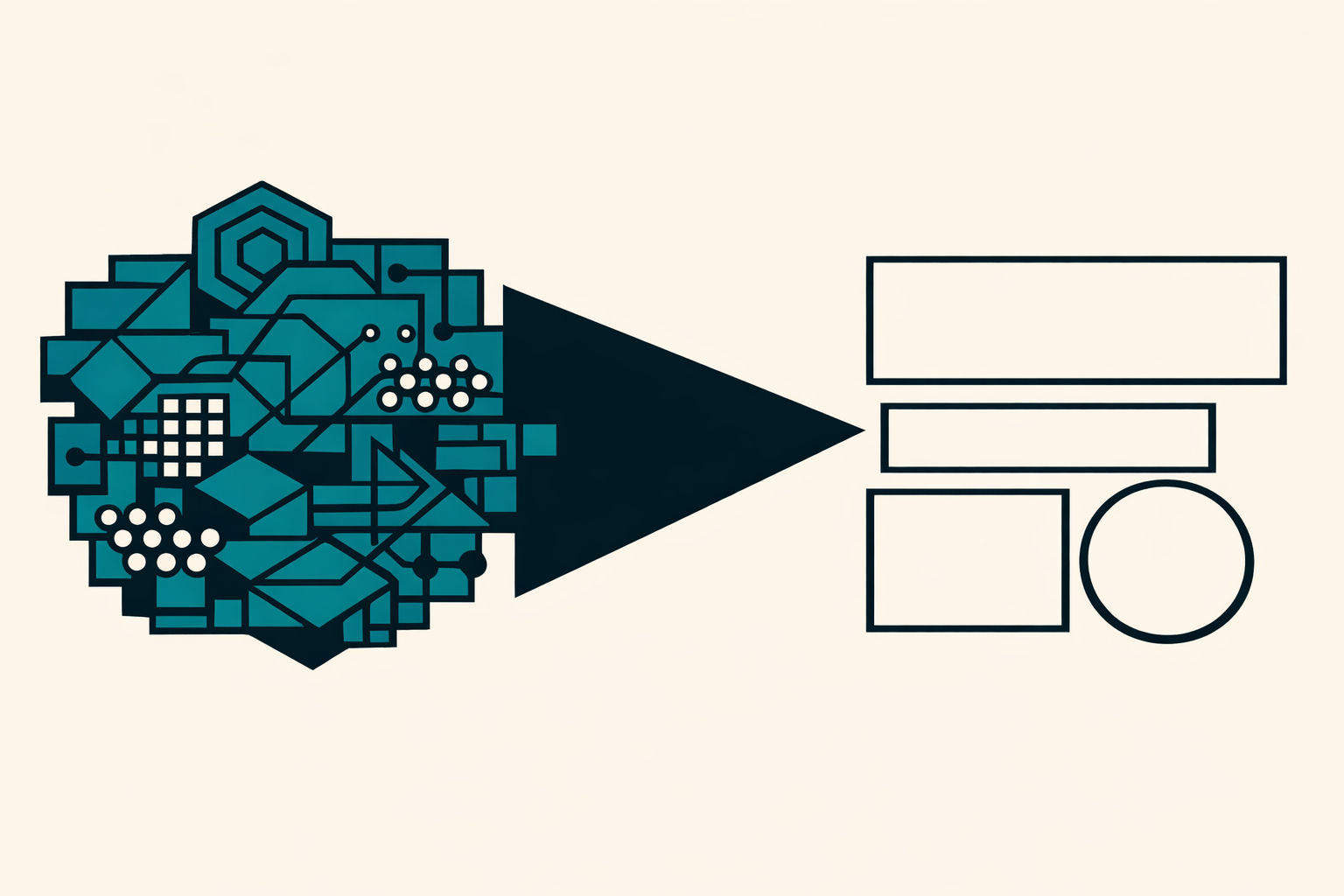
The core skill in selling AI to healthcare isn't technical expertise — it's translation. You need to take what you know and express it in language a practice owner, office manager, or physician would actually use in a staff meeting.
Here's the cheat sheet:
| What You Know It As | What You Say Instead |
|---|---|
| AI ambient scribe / NLP documentation | "A tool that listens during the visit and writes the note for you" |
| Predictive analytics for no-shows | "It flags patients likely to miss, so your team can reach out first" |
| RPA for eligibility verification | "Automates insurance checks so your front desk doesn't log into 10 portals" |
| Chatbot / conversational AI for patient intake | "Patients fill out their info on their phone before they arrive" |
| Machine learning for claim denial prediction | "Catches billing problems before you submit, so you get paid faster" |
| NLP-powered inbox triage | "Sorts and drafts responses to patient messages, so doctors review instead of write" |
Your jargon-to-clarity translation guide for healthcare AI consulting sales conversations
A 2025 Johns Hopkins study found that doctors who use AI for decision-making face a "competence penalty" — their peers perceive them as less skilled. There's social stigma around AI in medicine. When you're in the room, consider leading with the outcome, not the label. Say "automated documentation" instead of "AI scribe." Say "smart scheduling" instead of "predictive analytics." You can always introduce the technical details later, once the value is clear.
Handle the HIPAA Objection Before It's Raised
If you're learning how to sell AI to medical practices, you need to know this: HIPAA will come up. Always. Sometimes it's a genuine concern. Sometimes it's a polite way of saying "I'm not interested."
Either way, you need to handle it proactively — not reactively.
The AMA's 2024 physician survey found that 86% of doctors cite data privacy as a concern with AI. And 88% say clear liability frameworks are the highest-priority regulatory need. These aren't irrational fears. They're informed positions.
Here's how to address it:
- Raise it yourself first. In your initial conversation, say: "Before we go further — everything we do is HIPAA-compliant, and I'll walk you through exactly how patient data is protected. Want me to cover that now?" Raising it first signals competence.
- Be specific, not vague. Don't say "We take privacy seriously." Say: "Patient data stays within your existing EHR. The documentation tool processes audio locally and generates notes that are reviewed before they enter the record. No patient data is stored by third-party servers." (Adjust to match whatever solution you're implementing.)
- Offer a BAA upfront. If you're involving any third-party tools, have a Business Associate Agreement ready before they ask. The practice's compliance officer will need it, and having it prepared shows you've done this before.
- Acknowledge the liability question. Reference AMA President Dr. Jesse Ehrenfeld's point that AI should support — not override — clinical judgment. Position your solutions as tools that augment the physician's workflow, with human review at every step.
Above all else, health care AI must be designed, developed and deployed in a manner which is ethical, equitable, responsible and transparent. Steps should be taken to ensure that these systems are not overriding clinical judgement and do not eliminate human review.
— Dr. Jesse Ehrenfeld, President, American Medical Association
Your Entry Point: A Paid Assessment, Not a Free Demo
Here's a mistake I see consultants make repeatedly in healthcare AI consulting: they offer a free demo or a free consultation to get in the door.
The problem? Free demos attract tire-kickers. And in healthcare, where procurement cycles average 4.7 months for outpatient providers (Menlo Ventures 2025 report), a tire-kicker can waste a full quarter of your year.
Instead, lead with a paid AI readiness assessment. This works exceptionally well for medical practices because:
- It respects their time. Doctors value efficiency. A structured assessment signals professionalism over a meandering sales pitch.
- It surfaces the real numbers. You'll quantify their documentation time, no-show rate, admin hours, and revenue leakage — giving both of you concrete data to work with.
- It builds trust before the big engagement. The practice gets a deliverable they can act on regardless of whether they hire you for implementation. That's how you earn referrals in healthcare.
- It qualifies the lead. A practice willing to pay $1,500-$3,000 for an assessment is a serious buyer. One that balks at any upfront investment will likely stall on a $30K implementation.
Our playbook on the audit-first sales model goes deep on structuring this as your primary sales motion. For medical practices specifically, focus your assessment on the three pain points above: documentation burden, no-show economics, and front-desk workflow efficiency. If you want to understand the full framework behind what a quality assessment delivers — and what separates a professional report from a generic slide deck — see what an AI readiness assessment actually is and why every client needs one.
Open with their world, not yours
Quantify the pain with their numbers
Mirror it back with industry data
Introduce the outcome, not the technology
Address HIPAA proactively
Propose a paid assessment as the next step
The Numbers That Close the Deal
Doctors are scientists. Practice owners are businesspeople. Either way, they respect numbers more than narratives. When it's time to close, lead with concrete ROI framing.
Here's a simple framework you can use for a 5-physician primary care practice:
| Intervention | Conservative Impact | Source |
|---|---|---|
| AI documentation (5 physicians × $3,044 additional revenue) | $15,220/year | UCSF/JAMA 2025 study of 1,565 physicians |
| No-show reduction (15% → 10% at $200/slot) | $50,000-$75,000/year | MGMA data, $200/missed appointment average |
| Admin automation (eligibility, intake, inbox) | $50,000-$100,000/year | Valley Diabetes case study: $107K-$149K/physician |
| Reduced physician turnover (burnout reduction) | Avoids $800K-$1.3M replacement cost | Yale/AMA burnout research |
| **Total conservative annual impact** | **$115,000-$190,000+** |
Conservative ROI framework for a 5-physician primary care practice implementing AI across documentation, scheduling, and administration
A multi-location dermatology practice with 8 providers invested $12,900 in AI-powered patient intake automation and saw a $185,000 annual impact — a 1,334% ROI. Patient wait times dropped from 22 minutes to 4 minutes, data entry errors fell from 3.8% to 0.3%, and their Google rating jumped from 4.1 to 4.6 stars (AffixedAI case study). That's the kind of story that gets a practice owner to lean forward in their chair.
The AMA's physician survey found that nearly two-thirds of physicians see advantages in AI — but 41% are equally excited and concerned. They want it to work. They're just afraid it won't.
Your job in the sales conversation isn't to convince them AI is amazing. It's to make it feel safe and practical.
Here's what they need to hear from you:
- "This works with your existing systems." Integration anxiety is real. 85% of physicians want direct involvement in AI adoption decisions. Show them you'll work within their EHR, not replace it.
- "You'll see results in weeks, not months." Healthcare AI procurement cycles have compressed to under 5 months for outpatient providers. But the practice owner is thinking smaller — they want to know when they'll feel the difference.
- "Your doctors stay in control." As Johns Hopkins researcher Risa Wolf noted: "AI has the potential to complement — not replace — clinical judgment, ultimately strengthening decision-making and improving patient care." That's the message that resonates.
- "Other practices your size are already doing this." 43% of medical groups expanded AI in 2024. You're not asking them to be pioneers — you're helping them catch up.
Once the engagement is scoped, a tight AI consulting scope of work is especially important in healthcare, where undefined deliverables and assumption gaps can create compliance exposure. Before the sales conversation even begins, use the BANT+Data framework for qualifying AI consulting leads to assess whether a practice has the budget, decision authority, and AI readiness to move forward — qualifying healthcare leads rigorously saves significant pre-sales time.
Putting It All Together
Selling AI for medical practices isn't about the technology. It never was.
It's about understanding that the person across from you is drowning in paperwork, losing money to empty appointment slots, and watching their best staff burn out. They need a partner who speaks their language, quantifies the problem, and provides a clear, low-risk path forward.
Drop the jargon. Lead with the pain. Show the numbers. And start with a paid assessment that proves your value before you ask for the big engagement.
If you've already read our guide on how to sell AI to businesses, this is the healthcare-specific layer. The principles are the same — lead with problems, quantify value, reduce risk — but the language is different. And in healthcare, the language is everything.
The 80% of the market that hasn't adopted AI yet? They're not waiting for better technology. They're waiting for someone who can explain it in terms that make sense.
Be that person.
Related reading: Healthcare practices in regulated environments increasingly need AI governance alongside any implementation. The guide to selling AI governance to SMB clients shows how to layer this as a high-margin add-on once the core AI engagement is underway — particularly relevant for medical practices navigating HIPAA and state AI disclosure laws.
