

Here's a scenario that should keep you up at night.
You recommend an AI tool to a client. They deploy it. The tool hallucinates — invents data, fabricates a compliance rule, or generates a recommendation that costs the client real money. The client calls you. Not the vendor. You.
And your contract? It probably won't protect you.
AI consulting contract risk is the blind spot most independent consultants, freelancers, and small agencies refuse to address until it's too late. U.S. professional liability claim frequency rose 14% between 2022 and 2025, with technology E&O claims among the steepest risers. The average tech E&O settlement now hits $245,000 per case — and AI-driven decision-error claims in finance and healthcare have produced settlements exceeding $2 million (Dataintelo, 2025). Meanwhile, researchers have logged 268 GenAI hallucination-related legal decisions across multiple jurisdictions since June 2023 alone (Lloyd's Market Association / HEC Paris).
This isn't theoretical. The liability landscape is catching up to the hype. And if you're delivering AI implementations without the right contract language, expectations framework, and recovery playbook, you're operating without a net.
This article is not legal advice. It's practical guidance from one AI consultant to another. Your contracts should be reviewed by a qualified attorney who understands your jurisdiction, your service model, and the specific risks of your engagements. Use this as a starting framework for that conversation — not as a substitute for it.
The Five Ways AI Engagements Blow Up
Before we talk contracts, let's be honest about what actually goes wrong. AI consulting contract risk doesn't come from exotic failure modes — it comes from predictable, repeatable problems that most consultants have seen at least once.
1. Hallucination-Driven Bad Outputs
The AI tool you recommended generates fabricated data, invented citations, or wrong recommendations. Your client acts on them. A Stanford HAI-linked study found general-purpose chatbots hallucinate on 58–82% of legal research queries. Even specialized RAG systems still hallucinate on over 17% of queries. When Air Canada's chatbot invented a refund policy that didn't exist, a tribunal forced the airline to honor it. If your client's AI does the same thing with compliance rules or financial data, guess who they're calling.
2. Data Privacy Exposure
Client data gets fed into a public model, or an AI system you configured processes personal data in ways that violate privacy regulations. This is growing fast — 2024 saw a surge in lawsuits alleging personal data was used to train generative AI models in violation of privacy laws, concentrated in the Northern District of California (WilmerHale, 2025).
3. Vendor Failure or Misrepresentation
The AI vendor you recommended changes their terms, discontinues a feature, or turns out to have overstated their capabilities. The SEC brought enforcement actions against firms for "AI washing" — false claims about AI capabilities — with settlements of $225,000 and $175,000 in March 2024. The FTC followed with five more cases in September 2024. If you recommended the vendor, you're in the blast radius.
4. Scope Ambiguity
The client thought "implement AI" meant something different than what you delivered. They expected a production system; you delivered a proof of concept. They assumed ongoing maintenance; your SOW ended at deployment. As we've covered in our piece on why AI projects fail at the people layer, the gap between expectation and delivery is where most consulting relationships die.
5. Client Misuse of a Tool You Recommended
You set up an AI system for one use case. The client extends it to another — feeding it sensitive data, using it for decisions it wasn't designed for, or removing the human-in-the-loop guardrails you built in. The tool fails in its new context. The client blames you for not "making it safe enough."
The Five Contract Clauses Every AI Consulting SOW Needs
Here's where most consultants fall short. They use generic consulting agreements — or worse, no contract at all — and then wonder why they're exposed when things go sideways.
These five clauses aren't optional anymore. They're the minimum viable contract for anyone delivering AI consulting services.
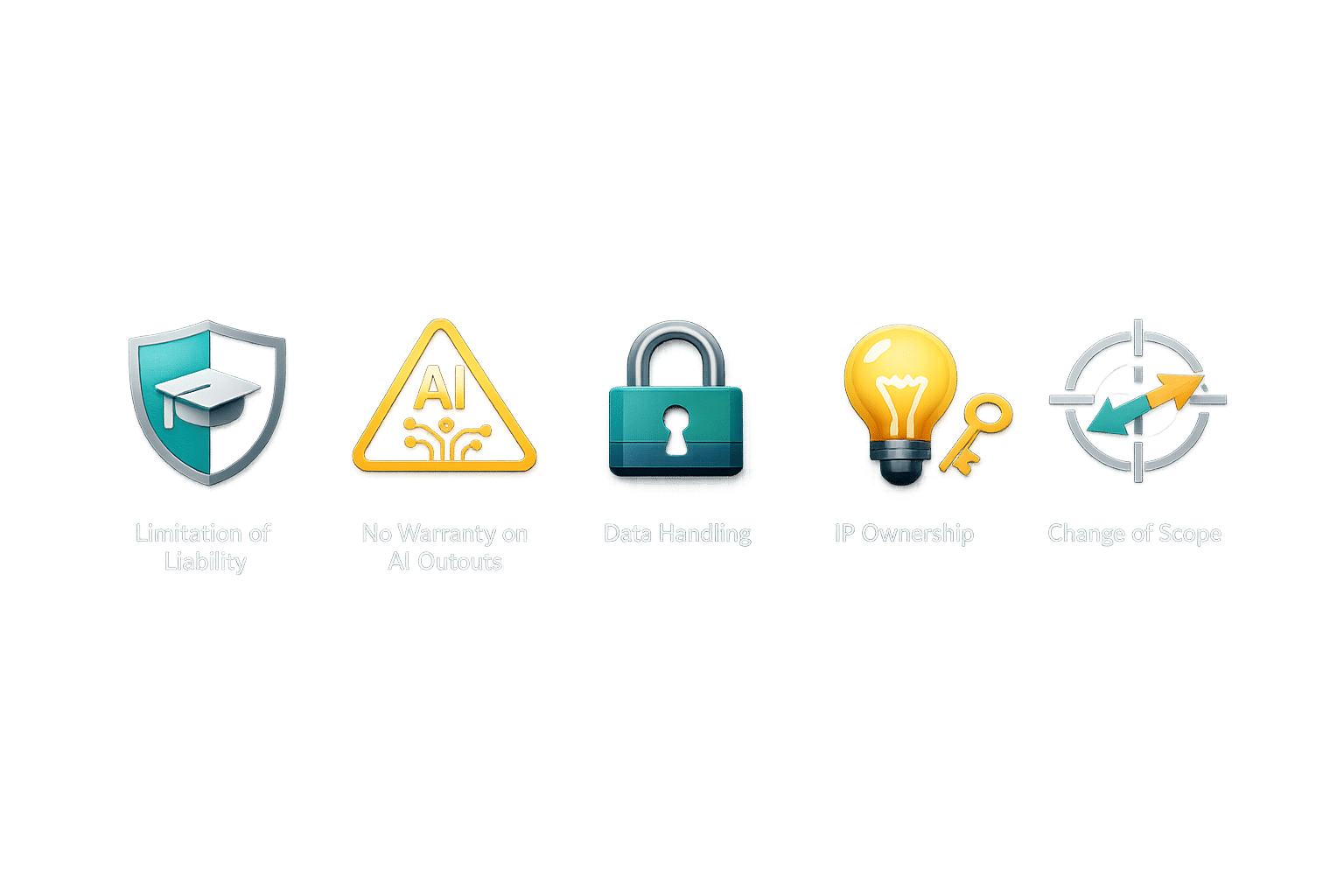
| Clause | What It Does | Why It Matters for AI |
|---|---|---|
| Limitation of Liability | Caps your total financial exposure to a multiple of fees paid (typically 1–2×) | AI failures can cascade — a $15K engagement shouldn't expose you to a $2M claim |
| No-Warranty on AI Outputs | Explicitly states you don't guarantee accuracy of AI-generated content or recommendations | AI models hallucinate. You need written acknowledgment that outputs require human review |
| Data Handling & Indemnification | Defines who is responsible for data fed into AI systems and mutual fault-based indemnity | Client-supplied data creating privacy violations shouldn't be your liability |
| IP Ownership | Specifies who owns fine-tuned models, custom prompts, configurations, and outputs | Without this, a $50K engagement could cost you your reusable IP and methodologies |
| Change-of-Scope Triggers | Defines what counts as new work, how changes are priced, and requires written approval | AI projects evolve constantly — without triggers, scope creep eats your margin and creates disputes |
The five essential contract clauses for AI consulting SOWs
Clause 1: Limitation of Liability
Cap your total liability to 1–2× the total fees paid under the engagement. Exclude consequential, indirect, and punitive damages explicitly. As one technology contracts practitioner advises: "Caps on liability and exclusions for consequential damages are must-haves."
For AI-specific work, consider tiered caps: a general cap for ordinary breaches, and higher specific caps carved out for data breaches or IP infringement — aligned with your professional liability insurance limits.
Critical detail: make sure your limitation of liability clause explicitly governs your indemnification obligations too. Otherwise, a client can argue indemnity claims fall outside the cap.
Clause 2: No-Warranty Language for AI Outputs
This is the clause most AI consultants are missing entirely. You need explicit language stating:
- AI-generated outputs are probabilistic, not deterministic
- You do not warrant the accuracy, completeness, or fitness of any AI-generated content
- The client is responsible for human review and validation before acting on AI outputs
- You are not liable for decisions the client makes based on AI recommendations
This isn't about dodging responsibility. It's about accurately representing what AI does and doesn't do. Every major AI vendor — OpenAI, Anthropic, Google — disclaims output accuracy in their own terms. You should too.
Clause 3: Data Handling and Indemnification
Use mutual, fault-based indemnification. Each party indemnifies the other for third-party claims arising from their own negligence. Specifically:
- You indemnify for: negligent implementation, professional errors, misuse of training data you controlled
- The client indemnifies for: misapplication of AI recommendations, client-supplied data that violates regulations, extending AI tools beyond agreed use cases
Define data handling obligations clearly: what data goes into which systems, who controls retention, and what happens to data at engagement end.
Clause 4: IP Ownership
This is where Forrester reports 62% of AI initiatives fail — ambiguous IP strategy. For consulting engagements, the standard split is:
- Client owns: fine-tuned model weights created for their specific use, custom configurations, outputs, and company-specific deliverables
- You retain: your general methodologies, reusable frameworks, generic prompt templates, and pre-existing tools
The client gets a license to use your embedded background IP. You get restrictions preventing them from reselling your methodology. Both sides win.
Clause 5: Change-of-Scope Triggers
Define exactly what constitutes new work. Include:
- A formal change request process with written approval required
- Pricing for out-of-scope work (rate card or estimate-then-approve)
- The rule that any addition changes either scope, timeline, or budget — the client picks which
One consultant framework puts it simply: "Any add-on must change something — scope, time, or resourcing." This single rule stops 80% of scope creep before it starts.
Your liability caps should align with your professional liability (E&O) and cyber insurance limits. One in five insurance professionals report that their insureds have already experienced AI-related losses — and 44% of those losses were only partially covered (Gallagher, 2026). If your indemnity obligations exceed your insurance, you're making promises you can't back up. Talk to your broker about AI-specific coverage gaps.
Set Expectations Before Day One — Not After Things Break
The best contract in the world won't save a relationship where expectations were never aligned. The most effective tool for managing ai consultant liability isn't a clause — it's a documented AI readiness assessment and written scope completed before any implementation work begins.
Here's what this looks like in practice:
Before you write a single line of a SOW, run a structured assessment that documents:
- The client's actual data readiness — quality, accessibility, governance
- Their technical infrastructure and integration capabilities
- Workforce AI literacy and change management readiness
- Governance and compliance requirements specific to their industry
- Use-case prioritization — which AI opportunities have clear business value vs. which are speculative
This assessment serves two critical purposes. First, it tells you whether the project is even viable — and if it's not, you've saved yourself from a guaranteed dispute. Second, it creates a documented baseline that both you and the client signed off on. When a client later says "this should have worked," you can point back to the assessment that said their data quality was a 4/10 and they chose to proceed anyway.
This is where tools like ConsultKit earn their keep. When your readiness assessment, scope document, and deliverables are all generated and stored in a system that creates a clear paper trail, you have evidence of what was agreed, what was flagged as a risk, and what the client acknowledged before work began. That paper trail protects both you and the client.
For consultants moving upmarket to mid-market companies, this documented pre-work isn't just risk management — it's a selling point. Sophisticated buyers expect it. If you're competing against big firms, a documented assessment signals professionalism that many larger competitors skip in favor of generic slide decks.
Acknowledge the problem immediately — in writing
Diagnose root cause before proposing solutions
Pull your documentation
Propose a recovery charter — not a band-aid
Separate the relationship conversation from the legal conversation
Know when to walk away
The Bigger Picture: AI Project Risk Management Is a Consulting Skill
Here's what separates consultants who build durable practices from those who get burned out by bad projects: they treat ai project risk management as a core competency, not an afterthought.
That means:
- Every engagement starts with a documented assessment — not a handshake and a Notion doc
- Every SOW includes the five clauses above — reviewed by your attorney, not copy-pasted from a template you found online
- Every client gets educated on what AI can and can't do before implementation begins
- Every project has a change management process — because as we've written about extensively, most AI projects fail at the people layer, not the tech layer
The consultants who do this aren't just protecting themselves. They're building a reputation for rigor that wins bigger deals and commands higher fees. When a mid-market buyer sees a structured readiness assessment, a detailed SOW with proper risk allocation, and a clear scope — that's how independent consultants win deals that big firms are pitching for.
AI consulting indemnification isn't just a legal term — it's your business model. The more clearly you define who's responsible for what, the more confidently you can deliver, the more trust you build, and the more repeat business you earn.
You don't need to be a lawyer to protect your AI consulting business. You need five contract clauses, a documented readiness assessment, a written scope, and a recovery playbook for when things go sideways. Add 30 minutes to your next SOW to include these protections. Then get your attorney to review it. That's it. That's the difference between a consultant who survives a bad outcome and one who doesn't.
