

Property management is one of the most overlooked verticals in AI consulting — and one of the most lucrative once you understand why.
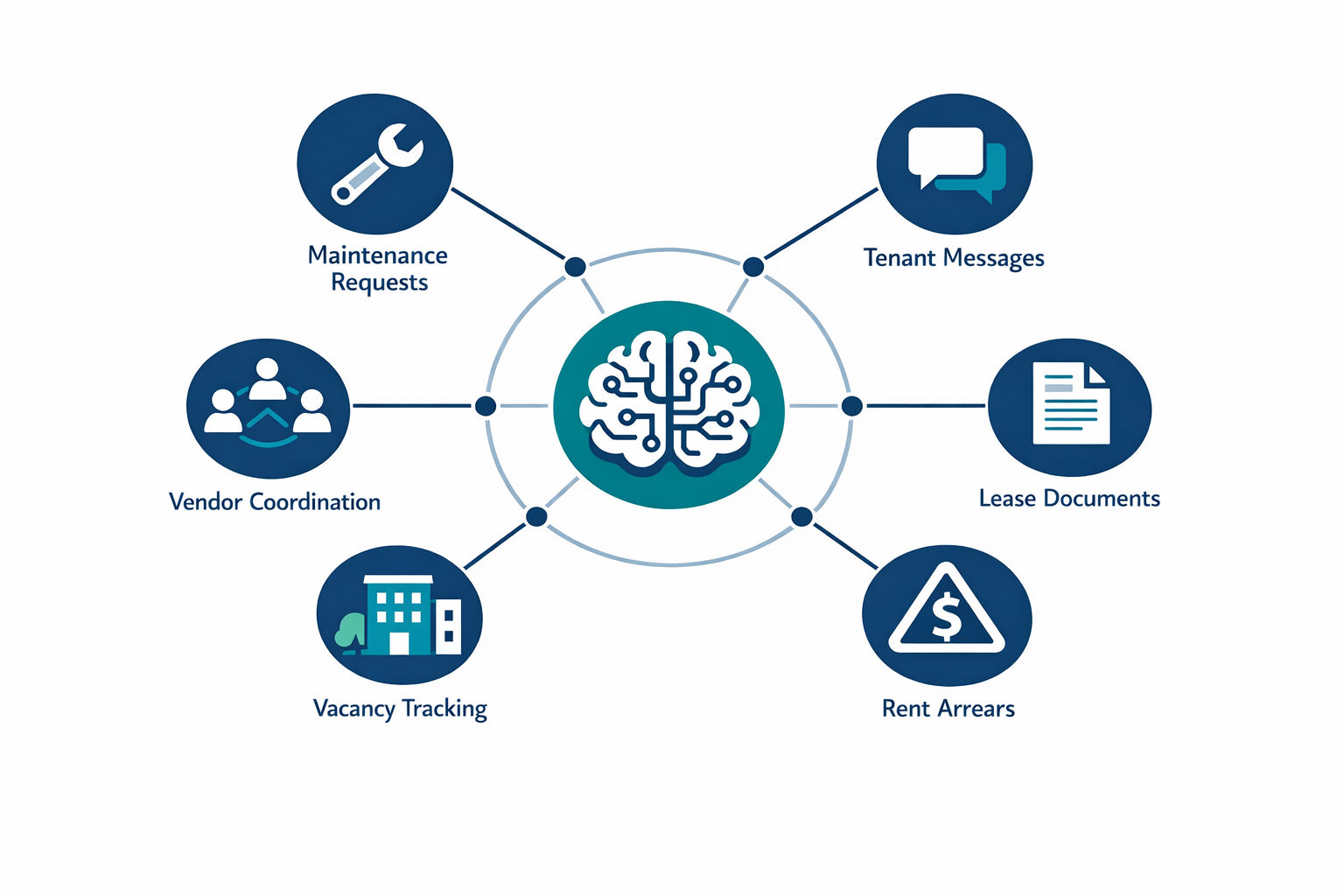
The U.S. property management industry generates $134.2 billion in annual revenue across roughly 325,000 firms (IBISWorld, 2025). Average net margins sit between 6% and 10%. Labor eats 40–45% of every dollar earned. And the day-to-day work? It's almost comically repetitive: lease renewals, maintenance tickets, tenant comms, rent chasing, vendor coordination, vacancy tracking. The same workflows, over and over, across hundreds or thousands of units.
This is the exact profile AI for property management was built to address. High-volume, low-variability tasks with clear ROI — the kind of work where automation doesn't just save time, it directly protects margin.
Yet adoption is still early. AppFolio's 2025 Benchmark Report found that only 34% of property management professionals were actively using AI — up from 21% a year earlier. Another 29% said they planned to start, while the percentage with "no plans" dropped sharply from 51% to 37%. The sector is at an inflection point: awareness is high, internal capability is low, and the door is wide open for external consultants.
If you've been looking for a vertical with operational density, budget authority, and a genuine need for what you sell — this is it. Here's exactly what to offer, what to charge, and how to get in the door.
Note: This playbook covers property management operations companies — the firms that manage portfolios of residential or commercial units. If you're targeting real estate agents and brokerages, see our AI for real estate agencies playbook instead.
The Six Pain Points That Make AI for Property Managers a Consulting Goldmine
Property management companies don't need abstract AI strategy. They need specific workflows fixed. Here are the six pain points that come up in virtually every discovery conversation — and the AI service each one maps to.
1. Maintenance Dispatch and Triage
The pain: Maintenance requests flood in via phone, email, text, and tenant portals — often after hours. Staff manually categorize urgency, route to vendors, and follow up. A NARPM 2025 Maintenance Cost Analysis found that misclassified requests cost an average of $312 per incident across 8,400 requests and 47 management companies. Emergency classification errors run at 14% under manual processes.
What you sell: AI-powered maintenance triage and routing. An intake system that classifies urgency (emergency vs. routine), creates structured work orders automatically, and dispatches to the right vendor — 24/7, with no human in the loop for standard requests.
The proof: After implementing AI triage, emergency classification errors dropped to under 2% (NARPM). Average resolution time fell from 4.2 days to 1.7 days (NAA survey). One case study showed 38% reduction in vendor coordination overhead, saving roughly 6.4 staff hours per week for a 500-unit portfolio.
2. Tenant Communication Volume
The pain: A mid-size PM firm handling 100+ units can process 350+ tenant inquiries per month. Response times average 3+ days. AppFolio's 2024 Industry Pulse reports that property managers spend 35% of their time on communication tasks that are partially or fully automatable.
What you sell: Automated tenant communication workflows — AI agents that handle routine inquiries (parking, lease terms, payment questions, amenity bookings) via text, email, or chat with context-aware responses. Complex issues escalate to humans.
The proof: Rheinland Immobilien, a 142-property German PM firm, deployed an AI tenant communication agent and dropped response times from 3.2 days to 4 hours. Tenant satisfaction scores jumped from 3.1 to 4.6 out of 5. Separately, research shows that tenant NPS scores improve by 22 points within 90 days of implementing automated maintenance status updates.
3. Lease Document Processing
The pain: Lease administration is manual, error-prone, and time-intensive. Staff pull data from PDFs, cross-reference renewal dates, check escalation clauses, and flag compliance issues — all by hand. AI can slash lease administration errors by up to 42% and lower associated operational costs by 15% (Proprli, citing Deloitte).
What you sell: Document intelligence for leases and compliance. AI-powered lease abstraction that extracts key terms (rent, renewal dates, escalation clauses, responsibilities) from any document format, feeds structured data into the PMS, and flags upcoming deadlines or compliance gaps automatically.
4. Rent Arrears and Collections
The pain: Chasing late rent is time-consuming and emotionally charged for staff. Most firms rely on manual reminders and reactive follow-up. Late payments directly erode the already thin margins.
What you sell: Automated rent collection workflows with AI-driven outreach sequences — personalized reminders, payment plan suggestions, and escalation triggers. Haven AI reports that 73% of tenants are more likely to pay on time when engaged via automated outreach. Juniper Investment Group, a 50-property multifamily operator, saw measurable improvements in collection rates and reported approximately $15 per unit per month in ROI from their AI deployment.
5. Vacancy Management
The pain: Empty units bleed revenue. Most PM firms discover vacancies reactively and market them manually. Rheinland Immobilien had an average vacancy rate of 4.8% with a 47-day re-let time before automation.
What you sell: Predictive vacancy and rent risk scoring. AI systems that trigger marketing the moment a unit becomes available (or is predicted to become available based on lease expiry and renewal probability), optimize listing placement, and forecast rent levels by unit attributes and market conditions.
The proof: After deploying AI vacancy management, Rheinland Immobilien cut their vacancy rate from 4.8% to 2.9% and re-let time from 47 to 22 days.
6. Vendor Coordination
The pain: Dispatching vendors, tracking completion, managing invoices, and quality-checking work involves constant coordination across phone, email, and spreadsheets.
What you sell: AI-powered vendor matching and dispatch automation that selects preferred vendors based on job type, availability, and past performance — then tracks work orders through completion and flags exceptions. This is often bundled with maintenance triage as a combined engagement.
Property management operations is a completely different vertical from real estate agencies. The buyer, the workflows, the pain points, and the pricing are all different. PM companies care about portfolio-level operational efficiency — not lead gen or listing marketing. If you're targeting both, run separate playbooks.
What to Charge: Realistic Pricing for AI Consulting in Property Management
Pricing AI services for property management firms requires understanding their economics. These are companies running on 6–10% net margins managing portfolios that generate 8–12% of monthly rent in management fees. They're cost-conscious but not cheap — they'll pay for anything that demonstrably protects or expands margin.
Here's what the market supports across three pricing models. (For deeper pricing frameworks, see our AI consulting rates and pricing guide.)
| AI Service | Project Fee | Monthly Retainer | Outcome-Based |
|---|---|---|---|
| Maintenance Triage & Routing | $15,000–$45,000 | $2,500–$6,000/mo | 10–15% of documented cost savings |
| Tenant Comms Automation | $12,000–$35,000 | $2,000–$5,000/mo | $3–$8 per unit/month |
| Lease Document Intelligence | $20,000–$50,000 | $3,000–$7,000/mo | 15–20% of admin labor savings |
| Rent Collection Workflows | $10,000–$30,000 | $2,000–$5,000/mo | % of improved collection rate |
| Vacancy Prediction & Marketing | $18,000–$40,000 | $3,000–$6,000/mo | Share of reduced vacancy loss |
| Vendor Dispatch Automation | $12,000–$30,000 | $2,000–$4,000/mo | Bundled with maintenance triage |
Pricing benchmarks for AI consulting services sold to property management firms. Ranges assume mid-market PM companies managing 200–2,000+ units.
A few pricing notes:
- Project fees cover discovery, build, and initial deployment. They work best for firms that want to test AI on a single workflow before committing.
- Retainers make sense for ongoing optimization, model tuning, and expanding to additional properties or workflows. This is where recurring revenue lives.
- Outcome-based pricing is the most compelling to PM operators because it ties directly to their P&L. A property management company running 1,000 units that reduces maintenance misclassification costs alone could save $50,000–$100,000 annually based on the $312-per-incident benchmark — making a 10–15% share a very easy sell.
The sweet spot for most independent AI consultants entering this vertical: a $15,000–$25,000 initial project (maintenance triage or tenant comms) that rolls into a $3,000–$5,000/month retainer as you expand across the portfolio. That's a $51,000–$85,000 first-year client from a single engagement.
The highest-value play is selling maintenance triage first (clearest ROI, fastest time-to-value), then expanding into tenant comms and lease intelligence once you're embedded. One PM client can easily support $80,000–$150,000+ in annual consulting revenue across multiple workflows.
Who Buys Inside a Property Management Firm (Hint: Not IT)
Property management companies — especially those managing 200–2,000 units — typically don't have a dedicated IT function. The technology buying decision sits with operations leadership.
Your target contacts:
- Operations Director / Head of Property Operations — Owns the day-to-day workflows you're automating. This is usually your champion.
- COO — Common in larger PM firms. Cares about headcount efficiency and margin. Your economic buyer.
- Managing Director / Principal — In smaller firms, one person wears all hats. They care about anything that reduces their personal operational load.
Who to avoid: Don't pitch the property managers themselves (too operational, no budget authority) or try to find an IT department that probably doesn't exist.
Frame the Conversation Around Margin and Headcount — Not Technology
PM operators don't care about AI architectures, model selection, or prompt engineering. They care about three things:
- Can I manage more units without hiring more people?
- Will this reduce my operating cost per unit?
- How fast will I see results?
Lead every conversation with these questions. One solo property manager documented publicly how automation let them scale from 80 to 120 units without hiring — a 40% capacity increase. That's the language PM operators understand.
When you're on a discovery call, don't ask "What's your AI strategy?" Ask:
- "How many maintenance requests does your team process per week, and what happens after hours?"
- "How many FTEs are involved in tenant communications across your portfolio?"
- "What does your lease renewal process look like — and how often do deadlines slip?"
These questions surface the pain and the budget simultaneously. Every answer maps directly to one of the six services above.
Pre-Qualify Prospects Before the First Call
Property management firms vary massively in operational maturity. Some are running modern cloud PMS platforms (AppFolio, Buildium, Yardi). Others are still on spreadsheets and a PHP app from 2014. You need to know which you're dealing with before you invest time in a sales cycle.
This is where a structured AI readiness assessment pays for itself. Use ConsultKit's AI readiness assessment to send prospects a quick pre-qualification survey that maps their operational workflows, current tech stack, and automation maturity before the first call.
You're looking for signals like:
- Portfolio size of 200+ units (below this, budgets are usually too small for a meaningful engagement)
- Cloud-based PMS in place (AppFolio, Buildium, Yardi, RentManager — this means integration is feasible)
- At least 3–5 FTEs handling operations (enough staff cost to justify automation ROI)
- Growth intent (they want to add units without proportionally adding headcount)
Firms that check these boxes are your ideal clients. Firms that don't can still be nurtured — but don't burn discovery time on a 50-unit operator running QuickBooks and email.
Build a target list of mid-market PM firms
Send the AI readiness assessment
Lead with maintenance triage or tenant comms
Deliver fast, then expand
Build your case study library
The Timing Window Is Now
Property management AI adoption tripled in a single year. The firms that haven't adopted yet know they're behind — 63% are either using AI or plan to according to AppFolio's latest data. But most lack the internal capability to implement. They don't have AI engineers. They don't have data teams. They have overworked property managers drowning in maintenance tickets and tenant emails.
That's your opening.
The consultants who win in this vertical will be the ones who speak the language of units, margins, and headcount — not the language of models, tokens, and architectures. Property management operators buy outcomes, not technology.
If you want to go deeper on structuring your pricing and winning against larger firms in competitive situations, we've covered those extensively. But the tactical work starts with picking your first PM prospect, sending the readiness assessment, and booking the discovery call.
The vertical is wide open. The pain points are obvious. The ROI math works. Go sell it.
