
You took the discovery call. You spent 45 minutes walking through their operations, asking smart questions, building rapport. You sent a proposal. Then… silence. Two follow-ups later, they say they "need to think about it" — which is code for we were never going to buy.
Sound familiar? You're not alone. Research shows that only 27% of B2B leads routed to sales are actually qualified to buy, and the average consultant burns roughly 50–60% of their selling time on prospects who were never a fit. At scale, that's not just frustrating — it's $30,000+ in wasted capacity per year.
The problem isn't your pitch. It's that you're pitching everyone the same way, without a system to tell you who's actually ready for AI before you invest a single hour.
What you need is an AI readiness assessment — not a vague checklist, but a weighted scoring system that runs before every discovery call and tells you exactly how to engage each prospect. Here's how to build one.
Enterprise consulting has a 4.1% lead-to-opportunity rate — one of the lowest in B2B. If you're not scoring prospects before calls, the math is working against you. AI-powered lead scoring achieves 40–60% accuracy in identifying qualified buyers, compared to just 15–25% for manual gut-feel scoring (Origami Agents, 2025). That's a 2–3× improvement in pipeline quality from a single system change.
The 5 Signals That Separate a Buyer from a Tire-Kicker
Forget generic BANT frameworks. AI consulting has a unique qualification challenge: you're not just assessing purchase intent — you're assessing whether the organization is structurally ready to implement AI at all.
After analyzing patterns across enterprise AI readiness frameworks (Microsoft, Cisco, Deloitte, and practitioner models), five signals consistently predict whether a prospect will convert — or waste your time.
Signal 1: Company Size and Budget Reality
This is your baseline filter. A 5-person agency asking about "AI transformation" is a different conversation than a 200-person manufacturing firm with $2M in annual IT spend.
What you're looking for:
- Revenue and headcount — enough operational complexity that AI produces measurable ROI
- Existing IT/technology budget — is there an allocated line item, or are they starting from zero?
- Prior consulting spend — have they hired external consultants before, or is this their first rodeo?
Organizations with AI readiness scores above 70% are 3× more likely to successfully implement AI within 12 months, according to Deloitte's 2025 AI Readiness Index. Budget alignment is a core predictor — but it only accounts for about 10–15% of the total score because it's the easiest gap to close.
Signal 2: Tech Stack Maturity
This is the signal most consultants miss entirely. A prospect's existing technology infrastructure tells you more about their AI readiness than anything they say on a call.
Strong positive indicators:
- Modern CRM (Salesforce, HubSpot, Dynamics)
- Cloud data infrastructure (Snowflake, BigQuery, AWS)
- Marketing automation or business intelligence tools in place
- API-accessible systems vs. spreadsheet-driven operations
Red flags:
- Legacy on-prem systems with no API access
- No centralized data — everything lives in spreadsheets and email
- Heavily manual, fragmented processes
You can detect most of this automatically using technographic tools (BuiltWith, Wappalyzer) or simply by reviewing their careers page — companies hiring data engineers are telling you something about their maturity. If you're working across verticals, a framework like our guide on running AI readiness assessments for law firms shows how to tailor these tech stack checks per industry.
Signal 3: AI Investment Signals
This separates the curious from the committed. You're looking for evidence that the organization has already started spending time or money on AI — even if it failed.
- Job postings mentioning data science, ML engineering, or AI operations
- Public case studies or blog posts referencing AI/ML projects
- Mentions of AI initiatives in earnings calls or press releases
- Executive social media activity around AI strategy
- Past AI vendors or failed POCs (these are excellent signals — they've already invested and learned)
BCG's 2025 research found that only 5% of firms are "AI future-built" while 35% are actively scaling AI. That top 40% is your sweet spot. The remaining 60% are laggards with little realized value from AI — and many of them are the tire-kickers filling your calendar.
Signal 4: Decision-Maker Access
This is the signal that kills deals silently. You can have a perfect-fit company with budget and tech maturity, but if you're talking to a mid-level manager who needs to "run it up the chain," your close rate drops off a cliff.
McKinsey's research on B2B sales shows that deal success correlates directly with multi-stakeholder engagement — specifically, involvement from economic buyers (CFO, COO, CIO) early in the process. Gong's conversation intelligence data reinforces this: deals where C-level executives join by the second call close at dramatically higher rates.
What to score:
- Is your primary contact a budget holder or an influencer?
- Have multiple stakeholders from different functions engaged?
- Is there an executive sponsor who's publicly championing the initiative?
- Can they make a purchasing decision within their authority?
Signal 5: Timeline and Urgency
A prospect can check every box but still stall for 18 months if there's no forcing function. Urgency separates "someday" buyers from "this quarter" buyers.
Look for:
- A regulatory or compliance deadline driving the initiative
- Competitive pressure (a competitor just announced AI capabilities)
- Board-level mandates or strategic planning cycles
- An existing RFP or vendor evaluation process already underway
- Recent leadership change with a digital transformation mandate
Prospects who mention specific KPIs they want to improve ("reduce claims processing time by 30%") are dramatically more qualified than those speaking in abstractions ("we want to explore AI").
How to Weight and Score Each Signal Into a 0–100 AI Readiness Score
Having five signals is useful. Having a weighted scoring system that produces a single number is what actually changes your behavior.
The weighting below is adapted from multiple enterprise AI readiness frameworks (CreativeBits SMB Framework, Cisco AI Readiness Index, Paiteq engineering rubric) and calibrated for the AI consulting sales motion — where data maturity and decision-maker access are stronger predictors than raw budget.
| Signal | Weight | Score Range | What You're Measuring |
|---|---|---|---|
| Tech Stack Maturity | 25% | 0–25 pts | Infrastructure readiness for AI implementation |
| AI Investment Signals | 25% | 0–25 pts | Evidence of prior AI commitment or active exploration |
| Decision-Maker Access | 20% | 0–20 pts | Direct access to budget holders and executive sponsors |
| Company Size & Budget | 15% | 0–15 pts | Organizational scale and financial capacity for AI projects |
| Timeline & Urgency | 15% | 0–15 pts | Forcing functions and concrete deadlines driving action |
AI Readiness Assessment Scoring Weights — Weighted toward implementation readiness signals, not just purchase intent
Data and technology readiness are the slowest gaps to close and the most reliable predictors of project success. The Paiteq engineering readiness rubric (2025) includes hard "no-go" rules: if data readiness scores below minimum thresholds, the overall verdict is no-go regardless of other scores. Budget, by contrast, is "the dimension you can buy" — it's the easiest to solve if everything else is in place. Weight your scoring accordingly.
How the Formula Works
Each signal is scored on its own 0–100 internal scale, then multiplied by its weight to produce the composite score:
AI Readiness Score = (Tech Stack × 0.25) + (AI Signals × 0.25) + (Decision-Maker × 0.20) + (Budget/Size × 0.15) + (Timeline × 0.15)
Example: A mid-market logistics company with a modern CRM and data warehouse (Tech: 80), active AI job postings and a failed chatbot POC (AI Signals: 70), a VP of Operations as your contact who reports to the CEO (Decision-Maker: 75), $500K+ IT budget (Budget: 65), and a board mandate to "automate operations by Q4" (Timeline: 85):
(80 × 0.25) + (70 × 0.25) + (75 × 0.20) + (65 × 0.15) + (85 × 0.15) = 20 + 17.5 + 15 + 9.75 + 12.75 = 75 out of 100
That's a strong prospect. But a 75 should get a different approach than a 45 or a 92. Which brings us to the part most consultants skip.
What to Do With Low, Mid, and High Scorers
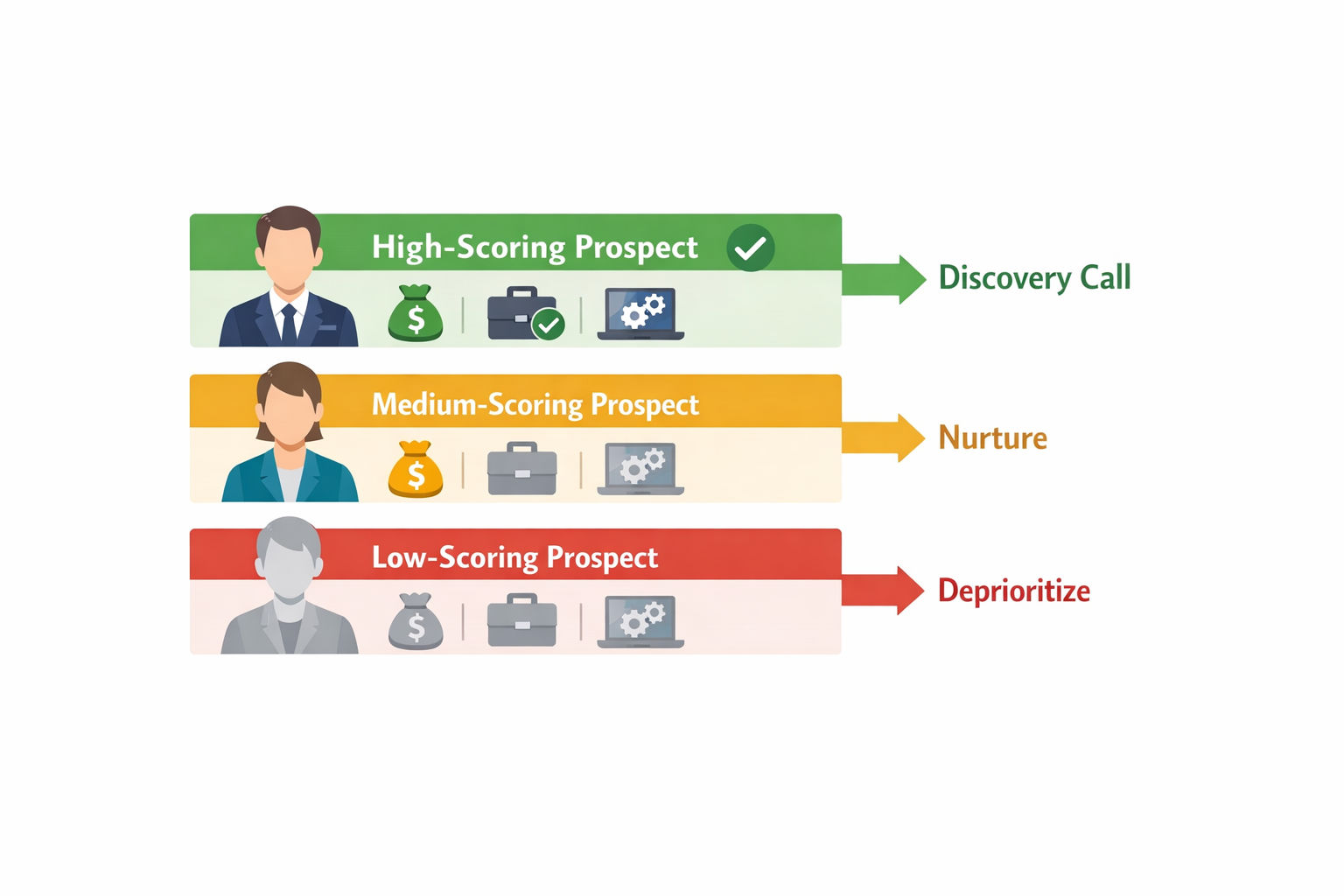
The entire point of scoring is differential treatment. If you pitch every prospect the same $50K strategy engagement, you're leaving money on the table with high scorers and burning time on low scorers. Here's how to handle each tier — and if you're unsure how to structure tiered offers, our AI consulting pricing guide breaks down the math.
The Critical Move: Don't Discard Low Scorers — Route Them Differently
A score of 35 doesn't mean "delete the contact." It means this prospect needs education, not a sales call. Most SMBs initially score between 35–55 on AI readiness (CreativeBits, 2025). Many of them will become buyers in 6–12 months if you nurture them correctly.
The mistake is treating a 35 and a 85 identically — burning your most expensive resource (your time on a call) on someone who needs a blog post, not a proposal.
For mid-market prospects hovering in the 50–70 range, a paid readiness workshop is the perfect wedge offer. It generates revenue, demonstrates expertise, and upgrades their score by surfacing the gaps that need fixing before a full engagement makes sense.
How to Automate This Before Every Discovery Call
A scoring system only works if it runs consistently and doesn't require 2 hours of manual research per prospect. Here's the reality: AI-driven qualification reduces manual scoring from 2 hours to 2 minutes per prospect while identifying 40% more qualified opportunities (Origami Agents, 2025).
The automation playbook has three layers:
Layer 1: Rules-based filtering (instant) Set hard disqualifiers that auto-reject or auto-deprioritize before a human ever sees the lead. Company too small? No relevant tech stack? No decision-maker identified? Auto-route to nurture. The Paiteq framework calls these "cap rules" — if data readiness is below minimum threshold, it's a no-go regardless of everything else.
Layer 2: AI-enriched scoring (minutes) Pull firmographic and technographic data automatically. Scrape LinkedIn for decision-maker titles. Check careers pages for AI-related hiring. Cross-reference against your closed-won client profile. This layer replaces the manual research you'd do before a call — but runs at scale.
Layer 3: Human validation (strategic only) For prospects scoring above 70, add a brief human check. Review the AI-generated profile, validate the scoring, and prep for the discovery call with specific talking points.
This is exactly the workflow that separates consultants who close 5 deals a quarter from those who close 15. It's not about working more hours — it's about spending every hour on the right prospect.
ConsultKit generates a complete AI readiness score and buyer profile for every prospect — including readiness score, estimated AI budget, mapped pain points, decision timeline, and pre-built tiered packages — before you even pick up the phone. Instead of spending 2 hours researching a prospect who scores a 30, you walk into every call knowing exactly where they stand and what to pitch. The scoring, enrichment, and package matching happens automatically, so your first conversation is already qualified, contextualized, and ready to close.
The Math That Makes This Non-Optional
Let's make this concrete. Say you're currently taking 20 discovery calls per month and closing 3 deals — a 15% close rate, which is typical for AI consulting.
With a scoring system that filters out the bottom 40% of prospects and fast-tracks the top 30%:
- You drop from 20 calls/month to 12 highly qualified calls
- Your close rate jumps to 35–45% because you're only talking to ready buyers
- You close 4–5 deals from fewer calls
- You reclaim 8+ hours per month previously burned on no-fit prospects
Multiply that across a year: that's 96 hours and 12–24 additional closed deals — from a single system change.
Predictive scoring adoption in B2B hit 54% in 2026, with adopters seeing a 41% improvement in sales-accepted lead rates and a 33% reduction in acquisition cost. If you're not scoring prospects, you're competing against consultants who are — and they're spending their time on better leads than you.
If you're moving upmarket to mid-market clients, this system becomes even more critical. Bigger deals have longer cycles, more stakeholders, and higher opportunity costs when you invest in the wrong one.
Build the System This Week
You don't need a perfect model on day one. Start with the five signals, weight them using the table above, and score your next 10 inbound leads before you book a single call. You'll immediately see which prospects you would have wasted time on — and which ones deserved more attention than they got.
The consultants who scale past six figures aren't necessarily better at delivery. They're better at choosing who to deliver for. A prospect scoring system is how you make that choice systematic instead of accidental.
