
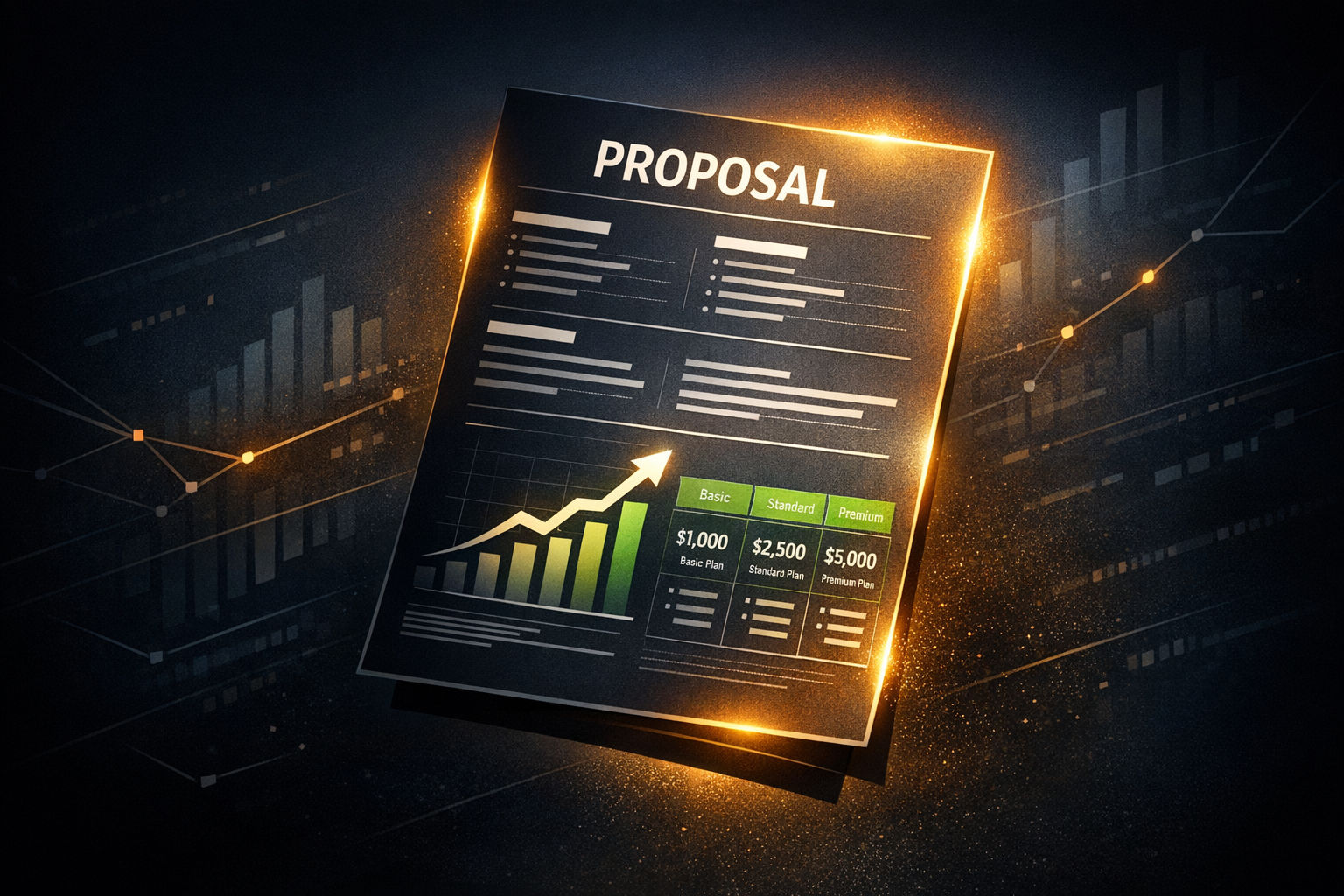
The average AI consulting proposal converts at roughly 45% — which means more than half the time, all that discovery work, all that scoping, all that back-and-forth just evaporates into a polite "we decided to go another direction" email.
But here's what the data actually shows: top-performing consultants close at 70–90%+ on the same types of deals (Loopio, 2025 RFP Benchmark Report). The gap isn't service quality. It's not pricing. It's the proposal itself.
Most AI consulting proposals lose because they read like a technical spec sheet. They lead with deliverables, bury the price on page seven, and are written for the technical contact who championed you internally — not the economic buyer who actually signs the check.
This is the guide to fixing that. No templates. No generic sales theory. Just the structure, psychology, and specific tactics that turn your AI consulting proposal from a forgettable PDF into a document the client can't say no to. Before you get to the proposal, you need to have scoped the project properly — because a winning proposal is only possible when you know the exact deliverables, exclusions, and success metrics before you open a blank doc.
The 5 Mistakes That Kill Your AI Consulting Proposal
Before we get to what works, let's kill what doesn't. These are the patterns I see repeatedly in proposals that lose — even when the consultant was clearly the best fit for the work.
Leading with deliverables, not outcomes
Writing for the technical contact, not the economic buyer
Presenting one flat price with no options
Burying the price on the last page
Scoping in hours instead of phases
Only 13% of proposal losses are tied to actual proposal quality. The majority come from price competition and poor pre-qualification (Loopio, 2025). Translation: if you're losing most of your proposals, the problem probably started before you opened a blank document. Your discovery and qualification process determines 80% of your close rate.
The AI Consulting Proposal Structure That Wins
Here's the structure that consistently converts. Each section has one job. No filler.
1. Problem Statement (Half a Page Max)
Restate their problem in their own words — pulled directly from your discovery call. This is the single highest-leverage section of your entire proposal. When a prospect reads their exact pain point reflected back to them, they immediately trust that you understand the assignment.
Don't write: "Your organization faces challenges in leveraging AI for operational efficiency."
Write: "Your customer support team is spending 22 hours per week manually categorizing and routing 1,400+ inbound tickets. This costs roughly $84K annually in labor and adds 6+ hours to average resolution time."
Specific numbers. Their language. Their pain.
2. Scope as Phases (Not a Feature List)
Break the engagement into 2–3 phases with clear milestones and deliverables for each. This does three things: it reduces perceived risk ("we're not committing to a 6-month black box"), creates natural check-in points, and gives the client an off-ramp that paradoxically makes them more likely to commit.
A typical AI implementation scope looks like:
- Phase 1: Discovery & Data Audit (Weeks 1–2) — Stakeholder interviews, process mapping, data quality assessment. Deliverable: AI Readiness Report with prioritized opportunities.
- Phase 2: Build & Integration (Weeks 3–6) — Solution development, API integrations, testing with real data. Deliverable: Working system in staging environment.
- Phase 3: Launch & Optimization (Weeks 7–8) — Production deployment, team training, 2-week performance monitoring. Deliverable: Deployed solution + performance baseline.
This is how you handle AI consulting deliverables — as outcomes attached to phases, not line items on a timesheet.
3. Outcomes-First Pricing
Before you show the number, restate the value. If your engagement saves them $84K/year in labor costs, say that right before the price. The price should feel like a fraction of the return — not a cost.
Target a 3–10X return on investment for the client (Consulting Success). If you're proposing a $15K engagement, the quantifiable annual value should be $45K–$150K. Make this explicit. For the full data on which pricing model maximises your earnings long-term, see the comparison of AI consulting pricing models.
4. Timeline
Keep it visual. A simple Gantt-style timeline or milestone list works. Clients care about two dates: when does this start, and when do we see results? Answer both clearly.
5. Risk Mitigation
Address the unspoken fears directly. For AI engagements, these are typically:
- "What if it doesn't work with our data?" → Phase 1 includes a data quality audit before any build work begins.
- "What if the team doesn't adopt it?" → Phase 3 includes training and a 2-week support window.
- "What if costs spiral?" → Fixed-fee phases with defined deliverables. No surprises.
Why You Should Always Present Three Tiers
Three-tier pricing is the single most effective structural change you can make to your AI consulting proposal. It exploits a well-documented psychological principle: when given three options, most people choose the middle one.
But it does something even more powerful — it shifts the decision from "Should we hire this consultant?" to "Which package should we pick?"
That reframe alone can boost your close rate significantly. Digital Applied reports that three-tier proposals consistently convert at 40%+, with the majority of clients selecting the middle tier — exactly where your margins should be strongest.
This tiered structure maps directly to how top consultants structure their overall service stack. If you're unsure which pricing model to build your tiers around, the breakdown of hourly vs. project vs. retainer AI consulting pricing gives you the data to decide which model belongs in each tier.
| Essentials — $9,000 | Recommended — $15,000 | Premium — $24,000 | |
|---|---|---|---|
| Scope | AI audit + opportunity roadmap | Full implementation (one workflow) | Implementation + 2 additional workflows |
| Duration | 2 weeks | 6–8 weeks | 10–12 weeks |
| Deliverables | AI Readiness Report, prioritized recommendations, executive briefing | Everything in Essentials + working AI system, team training, 2-week support | Everything in Recommended + 2 additional automated workflows, 60-day optimization support |
| Best For | Teams exploring AI for the first time | Teams ready to implement and see ROI | Teams wanting a comprehensive AI overhaul |
| ROI Potential | $40K–$80K annual savings identified | $85K–$140K annual savings delivered | $180K–$300K annual savings delivered |
Example three-tier pricing for an AI consulting engagement targeting mid-market companies. The middle tier is deliberately the best value.
Your Premium tier isn't there because most clients will buy it. It's there to make the Recommended tier feel reasonable by comparison. Price your Premium at 1.5–2X your Recommended tier. Price your Essentials at 0.5–0.6X. This anchoring structure ensures the middle option feels like the obvious, balanced choice.
Reducing Buyer Hesitation: What to Include Beyond the Scope
Even a well-structured proposal can stall if it doesn't address the fears the prospect won't say out loud. Here's what reduces friction and gets deals across the line.
Write for the Economic Buyer
Your proposal will be forwarded to people who weren't on the discovery call. Every section needs to stand on its own without your verbal explanation. The exec summary should be a self-contained business case. The pricing should include ROI context. The scope should explain why, not just what.
Include a Process Guarantee
Risk reversal is the most underused tactic in consulting proposals. Pietro Zancuoghi, COO at Scale Labs, puts it well: "A well-designed guarantee is not a discount. It is a confidence signal."
For AI engagements, a process guarantee works better than an outcome guarantee. Example: "By the end of Phase 1, you'll have a validated AI roadmap with quantified ROI projections. If you're not confident in the path forward, you pay nothing for Phase 1."
This is powerful because it shifts the risk from the buyer to you — and in practice, refund requests are extremely rare because Phase 1 always delivers value.
Add a Mini Case Study
You don't need a polished case study deck. Two to three sentences that mirror the prospect's situation work better than a generic logo wall:
"We implemented a similar ticket classification system for a 200-person SaaS company. Resolution time dropped 40% in the first month, saving their support team 18 hours/week. The system paid for itself in 11 weeks."
Define Clear Success Criteria
Include a section titled "How We'll Measure Success" with 2–3 specific, measurable KPIs. This does two things: it shows you're accountable, and it gives the buyer ammunition to justify the spend internally.
Examples:
- Average ticket resolution time reduced from 6.2 hours to under 2 hours
- Manual data entry eliminated for 85%+ of inbound requests
- Team capacity freed up by 15–20 hours/week within 60 days
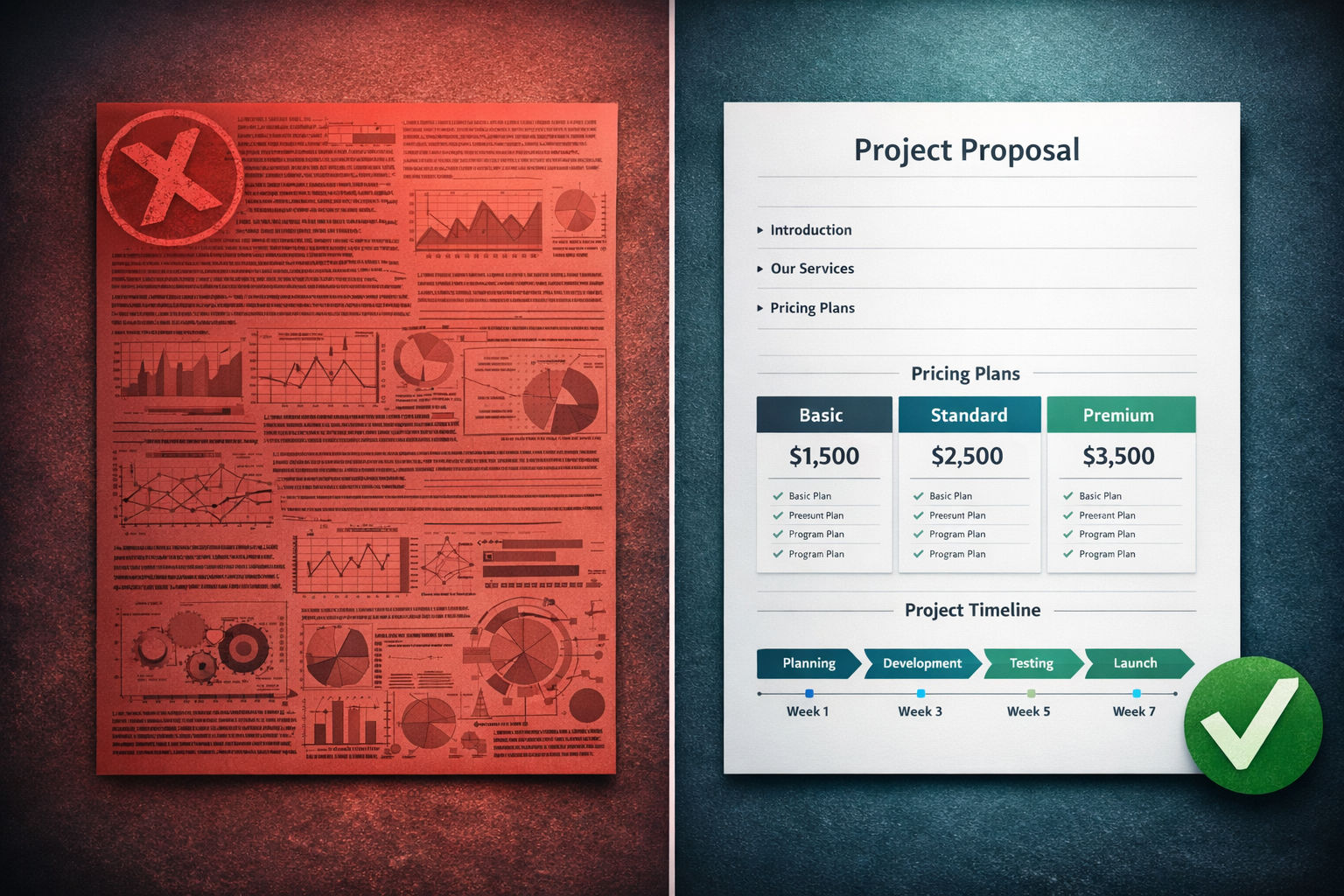
The $15K Proposal: Losing Version vs. Winning Version
Let's make this concrete. Here's the same AI consulting engagement — a ticket classification and routing automation for a mid-market SaaS company — proposed two different ways.
Same consultant. Same skills. Same $15K price point. But one proposal reads like a vendor pitch and the other reads like a strategic investment with a clear return. The winning version does five things the losing version doesn't:
- Mirrors the client's language from the discovery call
- Quantifies the cost of inaction — $84K/year is what doing nothing costs
- Gives the client options — shifting the frame from yes/no to which tier
- Makes ROI impossible to ignore — 5.6X return, stated plainly
- Removes friction from the next step — a specific date, not an open-ended question
A proposal is neither a negotiation nor an exploration. It is a summation of conceptual agreement. The sale is made prior to the proposal.
— Alan Weiss, Million Dollar Consulting, 6th Edition
The Input Problem: Why Great Proposals Start Before the Proposal
Here's the uncomfortable truth that ties everything together: you cannot write a winning AI consulting proposal if you don't have the right inputs.
The specific numbers in the problem statement? Those come from discovery. The ROI projections? Those come from understanding the client's current costs. The right tier structure? That comes from knowing their budget range and decision timeline. The language that mirrors their pain? That comes from asking the right questions and actually listening.
Every winning proposal is downstream of a great discovery process.
This is exactly why the best AI consultants run a structured AI readiness assessment before they ever open a proposal doc. A proper AI readiness assessment gives you every input you need:
- Budget range and decision timeline — so you can tier your pricing correctly
- Specific pain points with quantified costs — so your problem statement writes itself
- Stakeholder map — so you know who's reading your proposal and what they care about
- Data readiness and technical constraints — so your scope is realistic, not aspirational
- Competitive landscape — so you can position against alternatives
When you walk into the proposal phase with all of that, you're not guessing. You're assembling. And that's the difference between a 45% close rate and a 70%+ close rate.
For SMB automation engagements specifically, the inputs you need are simpler but equally important — the AI workflow automation playbook for SMBs gives you benchmarked pricing, ROI figures by automation type, and the qualification questions that ensure you're scoping the right project before the proposal goes out. For law firm engagements, where compliance and risk framing dominate the proposal conversation, see the AI readiness framework for law firms — it shows how pre-proposal discovery shapes the scope and pricing conversation in compliance-heavy verticals.
Your proposal's service tiers should also align with a broader service packaging strategy. The framework for packaging AI services into tiers that sell defines the Insight → Blueprint → Build structure that maps cleanly to the Essentials / Recommended / Premium proposal tiers above — building consistency between your sales collateral and your service delivery.
Related reading: Once a client signs, the next conversation is how you keep them. The playbook for transitioning AI consulting clients onto retainers shows how to propose ongoing work naturally — and what pricing ranges the market actually supports.
Before you send your next AI consulting proposal, make sure you can check every box:
- [ ] Problem statement uses the client's own words and specific numbers
- [ ] Scope is presented as phases with milestones, not hours
- [ ] Three pricing tiers with the middle tier as the obvious choice
- [ ] Price appears within the first 3 pages, with ROI context immediately before it
- [ ] At least one mini case study that mirrors the prospect's situation
- [ ] Clear success criteria with 2–3 measurable KPIs
- [ ] A process guarantee or risk reversal statement
- [ ] A specific next step with a date — not 'let us know'
- [ ] Written so a CFO who wasn't on the discovery call can understand the business case
