

You close a $15,000 AI consulting engagement with a mid-market law firm. The scope is clear: automate client intake, classify documents, and build a smarter case routing workflow. You kick off the project. And then, six weeks in, you discover the client's intake forms live in four different formats across three systems — half of them are PDFs with no consistent field structure, and nobody knows who owns the data.
The project stalls. You spend three weeks doing data cleanup you didn't scope for. The client starts asking uncomfortable questions about timeline. Your margin evaporates.
This isn't a fringe scenario. It's the default outcome when you skip the ai data strategy step before signing the contract.
According to Gartner, 85% of AI projects fail due to poor or irrelevant data — not bad models, not wrong algorithms, not insufficient compute. Data. And a Vanson Bourne survey found that 99% of AI/ML projects encounter data quality issues at some point during delivery. The question isn't whether your client's data has problems. It's whether you surface those problems before or after you've committed to a fixed scope and timeline.
92.7% of executives identify data as the most significant barrier to successful AI implementation (NewVantage Partners, 2024). And Gartner predicts that 60% of AI projects without AI-ready data will be abandoned through 2026. If you're not assessing data readiness before the engagement starts, you're building on a foundation you haven't inspected.
Data Strategy Isn't the Client's Job — It's Your Discovery Step
Here's the mindset shift most consultants miss: your client doesn't know what "data readiness" means. They hired you because they want AI to solve a business problem. They're not thinking about data formats, governance gaps, or integration bottlenecks. That's your job.
The best AI consultants treat data assessment like a structural inspection before a renovation. You wouldn't start knocking down walls without checking the foundation. But that's exactly what most consultants do — they jump straight to the AI solution because that's the exciting part, and they assume the data will sort itself out.
It won't.
An ai data strategy isn't a 40-slide deck about data lakes and cloud architecture. For SMB and mid-market clients, it's a focused diagnostic that answers one question: Can we actually build what we're proposing with the data this client has today?
If yes, you scope normally. If no, you've just identified a billable pre-engagement — a data readiness sprint — that protects both you and the client from a project that was going to fail anyway.
This is what separates consultants who deliver clean results from those who end up in contractual disputes mid-project. The data conversation happens before the SOW is signed, or it happens as a painful renegotiation six weeks later.
The 5 Questions to Ask in Every AI Discovery Call
You don't need a 50-question assessment to gauge ai data readiness. You need five pointed questions that reveal whether the client's data landscape can support the project you're about to propose. Ask these on the first discovery call — before you send a proposal.
Data Availability: "Where does the data we need actually live today?"
Data Quality: "When was the last time anyone cleaned or audited this data?"
Data Ownership: "Who is responsible for the accuracy of this data?"
Integrations: "Can we pull data from these systems programmatically?"
Governance & Compliance: "Are there restrictions on how this data can be used or shared?"
Rate each dimension on a 1–5 scale during the call. A total score of 20+ means the client is data-ready for implementation. 12–19 means scoping needs adjustment. Below 12, you're looking at a data readiness sprint before any AI work begins. Having a systematic scoring framework like this before your first call gives you a cleaner engagement and a significantly better close rate — because you're proposing work you can actually deliver.
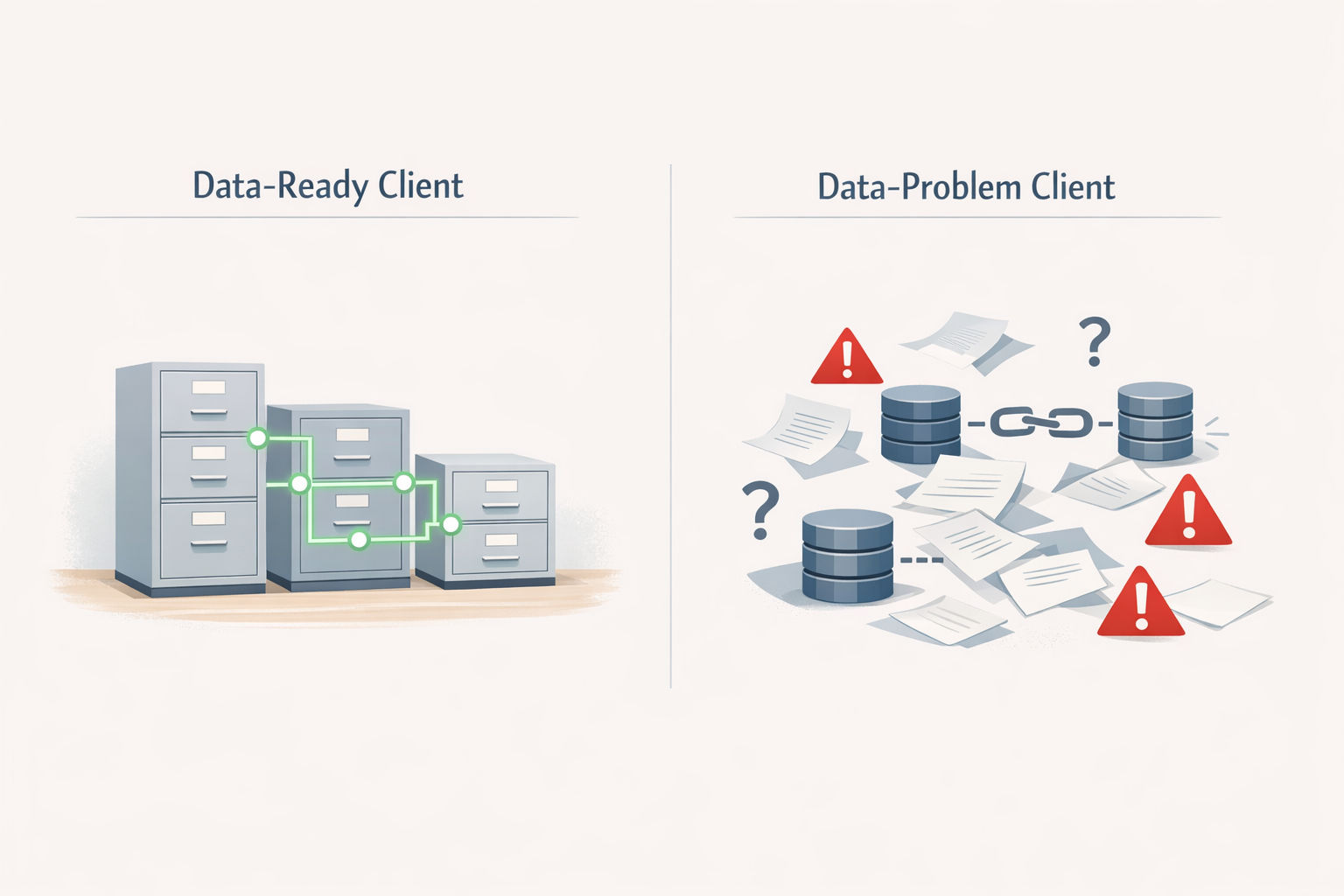
What a 'Data-Ready' Client Looks Like vs. a 'Data-Problem' Client
After running dozens of these assessments, the pattern becomes obvious fast. Here's what each archetype looks like in practice — and how it should change your scoping and pricing.
Real-World Examples
The data-ready financial advisor: A $500M AUM advisory firm uses a single CRM integrated with their custodial platform. Client records are deduplicated quarterly. They have API access to both systems. You can scope an AI-powered portfolio reporting tool with confidence — the data foundation is solid.
The data-problem law firm: A 30-attorney firm has client intake forms in four different formats — paper (scanned), PDF, a web form from 2019, and direct emails to attorneys. Matter data lives in a practice management system that hasn't been cleaned since implementation. Billing codes are inconsistent across practice groups. If you scope an AI document classification project here without addressing the data layer first, you will spend half your engagement doing data normalization work you didn't price for.
The difference between these two scenarios isn't the AI use case. It's the data readiness. And the consultant who surfaces this before the engagement starts is the one who delivers on time, on budget, and with results that actually stick.
Companies that invest in data infrastructure first achieve 3× better AI ROI than those that skip straight to model deployment (Trax Technologies). That's not a marginal difference — it's the difference between a successful engagement and a refund conversation.
How to Document a Client's Data Landscape in One Page
You don't need a 40-slide deck. You need a one-page data landscape document that captures everything required to make a go/no-go decision on implementation. As one AI strategy consultant put it after watching a board ignore 74 pages of a €240,000 readiness assessment: "The artifact has become the deliverable. The artifact is not the deliverable. The decision is the deliverable."
Here's what goes on your one-page ai data strategy document:
| Section | What to Include | Why It Matters |
|---|---|---|
| Use Case Summary | The specific AI application and the business outcome it serves | Anchors the data assessment to a real deliverable — not abstract 'data quality' |
| Data Source Map | Every system involved, what data it holds, and how it's accessed (API, export, manual) | Shows fragmentation at a glance and identifies integration work |
| Quality Snapshot | Known issues: missing fields, duplication rates, format inconsistencies, staleness | Quantifies the cleanup effort before implementation |
| Ownership Matrix | Who enters, who maintains, who is accountable for each data source | Surfaces governance gaps that will block AI deployment |
| Compliance Flags | GDPR, HIPAA, client confidentiality, data residency requirements | Prevents legal and compliance surprises mid-project |
| Readiness Score | 1–5 score across all five dimensions, with overall assessment | Gives a clear go / go-with-conditions / not-yet decision |
| Recommendation | Proceed to implementation, scope a data readiness sprint, or defer | The actual deliverable — a decision, not a document |
One-Page Data Landscape Document Template
This document takes 2–4 hours to produce after a thorough discovery call. It becomes your scoping artifact, your pricing justification, and your risk management tool — all in one. Attach it to your proposal. It shows the client you've done the diagnostic work, and it gives you the evidence to price the engagement correctly.
This is also the kind of deliverable that wins deals against larger competitors. While a Big 4 firm is proposing a $100K discovery phase, you're handing the client a one-page assessment that gives them a clear answer in a week.
When to Implement vs. When to Sell a Data Readiness Sprint First
This is the commercial decision that most consultants get wrong. They want the bigger project, so they skip the data assessment and hope for the best. Here's the framework for when to proceed directly to implementation and when to recommend a data readiness sprint as a separate, paid engagement.
Pros
Cons
How to Position the Data Readiness Sprint
The framing matters. Don't call it "data cleanup" — that sounds like you're asking the client to pay for grunt work. Position it as a Data Readiness Assessment or AI Foundation Sprint. Here's the pitch:
"Before we build, I run a two-week diagnostic to map your data landscape and confirm we can deliver the results we're targeting. This protects your investment in the larger project — 85% of AI projects fail at the data layer, and this ensures yours won't. The sprint costs $X, produces a one-page data landscape document with a clear go/no-go recommendation, and the fee is credited against the implementation project if we proceed."
That last line — crediting the sprint fee against the larger project — removes the objection. The client isn't paying extra. They're paying for insurance that makes the real project succeed.
Current market benchmarks for these sprints: $2,000–$8,000 for SMB clients, $8,000–$20,000 for mid-market, and 1–3 weeks of duration. If your outreach is already targeting the right prospects, a data readiness sprint is often the easiest first engagement to close — lower commitment, clear deliverable, and it naturally converts to the bigger project.
Companies that invest in data infrastructure first achieve 3× better AI ROI compared to those that skip to model deployment (Trax Technologies). For you as a consultant, this means better client outcomes, stronger case studies, and a referral pipeline that compounds. The 2-week sprint you sell today funds itself many times over in repeat business and referrals from clients whose projects actually worked.
Build the System, Not Just the Habit
Asking these five questions on a call is a good start. But the consultants scaling their practices don't rely on memory — they systematize the process. A structured data readiness scorecard that runs before the first call gives you three things:
- Faster qualification — you know whether you're looking at a data-ready or data-problem client before you invest an hour on a call
- Better proposals — your scoping is based on evidence, not assumptions
- Higher close rates — clients trust consultants who diagnose before they prescribe
This is exactly the kind of structured discovery that ConsultKit is built to automate. Instead of running through a mental checklist, you can embed data readiness questions into your pre-engagement assessment, score responses automatically, and walk into every discovery call with a clear picture of the client's data landscape. The result: cleaner engagements, fewer mid-project surprises, and proposals that are scoped to actually succeed.
The Bottom Line
The ai data strategy conversation isn't optional — it's the single highest-leverage step in your entire consulting process. Get it right, and you scope projects that deliver. Skip it, and you join the 85% of AI projects that fail at the data layer.
Five questions. One page. A clear decision. That's all it takes to separate yourself from every other consultant who jumps straight to implementation and hopes the data sorts itself out.
It won't. But now you know what to do about it.
