
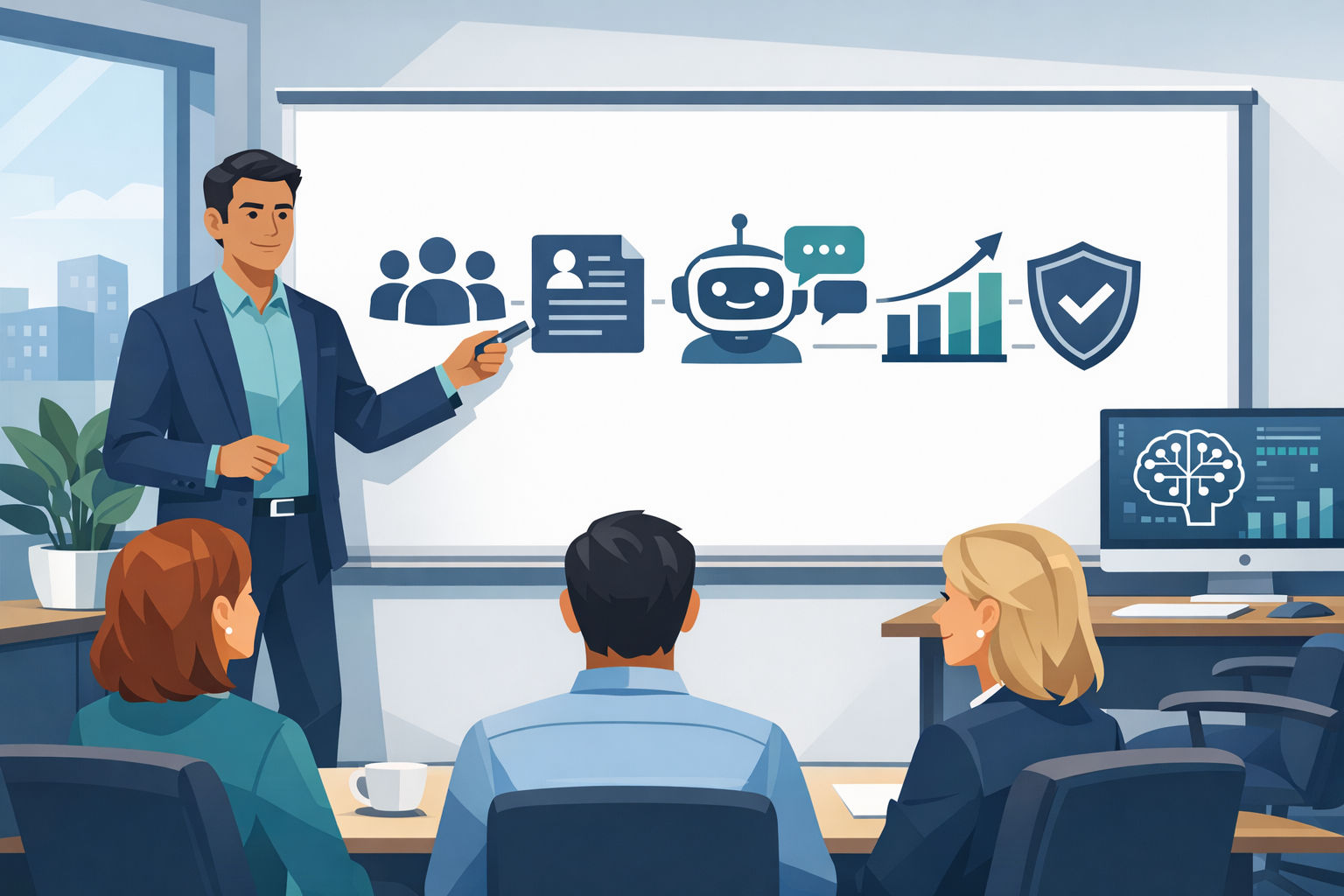
Every AI consultant and their dog is chasing marketing departments and sales teams. Meanwhile, ai for hr departments — a $6.5 billion market growing at nearly 25% year-over-year — is sitting right there, wildly under-served by independent consultants and boutique firms.
Here's what makes this vertical even more interesting: the HR leader you sell to today often becomes the internal champion who pulls you into company-wide AI adoption. SHRM's 2026 report found that 92% of CHROs expect further AI integration across the workforce this year. They're not just buying for their department. They're buying for the organization.
If you're an AI consultant looking for a vertical where the pain is real, the ROI is measurable, and the deals expand — HR is where you should be looking. This is the playbook.
The 5 AI Use Cases HR Teams Are Actively Buying in 2026
Forget the theoretical. These are the five use cases that HR teams are spending real money on right now, ranked by how easy they are to scope, sell, and deliver. For each, I've included the ROI anchor you'll use in your pitch.
1. Candidate Screening & Recruiting Automation
The pain: Recruiters spend 60–70% of their time on manual resume reviews and scheduling. For a mid-market company hiring 100+ roles per year, that's 2–3 FTEs just on triage.
What you build: AI-powered screening that ranks candidates against role requirements, automates interview scheduling, and surfaces top matches from existing applicant pools.
ROI anchor: AI-enabled HR systems reduce time-to-hire by 23% (SQMagazine, 2025). Unilever saw a 50% reduction in time-to-fill and a 16% increase in new-hire diversity with AI-driven hiring. IBM reports a 30% boost in recruiter productivity. For clients, frame this as: "Every day a role stays open costs your company $500. We cut that timeline by a quarter."
2. HR Policy Q&A Bots
The pain: HR teams drown in repetitive questions — PTO balances, benefits eligibility, expense policies, parental leave rules. A typical HR team fields 30+ of these tickets daily.
What you build: A RAG-based chatbot trained on the company's policy documents, employee handbook, and benefits guides. Deployed in Slack, Teams, or a web portal with human escalation paths.
ROI anchor: Enterprise deployments achieve 73–85% ticket deflection (Assembly Industries; Second Talent, 2026). Johnson Controls reduced HR call volume by 30–40% across 100,000+ employees. Typical ROI window is ~4 months. This is the fastest use case to deliver and the easiest to prove value.
3. Onboarding Automation
The pain: Only 12% of employees say their company does onboarding well (Kore.ai). Bad onboarding makes new hires 2x more likely to leave within their first year — and replacing them costs 1.5–2x their annual salary.
What you build: An orchestrated onboarding journey that triggers document collection, IT provisioning, training schedules, manager introductions, and compliance tasks automatically from an offer acceptance event.
ROI anchor: AI-powered onboarding cuts admin workload by 75%, delivers 53% faster completion, and improves first-year retention by 82% (HR Cloud, 2026). Frame this as: "You're not paying me to onboard people. You're paying me to stop losing the ones you just spent $15K to hire."
4. Performance Review Synthesis
The pain: Managers hate writing reviews. They procrastinate, rush them, and produce generic feedback that helps no one. The average review takes 4 hours per employee when done manually.
What you build: A generative AI layer that drafts first-pass review narratives from OKR data, continuous feedback logs, peer recognition, and project completion records. Managers edit and approve instead of writing from scratch.
ROI anchor: 75% time savings per review cycle (Second Talent, 2026). For a 500-person company, that's roughly 1,500 hours returned to managers annually. The pitch: "Your managers are spending three weeks a quarter writing reviews instead of leading their teams. We give them that time back."
5. Attrition Prediction & Retention Analytics
The pain: By the time an employee submits their resignation, you've already lost them — and the institutional knowledge they carry. Most HR teams are reactive about turnover.
What you build: A predictive model that flags flight risks 60–90 days before they resign, using engagement survey data, tenure patterns, compensation benchmarks, and performance trajectories.
ROI anchor: Predictive analytics can reduce turnover by 2+ percentage points — which in a 2,000-person company translates to $600K+ in annual savings (One Model). Cost of replacing a mid-level employee: 20% of annual salary at minimum, up to 200% for senior roles (SHRM/Gallup). The pitch: "You already know who you can't afford to lose. We tell you when they're about to leave — before they do."
| Use Case | Time Savings | Typical ROI Window | Starter Project Size |
|---|---|---|---|
| Candidate Screening | 23–50% faster time-to-hire | 3–6 months | $25K–$75K |
| Policy Q&A Bot | 73–85% ticket deflection | ~4 months | $20K–$50K |
| Onboarding Automation | 75% less admin work | 4–6 months | $30K–$75K |
| Performance Review Synthesis | 75% time saved per cycle | ~6 months | $20K–$50K |
| Attrition Prediction | 2+ point turnover reduction | 6–12 months | $40K–$100K |
The 5 HR AI use cases consultants should prioritize, with ROI anchors and starter project sizes
Who Controls the Budget (And How to Navigate the Triad)
Selling AI to HR is not a single-stakeholder sale. Understanding who holds what power is the difference between a deal that closes in six weeks and one that dies in procurement. If you've already built a repeatable sales process, you know multi-stakeholder navigation is everything.
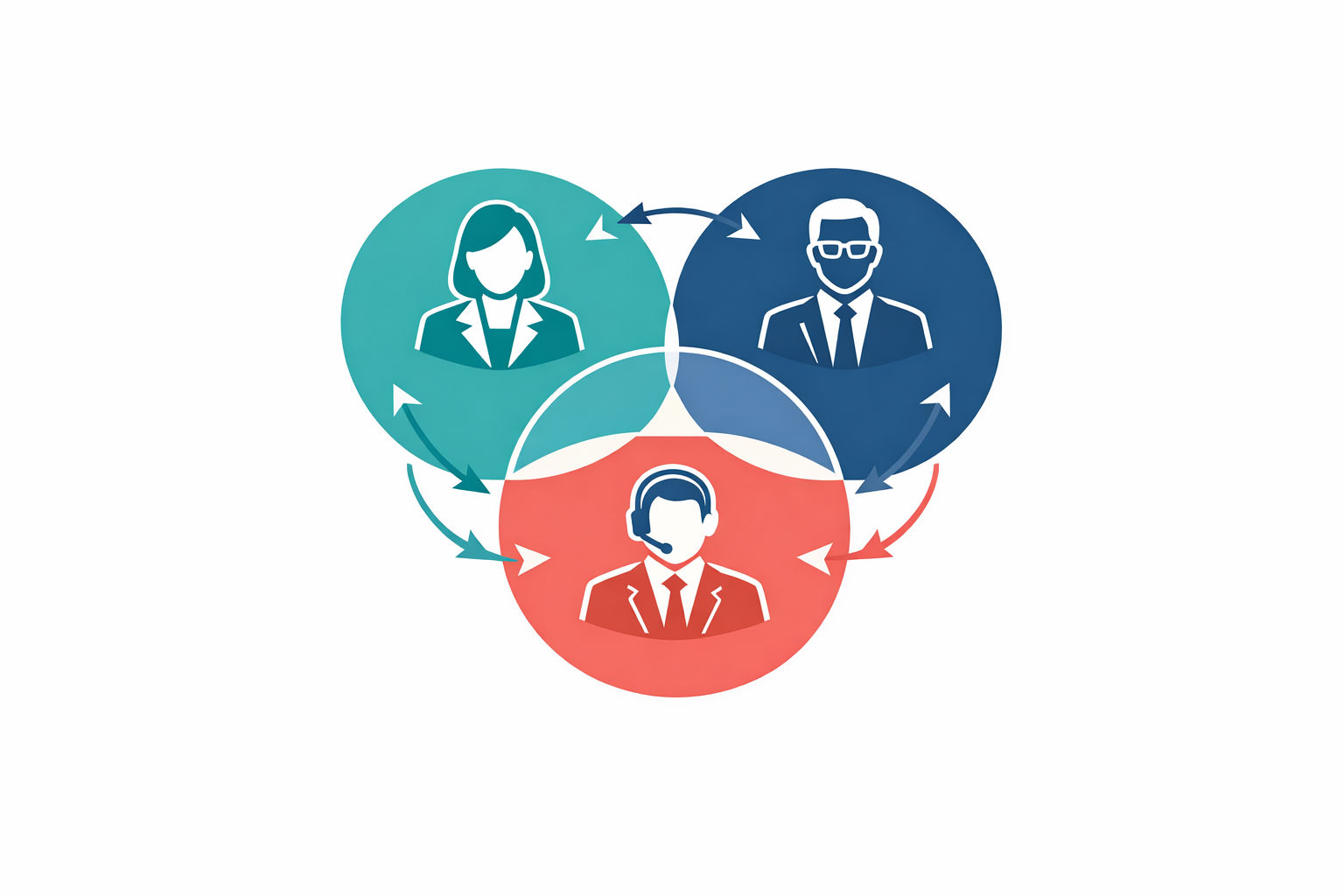
The CHRO / HR Director defines the pain and champions the project internally. They control use-case selection and own the HR-tech line item. But for anything above ~$50K, they usually need sign-off from Finance.
The CFO sets the investment envelope, ROI expectations, and risk tolerance. Bain's 2025 survey found 56% of CFOs plan to increase AI investment by 15%+ this year — but they're funding it partly by constraining headcount. Your pitch to the CFO: "This replaces spend you're already burning on manual processes and agency fees."
The CIO / IT approves the technical stack, manages vendor contracts, and governs data access. They care about security, integration with existing HRIS (Workday, SAP, Oracle HCM), and whether your solution creates technical debt.
How to navigate it: Enter through the CHRO. Build the business case for the CFO. Pre-empt IT concerns by scoping integration requirements in your proposal. The fastest-closing deals are the ones where you hand the CHRO a CFO-ready ROI deck they can forward internally.
HR leaders are increasingly being asked to lead company-wide AI strategy — not just HR AI. SHRM reports that 73% of HR directors and above have already adopted AI. When you help an HR leader succeed with a department-level project, you're positioning yourself as the consultant they bring into the broader transformation. That's how a $40K policy bot becomes a $300K enterprise engagement. If you want to learn how to turn initial projects into long-term accounts, read our guide on keeping clients after the first project.
The Compliance Landmines (And How to Sell Governance as a Feature)
Here's the part most AI consultants gloss over — and it's exactly why HR leaders need you.
The regulatory landscape around AI in HR has exploded. Hiring algorithms are now classified as "high-risk" under the EU AI Act. NYC's Local Law 144 mandates annual independent bias audits and public disclosure of impact ratios for automated employment decision tools. California's new FEHA regulations (effective October 2025) explicitly govern employer use of AI in hiring. Illinois now treats algorithmic discrimination as a civil rights violation.
And the numbers are alarming: ~30% of AI-powered recruitment systems have been flagged for discriminatory practices in recent audits (NextInHR, 2025). The EEOC's iTutorGroup case — where an AI system auto-rejected women over 55 and men over 60 — resulted in a $365,000 settlement and years of monitoring.
This isn't a reason to avoid HR. It's a reason HR teams need consultants.
Every HR AI engagement should include a governance component: bias testing protocols, human-in-the-loop review workflows, audit documentation, and compliance mapping to relevant regulations (EEOC, GDPR Article 22, EU AI Act, state laws). This isn't a nice-to-have — it's what separates a professional engagement from a liability. Package it. Price it. Deliver it. Read our full breakdown on how to sell AI governance.
The consultants who win in this space are the ones who lead with compliance. When you walk into a discovery call and ask, "How are you currently auditing your hiring algorithms for disparate impact?" — and they don't have an answer — you've just created urgency that no feature demo can match.
How to Scope and Price an HR AI Engagement
Pricing AI consulting for HR follows a clear tiering structure. Here's how typical engagements break down based on practitioner benchmarks and market data:
| Engagement Tier | Scope | Duration | Price Range |
|---|---|---|---|
| AI Readiness Assessment | HR data audit, use-case discovery, 3–5 prioritized opportunities, 12-month roadmap | 3–6 weeks | $15K–$60K |
| Single Use Case POC | One use case (e.g., policy chatbot or screening tool), integration with 1–2 systems, UAT + security review | 4–10 weeks | $20K–$75K |
| Multi-Use-Case Platform | 2–4 use cases, HRIS/ATS integration, governance framework, HRBP training | 3–6 months | $100K–$300K |
| Full HR AI Transformation | Operating model redesign, multi-country deployment, change management, compliance automation | 6–18 months | $300K–$750K+ |
Typical HR AI engagement tiers for boutique and mid-tier consultancies (enterprise Big 4 pricing runs 2–3x higher)
The smart entry point is always the assessment. A $15K–$60K readiness assessment is a low-risk commitment for the buyer and gives you everything you need to scope the larger engagement. You walk out with documented pain points, a prioritized roadmap, and a client who already trusts your thinking. That's how a five-figure diagnostic turns into a six-figure implementation.
If you're scaling past $20K/month, the HR vertical is ideal because these engagements are inherently repeatable: the same five use cases apply across industries, the compliance requirements are standardized, and the ROI math translates from one company to the next.
Value-Based Pricing Works Especially Well Here
The HR vertical lends itself to outcome-based pricing because the metrics are hard and visible: time-to-hire, cost-per-hire, ticket deflection rates, turnover percentages. Research from AISuperior suggests 73% of AI consulting clients now prefer value-based pricing over hourly billing. In HR, you can anchor to savings: "This attrition model will save you $600K/year. My fee is $120K. That's a 5:1 return."
The Objections You'll Hear (And How to Handle Them)
Let's be real about the pushback. If you're selling AI automation for people ops, you'll hit these three objections on almost every call.
"Our HRIS Already Has AI Built In"
This is the most common objection and the easiest to counter. Here's the truth: Workday, SAP SuccessFactors, and Oracle HCM all have AI features — and they're all limited to their own data silo.
Pyn's 2026 analysis of Workday put it bluntly: Workday's AI "depends entirely on what lives inside Workday" and "cannot reliably create unified insights" when critical context sits in Slack, your LMS, ServiceNow, or project tools. It can't orchestrate cross-system onboarding journeys. It can't detect behavioral signals from non-HR systems. It can't run agentic workflows across your actual tool stack.
Your counter: "Your HRIS AI is good at summarizing data inside its own walls. What it can't do is connect the dots across the 12 other systems your employees actually use. That's the gap we fill."
"We Don't Have Clean Enough Data"
This is actually a buying signal disguised as an objection. If their data is messy, they need you even more — because every AI tool they deploy on bad data will underperform or produce biased outputs.
Your counter: "That's exactly why we start with an assessment, not an implementation. The first thing we do is audit your data landscape and build a realistic roadmap based on what you actually have. Most clients are further along than they think."
"We Need to Get IT On Board First"
Translation: they want to buy but don't know how to navigate internal politics.
Your counter: "I've scoped this to integrate with your existing HRIS through standard APIs — no custom infrastructure. Here's a one-page technical summary your CIO can review. I'm happy to join a 20-minute call with IT to address security and architecture questions directly."
The most successful HR AI consulting engagements follow a pattern: assess → prove → expand. Start with a paid readiness assessment that surfaces specific pain points with dollar figures attached. Deliver one quick-win POC (usually a policy chatbot — fastest to deploy, easiest to measure). Then use those results to justify the multi-use-case platform engagement. Each step de-risks the next.
Your Entry Point: Lead With the Assessment
If you take one thing from this playbook, it's this: don't lead with a solution when approaching HR teams. Lead with a diagnostic.
HR leaders are overwhelmed. They're being asked to lead AI strategy without a roadmap, without dedicated resources, and without the time to figure it out. Nua's 2025 research confirmed exactly this — CPOs and Heads of HR Ops are consistently saying: "We need help turning strategy into action."
A structured AI readiness assessment gives you a consultative entry point that feels low-pressure to the buyer but high-value in practice. It lets you map their current tech stack, audit data quality, identify the highest-ROI use cases, and surface compliance gaps — all before you ever pitch a solution.
ConsultKit's AI readiness assessment framework is purpose-built for exactly this. It gives you a structured, repeatable process to walk into any HR or operations leader's office, run a professional diagnostic, and come out with a prioritized roadmap that practically sells the next engagement for you. No cold pitch. No guesswork. Just a clear picture of what's broken and what it's worth to fix it.
HR is a $6.5 billion AI market that most consultants are ignoring. The buyers are motivated, the use cases are proven, and the regulatory complexity means they need outside expertise. The only question is whether you're going to be the consultant who shows up with the right playbook — or the one who keeps fighting over the same marketing automation deals as everyone else.
