
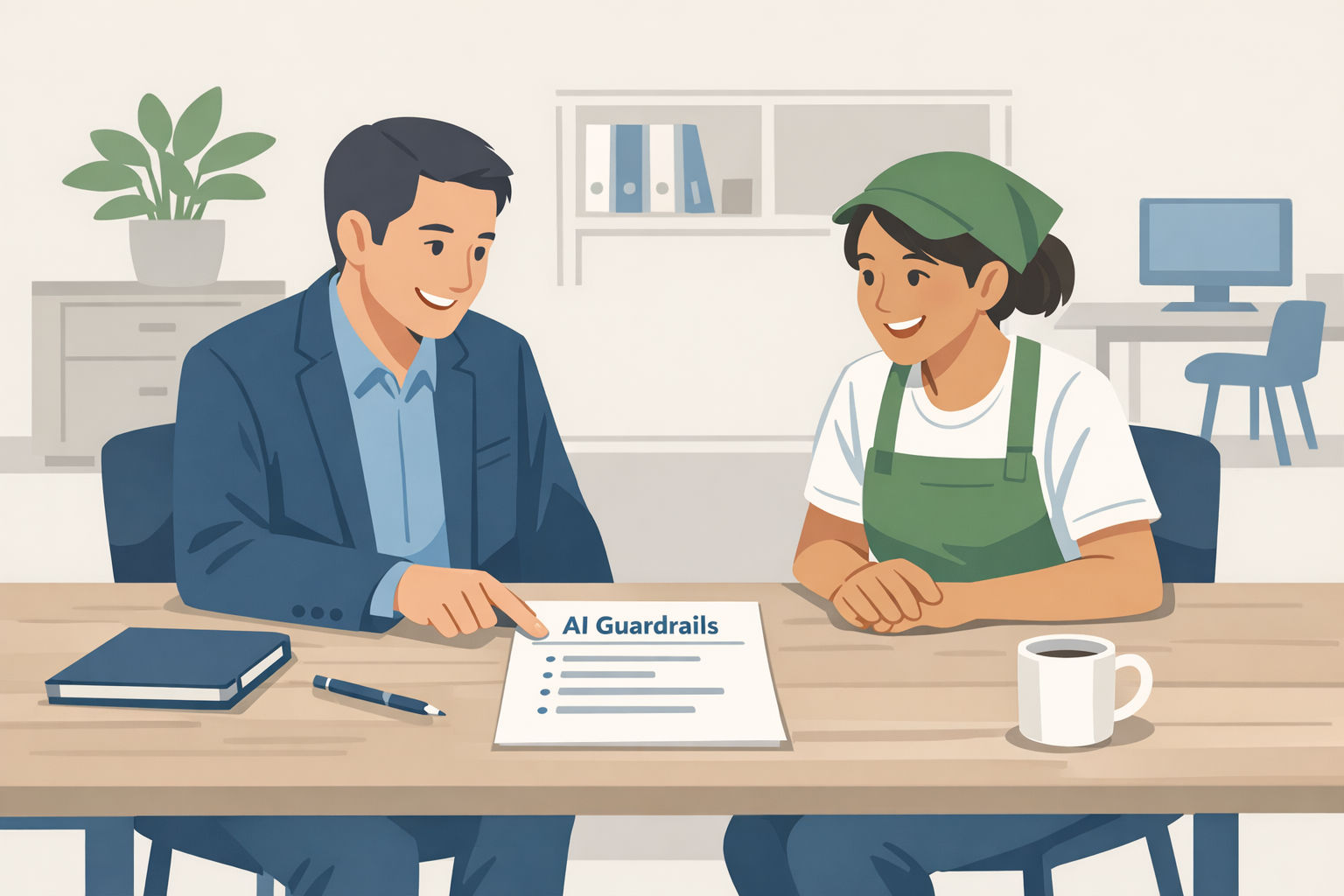
Here's what nobody tells you about ai governance consulting for SMBs: the conversation isn't the hard part. The hard part is that most consultants never start it.
You're deploying AI automations, building workflows, integrating LLMs into client operations — and you're doing it without a single governance guardrail in place. Not because you don't know better. Because you think governance is a 60-page compliance document that'll scare a 25-person accounting firm right out of the engagement.
It's not. And skipping it is costing you — in failed projects, in client churn, and in liability you haven't even calculated yet.
One in four AI projects fail due to weak governance, according to MIT research. Companies with strong governance see 27% higher efficiency gains and 34% higher operating profits from their AI investments. Meanwhile, Gartner found that ungoverned organizations experience 3.7 AI incidents per year — versus 0.8 for governed ones.
This isn't about policy documents. It's about protecting your clients, protecting your practice, and unlocking a service line that commands premium pricing with minimal delivery overhead.
If you've already read our primer on how to sell AI governance to SMB clients, this piece goes deeper. We're covering the delivery mechanics: what to actually say, what to actually hand over, how to price it, and what happens to your business if you keep skipping this conversation.
An Australian consultancy recently used an AI tool to generate a client quote without human verification — an AI hallucination caused a material pricing error, leading to significant financial losses and a professional liability claim. A separate contractor uploaded thousands of rows of sensitive data into ChatGPT with zero governance in place, triggering a major privacy violation. These aren't hypotheticals. They're happening now. — Source: Mark Luckin, Lockton Insurance
Stop Saying "Governance." Start Saying "Guardrails."
The first mistake consultants make is using the word "governance" with an SMB owner who's never heard the term. Their brain immediately goes to one of two places: government regulation or corporate bureaucracy. Neither makes them want to open their wallet.
Here's the language shift that works. You're not selling AI governance — you're selling AI guardrails. You're not delivering a compliance framework — you're delivering a risk playbook. You're not running an audit — you're doing an AI health check.
The framing matters because SMB owners think in outcomes, not processes. They don't care about ISO 42001 or the NIST AI Risk Management Framework. They care about:
- "What happens if my employee pastes client data into ChatGPT?" — That's a data exposure question, not a governance question.
- "Am I liable if our AI tool gives a customer bad advice?" — That's a risk management question.
- "Are we going to get fined for something we don't even know about?" — That's a compliance gap question.
All three questions are governance. None of them require the word.
The best consultants I've seen introduce this in the discovery call — not as a separate agenda item, but as a natural extension of the diagnostic. You're already asking about their tech stack, their workflows, their data. Add three questions:
- "Which AI tools is your team currently using — including personal ones?"
- "Who reviews AI outputs before they go to a client or customer?"
- "What's your plan if an AI tool generates something inaccurate that reaches a customer?"
Most SMB owners can't answer any of these. That gap — visible, specific, and immediate — is your governance opening. No policy lecture required.
What an SMB Governance Deliverable Actually Looks Like
Here's where most consultants overthink it. They look at enterprise ai governance frameworks — the 60-page policy suites, the multi-stakeholder review boards, the regulatory mapping documents — and think they need to scale that down for SMBs.
You don't. You need to build something completely different.
An SMB with 10-100 employees doesn't have a Chief Risk Officer. They don't have a compliance department. They probably don't have a dedicated IT team. The governance deliverable needs to be something the owner can read in 20 minutes, hand to their team, and actually enforce.
I call it the AI Guardrails Package. It's five documents, each one to three pages max.
| Document | What It Covers | Why SMBs Need It |
|---|---|---|
| AI Acceptable Use Policy | Approved tools, prohibited uses, data handling rules, consequences for violations | Stops shadow AI — 90% of employees use unapproved AI tools (MIT Report) |
| AI Tool Inventory | Every AI tool in use, what data it accesses, who owns it, vendor terms summary | Most SMBs have zero visibility into their AI footprint |
| Human Review Protocol | Which AI outputs require human sign-off before reaching clients/customers, escalation paths | Prevents the hallucination-to-client pipeline |
| Incident Response Playbook | Step-by-step for AI failures: who to notify, how to contain, when to disclose | One bad AI output reaching a customer without a response plan is a client-ending event |
| Quarterly Review Checklist | Simple one-page checklist for reviewing tool inventory, policy compliance, and emerging risks | Governance isn't a one-time deliverable — this keeps the retainer alive |
The AI Guardrails Package: Five lean documents that give SMBs enterprise-grade protection without enterprise complexity
Notice what's missing from this list: regulatory mapping, algorithmic bias assessments, model risk documentation. Those are legitimate governance needs for enterprises deploying custom AI models. Your 40-person insurance brokerage using ChatGPT, Jasper, and an AI scheduling tool doesn't need them.
The beauty of this package is delivery speed. Once you've built the templates, you can customize and deliver the full AI Guardrails Package in two to three weeks. That's the kind of fast-turnaround, high-margin work that scales a consulting business without burning you out.
How to Price AI Governance for SMBs
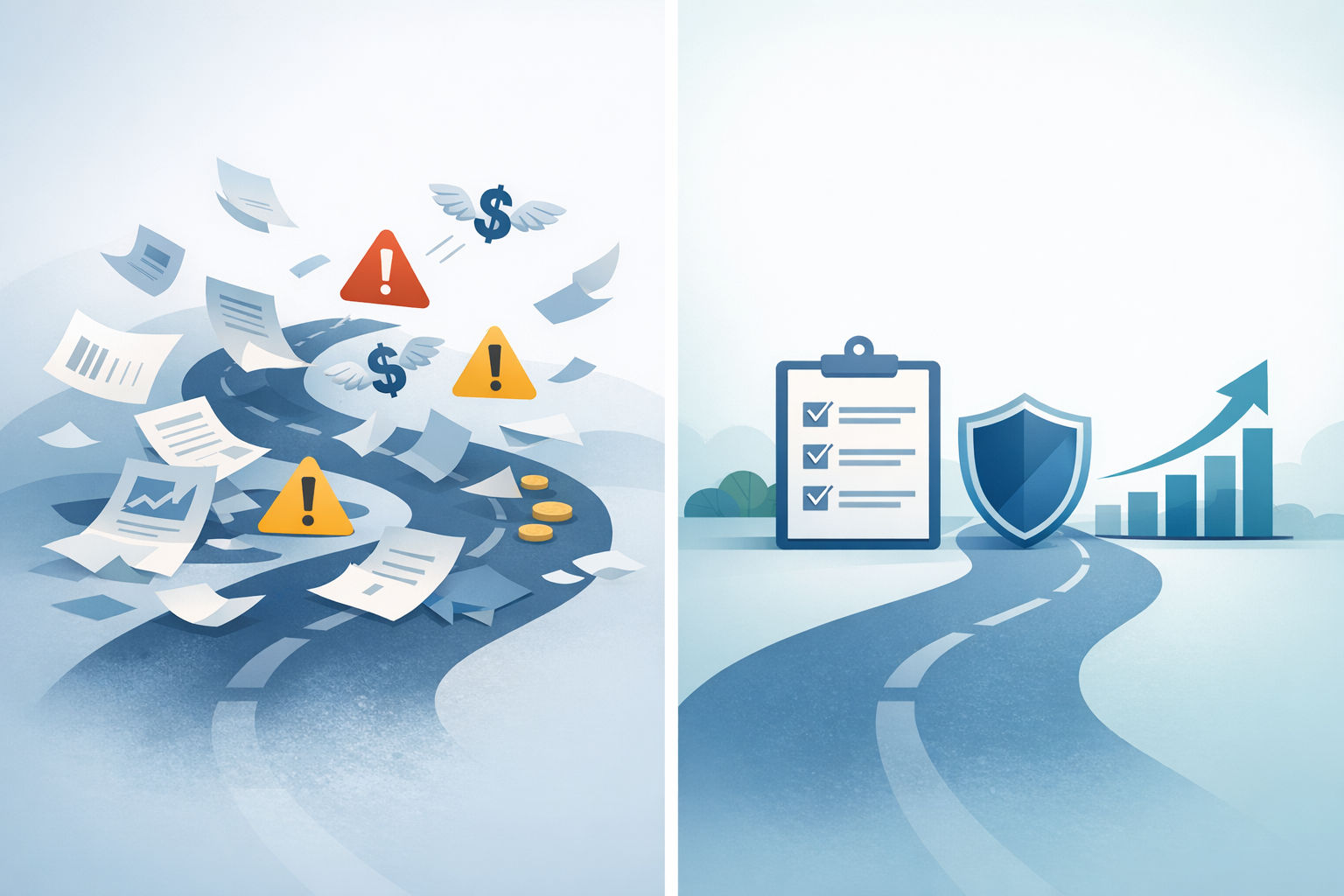
Governance pricing is where most consultants leave money on the table — either by giving it away as part of an implementation or by never offering it at all. There are three models that work, and the right one depends on your engagement structure.
| Pricing Model | Range | When to Use | Margin Notes |
|---|---|---|---|
| Standalone Governance Package | $3,000 – $7,500 | Client isn't ready for full AI implementation but needs guardrails for tools already in use | Highest margin — templates mean 80%+ of this is profit after first delivery |
| Add-On to Implementation | 15 – 25% of implementation fee | You're scoping an AI workflow build or integration project | Frames governance as risk mitigation, not an upsell. If implementation is $15K, governance adds $2,250 – $3,750 |
| Quarterly Governance Retainer | $500 – $1,500/month | Post-implementation ongoing oversight: policy updates, tool audits, incident reviews | The real play — this is recurring revenue that compounds across clients |
Three governance pricing models for SMB engagements
The standalone package is your entry point for clients who are already using AI but haven't engaged you for implementation. It's also a brilliant lead-in to larger projects — once you've documented their AI tool inventory and identified governance gaps, implementation recommendations write themselves.
The add-on model is the easiest to close. When you're scoping an AI implementation, you frame governance as the risk mitigation layer that protects their investment. The line I use: "We can build this without guardrails, but if an employee uses it incorrectly or data leaks through a tool we didn't account for, there's no playbook for what happens next. The guardrails package ensures we don't deliver something that creates more risk than it solves."
No rational business owner says no to that.
The retainer is where long-term value lives. It's also the model that turns one-off governance projects into long-term client accounts. Quarterly reviews, policy updates as new AI tools emerge, and a direct line when something goes sideways. For clients in regulated industries — financial advisors, law firms, healthcare practices — this isn't optional. It's expected.
For structuring the add-on into your proposals, see our guide on outcome-based pricing — governance maps naturally to risk-reduction outcomes that clients will pay a premium for.
The Regulatory Context You Need (Without Becoming a Lawyer)
You don't need to be a legal expert to sell ai compliance for small business clients. But you do need to know enough to explain why this matters now — in two minutes, without jargon.
Here's the landscape in plain English:
The EU AI Act is already in force. Prohibited AI practices were banned in February 2025. General-purpose AI rules kicked in August 2025. High-risk system compliance arrives August 2026. Even if your client isn't in the EU, their SaaS vendors might be — and the compliance cost for a small business is estimated at €12,000 per high-risk AI system (AI Policy Bulletin). That's a number your client needs to hear.
In the US, the regulatory picture is fragmented but accelerating. Executive Order 14365 (December 2025) is trying to establish a national AI framework while challenging "onerous" state laws. But in the meantime, 40+ states passed AI bills in 2025 alone, with 175 state-level AI laws enacted since 2020 (NCSL). Colorado's AI Act hits June 2026 with algorithmic discrimination requirements. Texas passed its Responsible AI Governance Act. Illinois expanded AI in hiring rules.
The practical takeaway for your client: regulations are coming from multiple directions, they're inconsistent, and waiting until they apply to you is 3-4x more expensive than getting ahead of them (PwC). That's the only regulatory pitch you need.
Don't recite legislation. Instead, use this framing: "The rules are still being written, which means the businesses that put basic guardrails in place now will spend a fraction of what it costs to retrofit later. This isn't about compliance — it's about not having to scramble when the rules finally arrive."
What Happens When You Skip the Governance Conversation
Let's talk about what's at stake for your practice — not just your client's business.
Failed deployments. 73% of enterprises fail to achieve intended benefits from their first AI implementation (ITPI). The number is likely higher for SMBs with less technical infrastructure. A major failure driver? No one defined who reviews AI outputs, what data can go into which tools, or what "success" looks like beyond the automation itself. That's all governance.
Client churn. When an AI tool you deployed does something unexpected — hallucinates in a client-facing context, exposes data, or just underperforms — and there's no incident response protocol, no human review process, no documented guardrails, the client doesn't blame the AI. They blame you. No governance means no framework for handling the inevitable rough edges. That turns a fixable issue into a lost client.
Professional liability. This is the one that should keep you up at night. If you deploy AI tools for a client without documenting risks, establishing review protocols, or defining acceptable use — and something goes wrong — you're exposed. Insurance carriers are already scrutinizing AI-related engagements. As Mark Luckin at Lockton Insurance puts it: "The primary risk from artificial intelligence stems not from the technology itself, but from inadequate governance and quality assurance processes around AI-assisted work."
The consultant who deploys without governance is carrying unpriced risk on every engagement.
- 1 in 4 AI projects fail due to weak governance (MIT Report)
- 3.7 vs 0.8 — AI incidents per year in ungoverned vs. governed organizations (Gartner)
- 3-4x — How much more expensive compliance retrofitting is vs. proactive governance (PwC)
- Only 8% of business leaders feel prepared for AI governance risks (Riskonnect)
- $670K — Additional data breach cost for companies with high shadow AI levels (IBM)
Surface Governance Gaps Before the Engagement Starts
The smartest move isn't waiting until the implementation kickoff to bring up governance. It's building governance discovery into your pre-engagement process.
AI readiness assessments are the natural mechanism for this. When you run a structured assessment before scoping an implementation, you're not just evaluating technical readiness — you're surfacing governance gaps that the client didn't know they had. Shadow AI usage, missing data policies, zero incident response protocols, undefined review responsibilities.
Every gap you identify is a line item in your proposal. Every risk you flag positions governance as the logical next step — not a compliance upsell, but a prerequisite for a successful deployment.
This is what separates consultants who close $5K projects from those who close $15K-$25K engagements. The implementation is the same. The difference is that one consultant identified the risk landscape first and scoped accordingly.
Add Three Governance Questions to Your Discovery Call
Build Your AI Guardrails Template Set
Price It Into Every Proposal
Deliver the Package in Week One
Offer the Quarterly Retainer at Handoff
The Bottom Line
AI governance consulting for SMBs isn't about compliance documents and regulatory checklists. It's about giving business owners a simple, practical framework for using AI without getting burned — and positioning yourself as the consultant who thought about the risks before they became problems.
The market is wide open. Enterprise firms dominate 70% of AI governance spending. SMBs — the segment growing fastest — are barely being served. The consultants who figure out how to deliver lean, practical governance alongside their implementations will own this space.
Stop thinking of governance as a policy project. Start thinking of it as the risk layer that makes every other service you sell more valuable, more defensible, and more likely to lead to a long-term client relationship.
Your next engagement is the right time to start.
