
The AI agent market hit $7.8 billion in 2025 and is growing at 45% year-over-year. Gartner predicts 40% of enterprise applications will include task-specific AI agents by 2026, up from less than 5% today. If you're learning how to sell AI agents, the market timing couldn't be better.
But here's what the market reports don't tell you: 75% of SMBs are already experimenting with AI (Salesforce, 2025), yet fewer than 10% have scaled a single AI agent in any business function (McKinsey, 2025). The gap isn't technology or budget. It's the conversation.
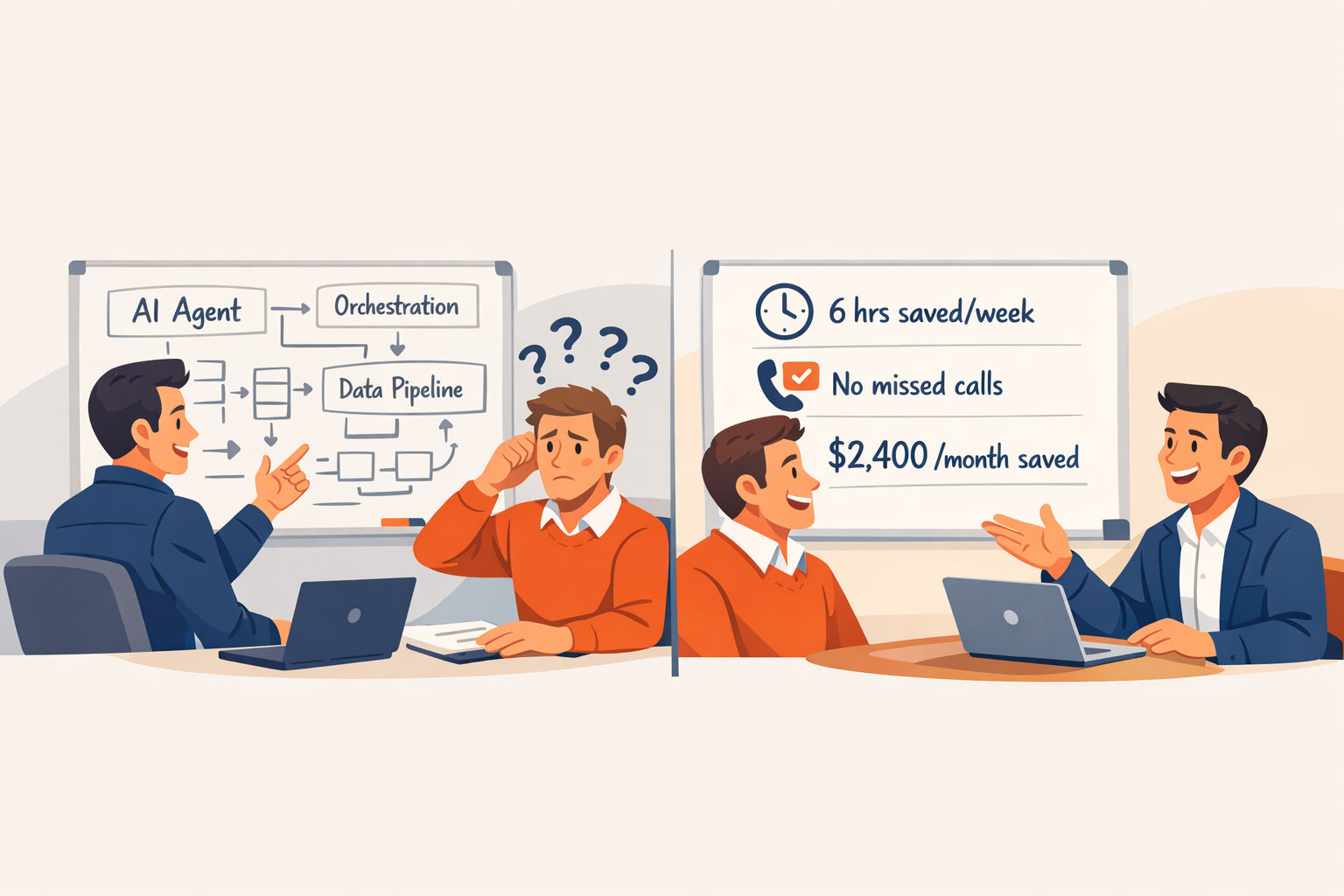
You're walking into a call with someone who runs a 12-person accounting firm or a regional law practice, and the first words out of your mouth are "I'd like to deploy an AI agent for your intake process." Their eyes glaze over. Not because they're not interested — because they have no idea what you just said.
The deals are there. The problem is how you're describing what you sell.
Why the Phrase 'AI Agent' Kills Deals Before They Start
Say "AI agent" to a non-technical business owner and you activate every piece of baggage they've accumulated from a decade of tech hype. Chatbots that couldn't answer simple questions. Blockchain promises that went nowhere. "Digital transformation" consultants who delivered PowerPoints and invoices.
As AI automation consultant Stephen Pope puts it: "Selling AI Automation is risky if you try to sell technology, innovation and/or possibilities to a business... Focus on those problems they have, talk with them first, listen, map out and help them solve those."
The word "agent" is especially dangerous because it implies autonomy — and autonomy is the last thing a business owner trusts from software they don't understand. They hear "agent" and immediately wonder: Who's controlling this? What if it goes rogue? Am I handing my business over to a robot?
The fix is simple: lead with the workflow, not the tool.
Don't say: "We'll build you an AI agent that handles client intake."
Say: "Right now, your front desk spends 6 hours a week collecting the same information from new clients — name, case type, documents needed, scheduling. We set up a system that does all of that automatically, so your team only touches the file when it's ready for real work."
Same technology. Completely different reaction. The first version sells a concept they need to research. The second version sells relief from a problem they experienced today.
If you can't explain the benefit in one sentence — with no jargon and no tech terms — you're still selling the technology instead of the result. Run every pitch through this filter before your next call.
The 3-Sentence Explanation That Non-Technical Buyers Understand
When a prospect inevitably asks "So what is this, exactly?" you need a crisp answer that avoids the jargon trap. Here's the framework:
- Name the task they hate. "You know how [someone on your team] spends [X hours per week] doing [specific repetitive task]?"
- Describe the outcome. "We set up a system that handles that automatically — [specific result] — so your team only steps in when something needs a human decision."
- Anchor the value. "Most clients see that pay for itself within [timeframe] just from the time it saves."
Example for a law firm: "You know how your paralegal spends the first half of every day collecting intake forms, chasing missing documents, and scheduling initial consults? We set up a system that captures all of that information from the client automatically — qualifies whether it's your kind of case, collects the right documents, and books the consult on your calendar — so your paralegal only touches a file when it's ready for legal work. Most firms we work with get 6+ hours back per week, which pays for the system in the first month."
Notice what's missing: no mention of AI, no mention of agents, no mention of any technology. You're describing a future state the business owner already wants.
The 4 Workflow Categories Where AI Agents Close Fastest
Not every workflow is a good first sale. The sweet spot for AI agent deployment in SMBs sits at the intersection of three things: high volume (happens daily or weekly), rule-based (follows a consistent pattern), and measurable (you can count hours saved or errors eliminated).
Four categories hit all three consistently:
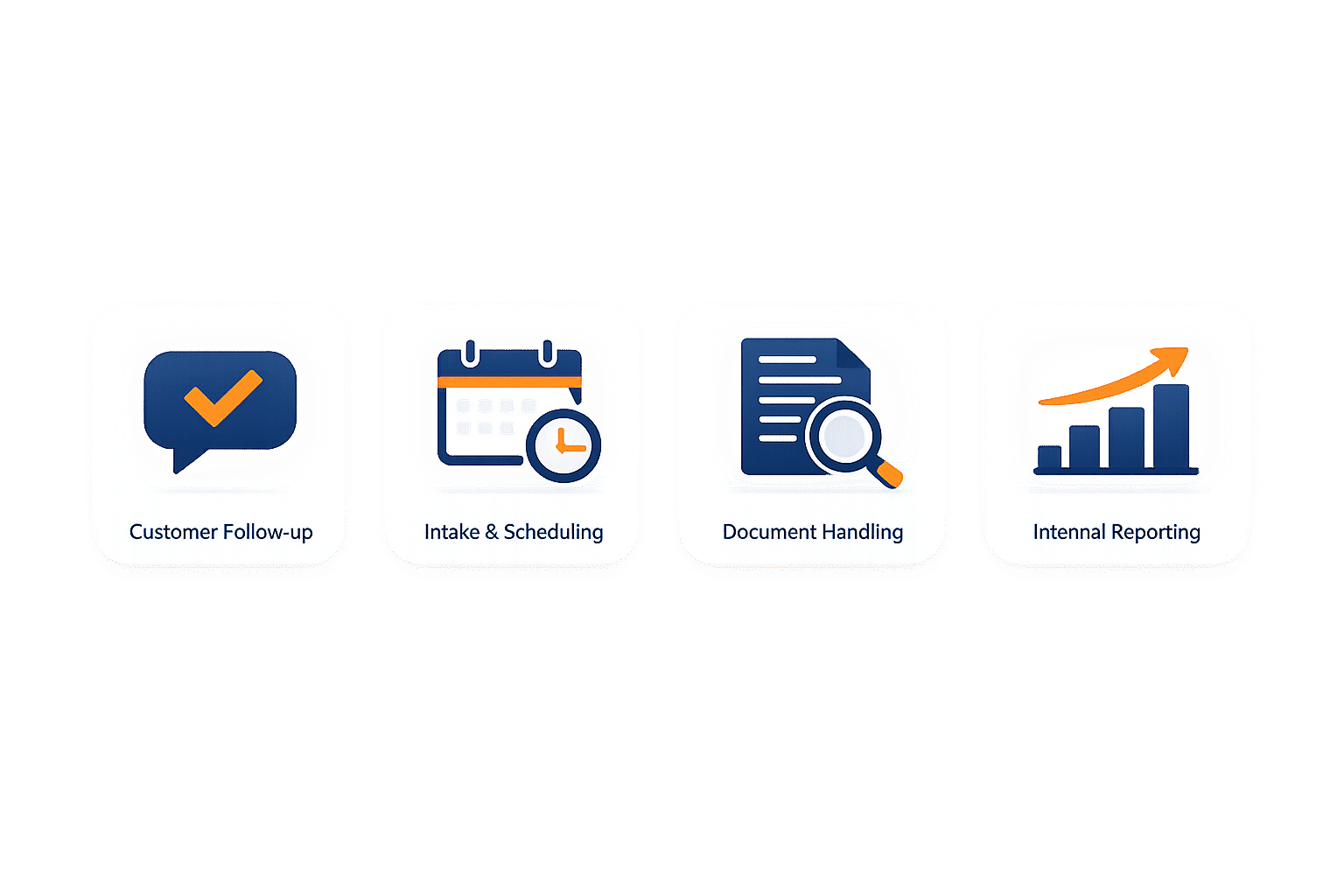
1. Customer Follow-Up
Every SMB leaks revenue here. Leads come in, get logged, and then sit in a spreadsheet while the owner is busy doing the actual work. A follow-up agent ensures every inquiry gets a response, every proposal gets a check-in, and no lead dies from neglect.
Sell it as: "You'll never lose a deal because nobody followed up."
2. Intake and Scheduling
This is the single highest-ROI entry point for service businesses. An intake agent collects client information, qualifies fit, gathers required documents, and books appointments — 24/7, across every channel. One law firm using AI-powered intake reported 22 hours saved per week while processing 3× more leads with the same staff (MHO Technology case study).
Sell it as: "Every new client gets the same professional intake experience — at 2 PM or 2 AM — without adding headcount."
3. Document Handling
Invoice processing, quote generation, contract review, data extraction from forms — these are workflows where SMB staff spend hours doing work that follows the same pattern every time. Agents can classify, extract, route, and even draft documents, with humans reviewing only the exceptions.
Sell it as: "Your team stops retyping the same data into three different systems."
4. Internal Reporting
The owner or operations manager who spends Friday afternoon building a performance spreadsheet is an ideal buyer. Reporting agents pull data from CRMs, financial tools, and ticketing systems to generate weekly summaries automatically.
Sell it as: "You get your Friday afternoon back, and your reports are more accurate than the ones you were building by hand."
Don't pitch a "company-wide AI transformation." Pick the single workflow where the pain is sharpest and the outcome is most measurable. Win that one, deliver results, and the client will ask you what else you can automate. If you need help building a client data strategy before implementation starts, we've covered that in detail.
Frame the Discovery Call Around Time Savings and Headcount Avoidance
The discovery call is where most consultants lose the deal — not because the prospect isn't interested, but because the conversation drifts into features instead of economics.
Here's the reframe: every question you ask should surface a number.
- "How many hours per week does your team spend on [workflow]?"
- "What does that person cost you, fully loaded?"
- "How many leads or clients fall through the cracks because that process is manual?"
Then do the math out loud, together.
If a paralegal spends 6 hours per week on intake at $35/hour, that's $840/month in labor on a task that could be automated. If missed follow-ups cost the firm two new clients per month at $3,000 average case value, that's $6,000 in lost revenue. The conversation shifts from "What does this AI thing cost?" to "How fast can we start?"
The two frames that close:
- Time savings: "This gives your team X hours back every week to focus on billable work."
- Headcount avoidance: "You won't need to hire that extra admin assistant you've been considering."
Neither frame mentions technology. Both speak directly to the P&L, which is the language every SMB owner is fluent in.
The Two Objections Specific to Agents — And How to Answer Them
Once you've framed the value, two objections come up in almost every conversation. They're both about trust, not technology.
"What if it makes a mistake?"
This is the big one. Business owners imagine the worst case: a wrong quote sent to a client, an incorrect appointment booked, sensitive information shared with the wrong person.
Your answer: "Everything has guardrails. The system handles the routine — the 90% that follows a consistent pattern — and flags anything unusual for your team to review. No customer-facing action happens without the rules you set. Think of it like cruise control, not a self-driving car: it handles the straightforward stretches, but you're always in the driver's seat."
The key is to name the specific safeguard, not just reassure. Tell them exactly which actions require human approval and which don't. The more specific you are, the more trust you build.
"Who's responsible if it does something wrong?"
This is a legitimate concern — and one you should take seriously, not wave away. Courts have consistently treated automated systems' actions as the actions of the business that deployed them. The Air Canada chatbot case made headlines precisely because the tribunal ruled the company was liable for its chatbot's incorrect statements.
Your answer: "You own the system — and we build it so that anything with financial, legal, or customer-facing consequences has a human checkpoint. We also set up logging so you can see exactly what the system did and why. Our contract spells out what the system does, what it doesn't do, and where your team stays in the loop."
If you want a deeper dive on structuring contracts that protect both you and your client, we've written extensively about liability, contracts, and protecting yourself as a consultant.
How to Price AI Agent Deployments
Pricing is where most new AI consultants leave money on the table. The market has settled around three models, and the best approach for most consultants is a hybrid.
| Pricing Model | Typical Range | Best For | Watch Out For |
|---|---|---|---|
| **Project fee** | $2,500–$15,000 one-time | Well-defined, single-workflow builds (intake, follow-up, reporting) | Scope creep and no recurring revenue |
| **Monthly retainer** | $1,000–$5,000/month | Ongoing optimization, monitoring, and expansion | Client resentment if they feel they're paying for nothing |
| **Hybrid (setup + retainer)** | $3,000–$10,000 setup + $1,000–$3,000/month | Most SMB agent engagements — covers build and ongoing care | Requires clear deliverables for each phase |
| **Outcome-based** | Tied to measurable results (leads booked, hours saved) | High-trust relationships with mature clients | Harder to scope; requires baseline measurement |
AI agent pricing models for SMB engagements (2025 market data from ADAI News and LaunchMyOpenClaw)
The hybrid model — setup fee plus monthly retainer — is where most successful consultants land. It covers your build cost, creates recurring revenue, and aligns your incentives with the client's ongoing success. An agent isn't a "set it and forget it" deployment; it needs monitoring, retraining as the business changes, and scope expansion as the client sees results.
A practical entry point: $5,000 setup for a single-workflow agent (e.g., intake automation), plus $1,500/month for monitoring, optimization, and support. At that price, if the agent saves the client even 6 hours per week of admin time at $30/hour, it pays for itself in month two.
Most agents replace 15–30 hours of weekly labor, delivering first-year ROI of 1.5–8× depending on the workflow and the client's cost structure (ADAI News, 2026).
Never charge hourly. Hourly billing punishes you for getting faster and better at delivering results. Price for the outcome the client receives, not the time you spend building it. Agencies using value-based pricing earn 3–5× more than those charging hourly or flat-rate.
The Conversation Before the Conversation
The sales framework above works — but only if you're sitting across from the right prospect. The fastest way to waste time selling AI agents is to demo for someone who doesn't have a repeatable workflow, doesn't have the budget, or isn't the decision-maker.
Before you invest 45 minutes in a discovery call, you need to know:
- Does this business have at least one high-volume, repetitive workflow? (If they can't name one, they're not ready.)
- Are they spending real money or real hours on it today? (No current pain = no urgency to buy.)
- Is the person you're talking to authorized to spend $5K–$15K without a committee? (If not, you're educating a messenger, not closing a deal.)
Qualifying prospects before the sales call — understanding which clients have the right workflows and readiness for agent deployments — is the difference between a 20% close rate and a 50% close rate. It means fewer wasted demos and faster closes. That's exactly what ConsultKit is designed to help you do: identify which prospects are actually ready for AI, so you walk into every call knowing the deal is closeable.
The technology is ready. The market is ready. Most SMB owners are ready — they just need someone who speaks their language. Stop selling AI agents. Start selling the outcome. The deals will follow.
What to Do Next
If you're building a consulting pipeline for AI agent services, these resources will help:
- Finding clients: Our guide on cold outreach sequences that actually get replies covers signal-based targeting for AI consulting prospects.
- Competing for deals: Learn how independent consultants win deals that big firms are pitching for with specific positioning and pricing strategies.
- Protecting your practice: Before you deploy your first agent, read our breakdown of AI consulting contracts and liability protection — the five clauses every SOW needs.
