
The AI for retail companies market is projected to hit $14.2 billion in 2025 and $82.7 billion by 2031, growing at nearly 35% annually (Mordor Intelligence, 2025). McKinsey estimates generative AI alone could unlock up to $390 billion in annual value for the sector.
And yet — 77% of retailers say they struggle to gain actionable insights from their own data. Only 26% have developed the capabilities to generate tangible value from AI. 96% say they're "using AI" in some form, but when you dig in, most are running a basic chatbot or an out-of-the-box recommendation widget and calling it a strategy.
That gap between aspiration and execution is where you sell.
If you're an AI consultant looking for a vertical with massive demand, clear ROI use cases, and buyers who are actively spending — retail and e-commerce should be near the top of your list. This is your playbook: the use cases that actually close, what to charge, how to qualify a retail prospect fast, and the discovery questions that surface budget before you waste a second call.
This is part of our vertical playbook series for AI consultants targeting specific industries. If you're building a multi-vertical practice, also check out our playbooks for manufacturing and real estate.
The 6 AI Use Cases Retail Clients Actually Pay For
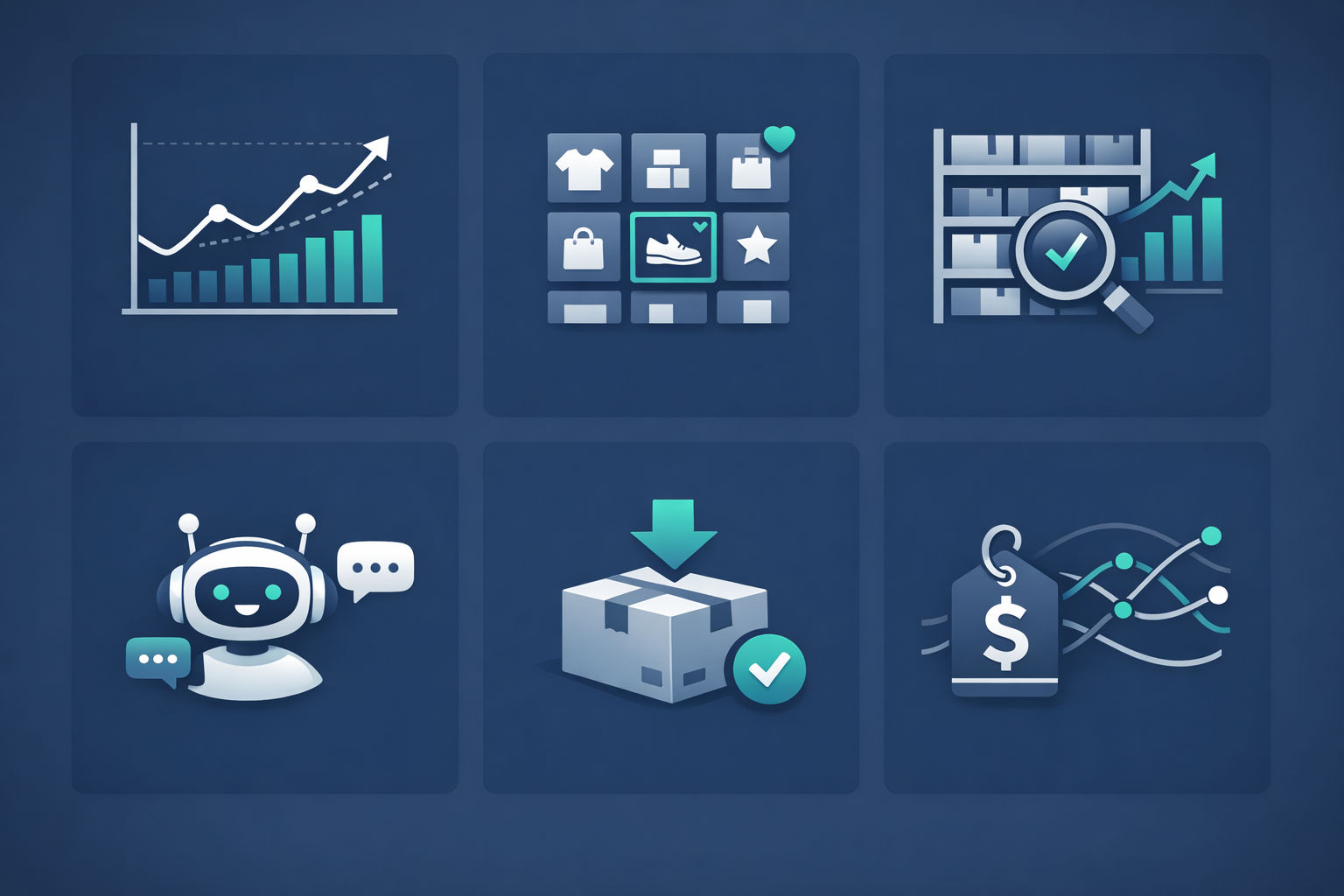
Retailers don't buy "AI strategy." They buy solutions to specific, measurable operational problems. Here are the six use cases that consistently close — with the problem each one solves, what you actually scope and deliver, and realistic project pricing.
1. Demand Forecasting
The problem: Mid-market retailers are still forecasting with spreadsheets, last year's sales data, and gut feel. They over-order slow movers, under-order best sellers, and bleed margin on markdowns.
What you deliver: SKU-level and store-level demand models trained on historical sales, seasonality, promotions, and external signals (weather, events, trends). The output is a forecasting engine that feeds directly into their replenishment workflow.
The ROI pitch: AI-driven demand forecasting cuts stockouts by 60–75% and excess inventory by 25–40% (NeuralChain AI, 2025). For a retailer doing $20M, even a 5% reduction in dead stock is a $200K–$400K annual save.
Typical project range: $25,000–$75,000 for initial build and integration; $5,000–$10,000/month ongoing optimization retainer.
2. Personalization Engines
The problem: Most mid-market e-commerce sites show every visitor the same homepage, the same product grid, and the same email sequence. They're leaving 15–40% revenue uplift on the table.
What you deliver: A personalized recommendation and merchandising system — per-customer product ranking, dynamic homepage content, personalized email triggers, and segment-specific offers. This plugs into their existing e-commerce platform (Shopify, Magento, WooCommerce, etc.).
The ROI pitch: AI-driven personalization increases conversion rates by 15–25% and can lift average order value by 10–30% (BCG Personalization Index). One fashion retailer case study showed a 22% AOV increase within 90 days of deploying an AI recommendation agent (Agentmelt, 2026).
Typical project range: $20,000–$60,000 for implementation; $3,000–$8,000/month retainer for ongoing tuning.
3. Inventory Optimization
The problem: Retailers with hundreds or thousands of SKUs across multiple locations can't manually optimize allocation. The result: $50K sitting in a warehouse in Ohio while the same product is sold out in Texas.
What you deliver: An AI-powered allocation and replenishment system that balances stock across locations based on sell-through velocity, local demand patterns, and lead times. Often paired with demand forecasting as a Phase 2.
The ROI pitch: AI-enabled supply chain planning reduces inventory levels by up to 20% and cuts supply chain costs by up to 10% (Anchor Group Tech, 2025). That's working capital freed up and markdown losses avoided.
Typical project range: $30,000–$80,000 for multi-location retailers; higher for omnichannel operators with warehouse + store + 3PL complexity.
4. Customer Support Automation
The problem: E-commerce support teams are drowning in repetitive tickets — "where's my order," return requests, sizing questions, policy lookups. It's a cost center that scales linearly with revenue.
What you deliver: An AI customer support agent integrated with their help desk (Zendesk, Gorgias, Intercom), order management system, and product catalog. Handles Tier 1 inquiries autonomously, escalates edge cases to humans.
The ROI pitch: AI shopping assistants convert at 12.3% vs. 3.1% for unassisted sessions — nearly 4x higher (Zowie, 2026). One DTC retailer deployed a conversational AI assistant and saw a 28% conversion lift and 35% reduction in cart abandonment within 90 days (DreamzTech, 2026).
Typical project range: $15,000–$45,000 for build + integration; $2,000–$6,000/month retainer.
5. Returns Reduction
The problem: E-commerce return rates average 20–30%, and in fashion, they can hit 40%+. Every return costs $10–$25 in reverse logistics alone — before you count the margin erosion.
What you deliver: AI-powered size and fit guidance, smarter product descriptions generated from data, and predictive models that flag high-return-risk orders before they ship (enabling proactive intervention). Often combined with personalization.
The ROI pitch: A mid-size DTC fashion brand with a 32% return rate deployed an AI agent for sizing guidance and cross-sell recommendations — returns dropped 35% and AOV rose 22% (Agentmelt, 2026). At $15M revenue, that 35% return reduction was worth hundreds of thousands in recovered margin annually.
Typical project range: $20,000–$50,000 as a standalone; often bundled with personalization for $40,000–$80,000.
6. Dynamic Pricing
The problem: Most mid-market retailers set prices manually, react to competitors days late, and run blanket promotions that destroy margin. Fewer than 15% use AI-powered pricing at scale.
What you deliver: An AI pricing engine that adjusts prices based on demand elasticity, competitive positioning, inventory levels, and margin targets. Can start with markdown optimization (lower risk, faster ROI) before moving to full dynamic pricing.
The ROI pitch: BCG reports that AI-powered pricing increases gross profit by 5–10% while also growing revenue and improving customer value perception. For a $10M retailer, a 5% gross profit lift is $500K straight to the bottom line.
Typical project range: $30,000–$75,000 for initial implementation; $5,000–$12,000/month for ongoing optimization.
| Use Case | Typical Project Fee | Monthly Retainer | Expected ROI |
|---|---|---|---|
| Demand Forecasting | $25K–$75K | $5K–$10K/mo | 60–75% fewer stockouts |
| Personalization Engine | $20K–$60K | $3K–$8K/mo | 15–25% conversion lift |
| Inventory Optimization | $30K–$80K | Project-based | Up to 20% inventory reduction |
| Customer Support Automation | $15K–$45K | $2K–$6K/mo | 4x conversion vs. unassisted |
| Returns Reduction | $20K–$50K | Bundled | 25–35% return rate reduction |
| Dynamic Pricing | $30K–$75K | $5K–$12K/mo | 5–10% gross profit increase |
Retail AI use case pricing benchmarks for independent consultants and small firms
What NOT to Pitch Retail Clients
Retail buyers are not buying "AI strategy workshops." They're not interested in a 60-page roadmap that sits in a shared drive. And they definitely don't want to hear about "transformational AI journeys."
Here's what kills deals in this vertical:
- Vague AI strategy engagements — Retailers want fast wins with measurable ROI. They've already been burned by consultants who delivered slide decks instead of working systems. If your proposal doesn't name a specific metric that will improve and by how much, you'll lose to the competitor who does.
- Boil-the-ocean transformation pitches — A $200K+ proposal to "reimagine the entire customer experience with AI" will get you a polite "we'll get back to you." Start narrow. Win. Then expand.
- Technology-first conversations — Retailers don't care about your LLM stack. They care about stockouts, cart abandonment, return rates, and margin. Lead with the business problem, not the architecture diagram.
- Anything that requires a 12-month runway before value — This vertical moves fast. If you can't show impact within 8–12 weeks, you'll lose executive attention and budget.
The consultants who win in retail lead with a single, measurable problem, scope a 60–90 day pilot with clear KPIs, and use that first win to land the expansion deal. Which brings us to qualification.
Retail operates on seasonal cycles. If your engagement doesn't align with their calendar — pre-holiday build, post-holiday analysis, spring inventory planning — your proposal goes to the bottom of the pile. Time your outreach to their buying rhythm, not yours.
How to Qualify a Retail Prospect (Green Flags vs. Red Flags)
Not every retailer who says they "want AI" is worth your time. Here's how to separate buyers from browsers — fast. If you want a deeper framework, our prospect scoring system breaks this down across all verticals.
The sweet spot for most independent consultants and small AI firms is mid-market retail: $5M–$200M in revenue, with a modern-ish tech stack, accessible data, and an executive who owns a specific KPI they need to move. Enterprise retail ($500M+) is lucrative but the sales cycles are 6–12 months and they'll likely have incumbents. Under $5M, the math usually doesn't work for custom AI.
The 5 Discovery Questions That Surface Budget in Retail
Once a prospect passes your qualification filter, your discovery call needs to do two things fast: confirm the problem is real and determine whether they can actually pay to fix it. Here are the five questions that work in this vertical:
1. "What's this problem costing you per month — in dollars, not percentages?"
Force specificity. A retailer who says "our return rate is too high" hasn't done the math. A retailer who says "returns cost us $45K/month in reverse logistics and another $30K in margin erosion" has — and that $75K/month number is your budget anchor. Your $40K project now looks like a rounding error against the annualized pain.
2. "What have you already tried to fix this, and why didn't it work?"
This tells you two things: (a) they've already invested in the problem (which means there's budget) and (b) what failed (which tells you what to avoid and what they're now comparing you against). Past spend is the single best predictor of future spend.
3. "If we could show measurable improvement in [specific metric] within 90 days, what would that be worth to your business?"
This reframes the conversation from cost to value. A 5% improvement in gross margin on $20M in revenue is $1M. Now your $50K project isn't an expense — it's a 20x return.
4. "Who else needs to say yes, and what's their biggest concern going to be?"
In retail, the buyer is usually the VP of E-Commerce, Head of Digital, or COO. But the CFO controls the checkbook and the CTO controls the tech stack. If you don't know who all three are, you'll get blindsided in the final stage. Map the decision-making unit on the first call.
5. "Is there a seasonal deadline driving this — holiday, spring launch, back-to-school?"
Retail runs on calendar urgency. A retailer who needs a personalization engine live before Black Friday has a hard deadline — and hard deadlines create real budgets. No deadline usually means no urgency, which means the deal will stall.
What a Typical Retail AI Engagement Looks Like
The consultants who close consistently in retail use a phased model that de-risks the buy for the client and creates natural expansion points for you. Here's the structure that works:
Phase 1: AI Readiness Assessment + Use Case Scoping (2–4 weeks | $5,000–$15,000)
Phase 2: Pilot Implementation — Single Use Case (6–10 weeks | $15,000–$75,000)
Phase 3: Scale + Retainer (Ongoing | $3,000–$12,000/month or project-based expansion)
The AI readiness assessment isn't just a qualification tool — it's your highest-converting sales mechanism. A $5K–$15K paid diagnostic that reveals exactly where their data gaps are, which use cases will deliver the fastest ROI, and what budget they'll need positions you as the obvious choice for the implementation. You stop competing on price and start competing on insight. Read more about how this fits into your overall pipeline in our pricing guide.
Pricing: Project vs. Retainer vs. Outcome-Based
Retail AI engagements can be priced three ways, and the best consultants use a mix:
- Project-based ($15K–$200K+): Best for initial builds and implementations. Clear scope, clear deliverables, clear timeline. This is how most retail deals start.
- Monthly retainer ($3K–$12K/month): Best for ongoing optimization — model tuning, performance monitoring, new feature rollouts. This is where your recurring revenue comes from.
- Outcome-based / revenue share: Best for pricing optimization and personalization where uplift is directly measurable. Structure: lower project fee + percentage of incremental revenue or margin improvement. High upside, but requires trust and transparency on both sides.
For a deeper breakdown of how to structure these models, see our guide on outcome-based pricing for AI services.
The key insight: don't start with the biggest deal you can pitch. Start with the smallest engagement that proves value — the $5K–$15K assessment — and let the results sell the $50K+ implementation. Retail buyers are skeptical of consultants who lead with big numbers. They're not skeptical of consultants who lead with evidence.
The Bottom Line
Retail and e-commerce is a $14 billion AI market growing at 35% per year where three-quarters of the buyers can't extract value from the tools they're already paying for. The opportunity isn't theoretical — it's sitting in your pipeline right now, waiting for a consultant who can turn "we should do something with AI" into a scoped, priced, delivered outcome.
The playbook is simple:
- Pick 1–2 use cases from the six above that match your skillset
- Qualify hard — look for data maturity, executive sponsors, and specific problems with dollar signs attached
- Lead with a paid AI readiness assessment to prove value before you pitch the big engagement
- Scope a 60–90 day pilot with clear KPIs and a measurable ROI target
- Expand on results — one use case becomes two, a pilot becomes a retainer, a $15K project becomes a $100K+ annual account
The retailers who need you most aren't the ones with "AI" in their strategy deck. They're the ones losing $50K/month to returns, stocking out on their best sellers every holiday season, and watching their conversion rate flatline while their competitors personalize everything. Go find them.
