

Here's a number that should bother you: 60% of sales leaders say poor discovery is the #1 reason deals die (Gong.io). Not bad proposals. Not pricing objections. The discovery call itself.
For AI consultants, it's worse. You're not selling a commodity — you're selling a capability most prospects barely understand. So the default move is to educate. You spend 30 minutes explaining what AI can do, answering technical questions, maybe even whiteboarding a solution. The prospect says "this is really helpful, let me think about it." And then silence.
You just gave a free AI consulting discovery call that doubled as a workshop. You qualified nothing. You advanced nothing. And you burned an hour (including prep) that could've gone toward a prospect who was actually ready to buy.
The math gets ugly fast. If you run 8 discovery calls a week and half are misqualified, that's 16+ hours a month wasted on prospects who were never going to close. At even $200/hr, you're leaving $3,200/month on the table — not in lost revenue, but in pure opportunity cost.
This framework fixes that. It's not about being a better teacher on calls. It's about running a tighter diagnostic that qualifies harder, advances faster, and never gives away the solution before the contract is signed.
If a prospect leaves your discovery call with enough information to brief their internal team or hire a cheaper implementer, you didn't run a discovery call — you ran a free consulting session. The framework below is designed to prevent that entirely.
Educating vs. Qualifying: The Split That Determines Your Close Rate
There are two types of AI consultants on discovery calls:
The Educator spends most of the call explaining AI concepts, walking through use cases, and answering "but how would that work for us?" questions in detail. They talk 60-70% of the time. They feel good afterward because the prospect seemed impressed. But they've created zero buying urgency — and handed over intellectual property for free.
The Qualifier flips the dynamic. They ask pointed questions, listen 55-60% of the time, and leave the prospect thinking "this person really understands my problem." They don't explain how they'd solve it — they confirm that it's solvable, and that both sides should invest in the next step.
The data backs this up decisively. Gong.io research shows that discovery calls with 11-14 targeted questions close at 74% higher rates than calls with fewer than 7 questions. Top performers ask 39% more questions than average reps and spend 54% more time on discovery. Meanwhile, 82% of B2B buyers say sellers show up unprepared — meaning structured qualification alone puts you in the top quintile.
The difference isn't personality. It's framework. Here's the one that works. Before diving in, it's worth understanding the alternative model: the audit-first sales model — where you replace the discovery call entirely with a paid diagnostic — is worth considering once your pipeline is established and you want to stop giving away free consulting altogether.
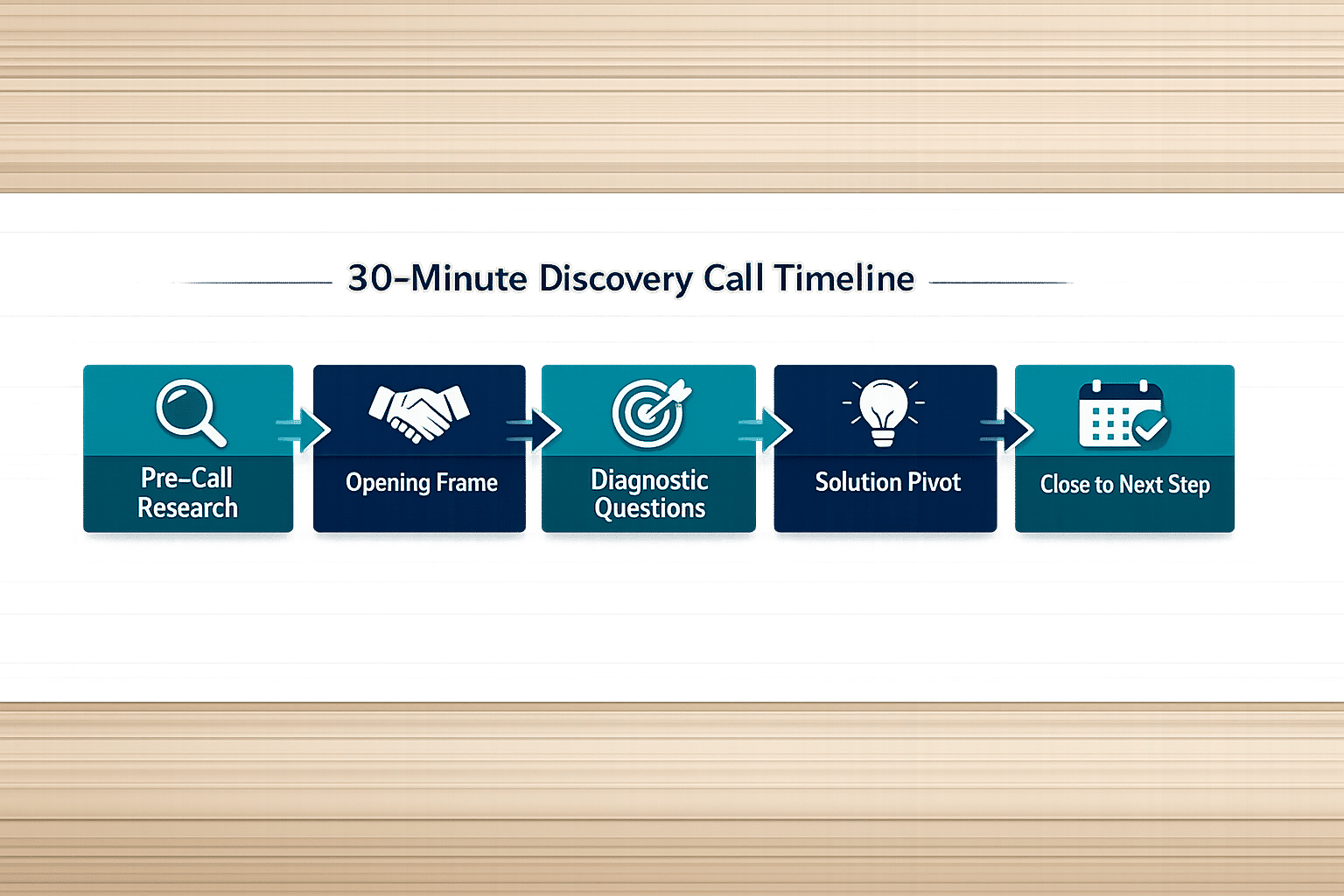
Phase 1: Pre-Call Prep (10 Minutes That Change Everything)
The discovery call starts before the call starts. Top reps invest 15-30 minutes in pre-call research — but most AI consultants wing it. You need a focused 10-minute prep that answers three questions:
1. What's their AI maturity? Check their job postings (hiring data engineers = infrastructure exists; hiring "AI strategy" = early stage). Look at their tech stack — do they use any automation or analytics tools already? Check LinkedIn for anyone with an AI or data title.
2. What's the likely pain? Identify their industry vertical. Look for operational bottlenecks common to that space. Review their website for clues — are they scaling? Launching new products? Dealing with regulatory change?
3. Who's on the call and can they actually buy? Map the attendee to a buying role: economic buyer (signs the check), champion (owns the problem), or evaluator (assesses technical fit). If it's only an evaluator with no budget authority, you need to adjust your strategy — this call qualifies whether to get the economic buyer on a second call.
For a fast pre-call qualifying system that lets you filter out low-fit prospects before they ever reach your calendar, the BANT+Data lead qualification framework covers exactly how to score leads in under 10 minutes.
Tools like ConsultKit let you pre-qualify and score prospects before they ever reach your calendar. By the time you sit down, you already know their AI readiness level, estimated budget range, and core pain points — so you're not spending the first 10 minutes of your call asking basic qualifying questions. The call gets sharper and shorter.
Phase 2: The Opening Frame (Minutes 0-3)
The first three minutes set the entire dynamic. Most consultants open with small talk and then say some version of "So, tell me what you're looking for." This hands control to the prospect and turns you into an order-taker.
Instead, set the agenda and the rules of engagement:
"Here's what I'd like to do in the next 25 minutes. I'll ask you some questions about what's going on in your business, what you've tried, and what success looks like. Then I'll be honest about whether I think we can help. If it's a fit, we'll talk about next steps. If it's not, I'll tell you that too. Sound fair?"
This does three things:
- Establishes you as the one running the call — not the prospect
- Creates psychological safety — they know you'll be honest, not pushy
- Sets a time boundary — no one's worried this will drag on
You've also subtly framed the call as your qualification of them — not a pitch. That power dynamic matters enormously.
Phase 3: Diagnostic Questions (Minutes 3-18)
This is the engine of the call. You're not asking generic BANT questions. You're running a targeted diagnostic that surfaces AI readiness, budget signals, decision-making structure, and pain urgency — all without tipping your hand on the solution.
Here are the exact questions, organized by what they reveal:
| Question | What It Reveals |
|---|---|
| "What triggered this conversation now — why AI, why today?" | Urgency and buying trigger. If there's no trigger, there's often no deal. |
| "Walk me through the process that's causing the most pain right now. Who touches it, and how long does it take?" | Operational pain + quantifiable waste. This is where you'll anchor ROI later. |
| "Have you tried to solve this before — with AI or anything else? What happened?" | Past failures, internal resistance, and realistic expectations. Also reveals if they're comparison shopping. |
| "Is there someone on your team who owns the data for this workflow? How clean is it?" | Data readiness — the #1 blocker for AI projects. If the answer is vague, they're not ready. |
| "If we could solve this, what would that be worth to you annually — in time, revenue, or cost savings?" | Budget signal + value anchor. Forces the prospect to quantify pain in dollars. |
| "Who else would need to sign off on this, and what does that process typically look like?" | Decision-making structure. Reveals if you're talking to the right person. |
| "Do you have a budget earmarked for this, or would this need to be approved separately?" | Direct budget qualification. No ambiguity. |
| "What would need to be true for you to move forward in the next 30 days?" | Timeline urgency + hidden objections. Surfaces blockers before they stall the deal. |
AI consulting discovery call diagnostic questions — each one surfaces a specific qualification signal
Gong.io's analysis of millions of sales calls found that 11-14 questions is the optimal range for discovery. Fewer than 7 and you don't qualify deeply enough. More than 14 and you risk interrogation fatigue. The 8 questions above form your core — add 3-6 follow-up probes based on their answers to stay in the sweet spot.
Follow-Up Probes That Go Deeper
The questions above open doors. These follow-ups walk through them:
- When they describe a pain: "What does that cost you when it goes wrong? Have you calculated the annual impact?"
- When they mention a failed AI attempt: "What specifically didn't work — was it the tech, the data, or the adoption?"
- When they're vague on budget: "Typically, projects like this run between $X and $Y. Does that range feel realistic for your situation?" (Anchoring with a range forces a reaction.)
- When they mention other stakeholders: "Would it make sense to get [name] on a follow-up call so we're all aligned before I put time into a proposal?"
Notice what you're not doing: explaining how AI works, pitching your methodology, or whiteboarding architecture. You're diagnosing, not prescribing. The prescription comes after they've committed to a paid engagement.
If you want to go deeper on how to handle the objections that surface during these conversations, read our breakdown of the 5 AI sales objections you'll hear every week.
Phase 4: The Solution Pivot (Minutes 18-23)
You've diagnosed the situation. Now comes the moment most AI consultants botch — the pivot from questions to positioning.
The wrong move: Launch into a detailed explanation of your solution, methodology, or tech stack. This is where education mode kicks in and deals go to die.
The right move: Reflect back what you heard, validate the problem, and bridge to a next step — without revealing the how.
Here's the script:
"Based on what you've told me, here's what I'm hearing: [restate their pain in their own words]. You've got [X process] that's costing you roughly [Y in time/money], and you need it solved by [timeframe]. We've done this for [similar company/industry] and the results were [one specific metric]. I think there's a strong fit here — but I'd need to do a deeper assessment to scope this properly. Here's what I'd recommend as a next step."
That last sentence is critical. You're not giving them the roadmap. You're confirming the problem is solvable, sharing one proof point, and moving toward a paid or committed next step.
The case study reference does heavy lifting here. If you don't have a strong one yet, read how to build an AI consulting case study that wins clients — it's one of the highest-leverage assets in your sales toolkit.
Phase 5: Closing to the Next Step (Minutes 23-28)
You're not closing the deal on this call. You're closing to the next committed action — and that action should have skin in the game.
Strong next steps for AI consulting discovery calls:
| Next Step | When to Use It | Why It Works |
|---|---|---|
| Paid AI Readiness Assessment ($1,500-$5,000) | Prospect has clear pain + budget authority + urgency | Converts the prospect into a paying client immediately. Eliminates free consulting entirely. |
| Scoping Call with Decision-Maker | You're talking to a champion, not the buyer | Gets the economic buyer involved before you invest in a proposal. |
| Proposal with Defined Timeline | Strong fit, clear scope, confirmed budget range | Locks in momentum. Always attach a deadline: "I'll have this to you by Thursday — can we review it together Friday?" |
| Disqualify and Refer Out | No budget, no urgency, no data readiness | Saves your time. Builds goodwill. They may come back when they're ready. |
Matching the right next step to the qualification signals you surfaced
The key: never end a discovery call with "I'll send over some information." That's a dead deal walking. Every call ends with either a specific, calendar-committed next step or an honest disqualification.
If you offer tiered AI service packages, this is the moment to reference them: "Based on what we discussed, you'd likely fall into our [mid-tier package]. I'll put together a proposal scoped to that. Can we block 30 minutes on Thursday to walk through it?"
That's how you close to the next step without giving away the farm.
The key: never end a discovery call with "I'll send over some information." That's a dead deal walking. Every call ends with either a specific, calendar-committed next step or an honest disqualification.
If you offer tiered AI service packages, this is the moment to reference them: "Based on what we discussed, you'd likely fall into our [mid-tier package]. I'll put together a proposal scoped to that. Can we block 30 minutes on Thursday to walk through it?"
That's how you close to the next step without giving away the farm. When you're ready to turn that next step into a signed engagement, the AI consulting proposal structure that wins deals gives you the exact framework for converting a post-discovery conversation into a closed contract.
The Quick-Reference Framework
Pin this somewhere you can see it before your next call:
Pre-Call Prep (10 min before)
Opening Frame (Minutes 0-3)
Diagnostic Questions (Minutes 3-18)
Solution Pivot (Minutes 18-23)
Close to Next Step (Minutes 23-28)
What Changes After You Adopt This Framework
Consultants who shift from education-mode to qualification-mode on discovery calls typically see three things change fast:
- Shorter sales cycles. Structured discovery frameworks close deals 33% faster because you're identifying — and removing — blockers in the first conversation instead of the third.
- Higher average deal size. When you quantify the prospect's pain in dollars during the call ("so this is costing you roughly $200K/year in manual processing"), the investment in your services feels proportional — not arbitrary. Teams with a well-defined ICP close deals 45% larger on average.
- Fewer wasted hours. You stop spending time on prospects who were never going to buy. That reclaimed capacity goes toward the 20% of prospects who represent 80% of your revenue.
The discovery call isn't a checkbox on the way to a proposal. It's the most leveraged 28 minutes in your entire AI consulting sales process. Get it right, and everything downstream — from scoping the project to closing the contract — gets easier.
Get it wrong, and you're just the smartest person nobody hires.
