

Here's the uncomfortable truth about being an AI implementation consultant: most of us are doing too much work for too little money — and the client still doesn't understand what they bought.
You spend 40 hours on a strategy document. The client skims it, nods politely, and asks, "So... what do we do first?" Sound familiar?
The problem isn't your expertise. It's your deliverable. Specifically, it's the gap between what you know and what you hand over. According to MIT's 2025 research, 95% of generative AI pilots fail to deliver measurable returns — and the root cause isn't bad technology. It's bad scoping, unclear ownership, and roadmaps that read like technical wish lists instead of execution plans.
If you want to command $15K–$40K for an AI implementation roadmap instead of giving away your best thinking for free during discovery calls, you need to understand what separates a deliverable clients pay for from a strategy dump they forget about.
This post breaks down the exact structure, with real phases, realistic timelines, and the presentation strategy that builds confidence instead of creating new objections.
42% of companies are now scrapping AI initiatives before they reach production — up from just 17% in 2024 (S&P Global, 2025). Your clients are increasingly gun-shy. The roadmap you deliver isn't just a plan — it's their proof that this time will be different.
What a Real AI Implementation Roadmap Includes
Forget the 80-page strategy decks that nobody reads. The AI implementation roadmap that commands premium fees has five elements, and none of them are optional:
- Phased execution plan with specific timelines (not "Q3" — actual weeks)
- Named owners for every phase and deliverable
- Business outcomes tied to each gate (not technical milestones)
- Dependencies and blockers mapped before they become surprises
- Success metrics that a CFO can understand in 30 seconds
The key word is execution. A roadmap that only describes what AI could do is a strategy deck. A roadmap that specifies who does what, by when, and how you'll know it worked — that's the deliverable clients write checks for.
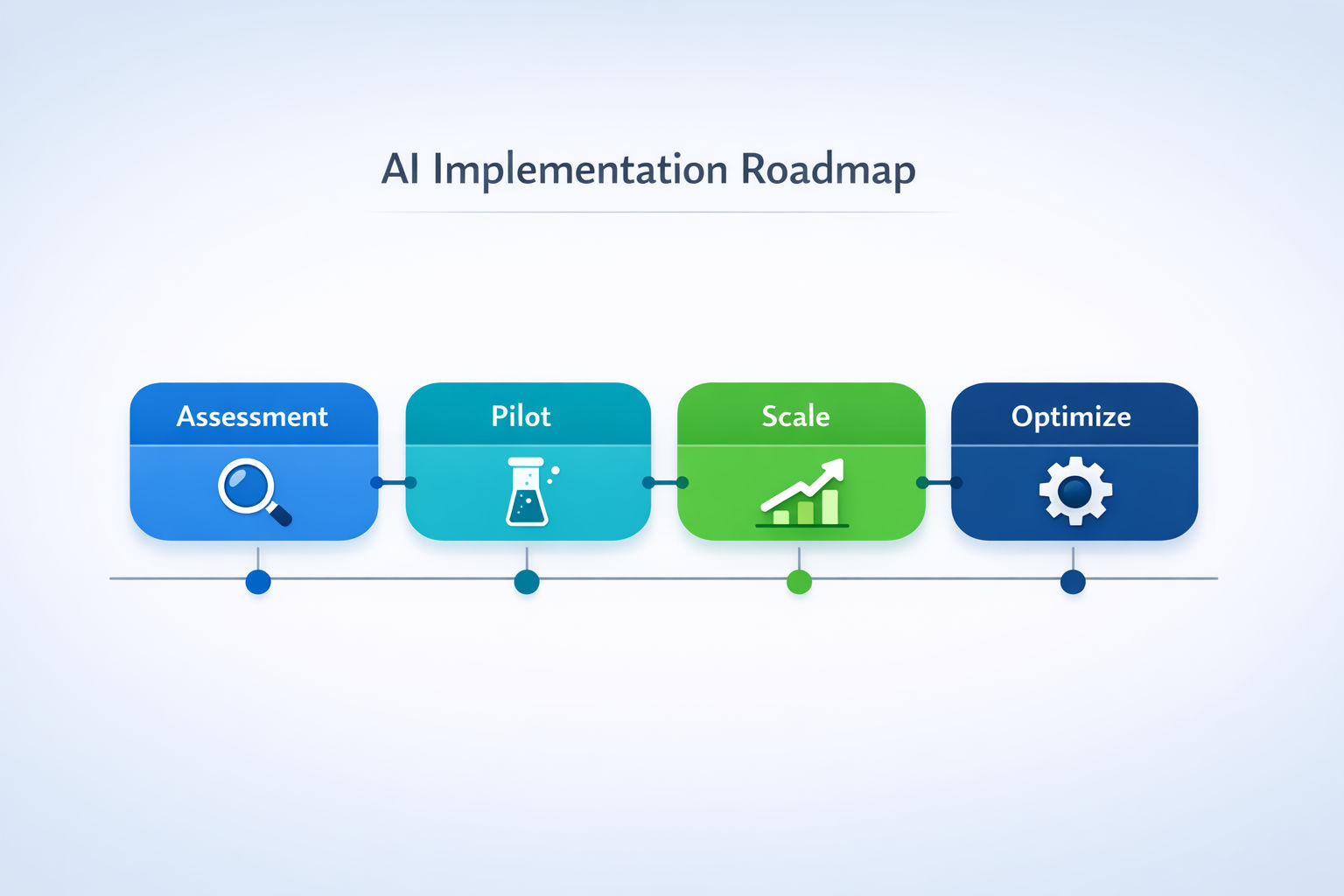
Let's look at what this actually looks like in practice. Here's a realistic ai project plan for a mid-market company automating their accounts receivable process with AI:
Phase 0: Assessment & Scoping
Phase 1: Focused Pilot
Phase 2: Validation & Expansion
Phase 3: Scale & Optimize
Notice what's in this roadmap that's missing from most: named owners at every phase, specific week ranges (not vague quarters), and business outcomes (reduction in manual review time) rather than technical milestones ("model deployed").
This is the structure that makes an ai strategy consulting engagement feel concrete. The client can see exactly what happens, who's responsible, and what "success" means before they spend a dollar on implementation.
Also notice Phase 0. We'll come back to that — it's the most important phase for your business model. And it only works if you've already run a proper AI readiness assessment before the roadmap conversation starts. Without a scored baseline of the client's data maturity and infrastructure, Phase 0 is just guesswork.
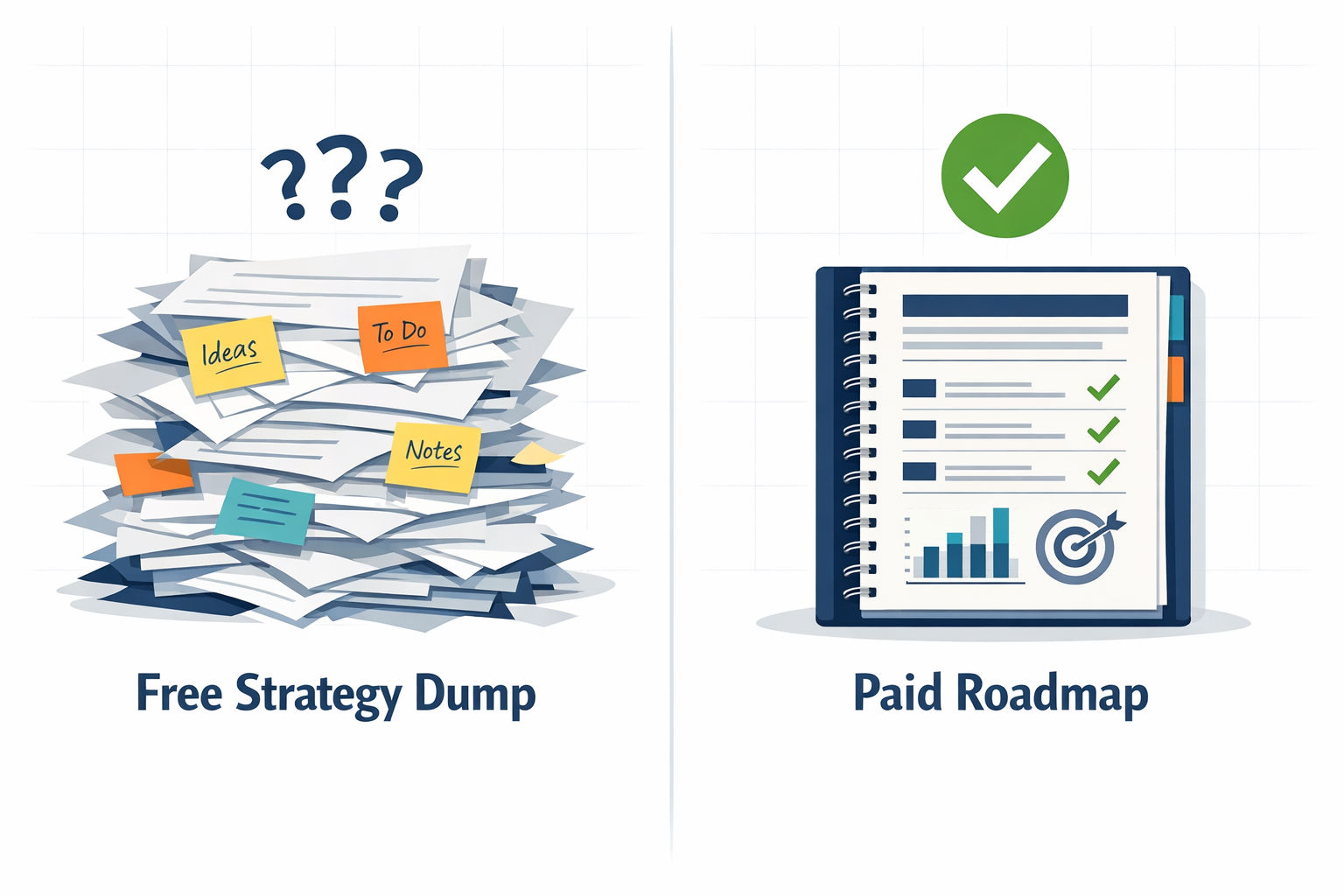
The Line Between a Free Strategy Dump and a $15K Deliverable
Every AI consultant has done this: you hop on a discovery call, the prospect describes their problem, and you start solving it in real time. You outline three use cases, sketch a rough plan, maybe even suggest tools. The call ends with "this was really helpful, let us think about it" — and you never hear from them again.
You just gave away a roadmap for free. The problem isn't generosity — it's structure.
Here's the distinction that matters:
The paid roadmap isn't longer or more complex. It's more specific. It assigns names to responsibilities, numbers to outcomes, and dates to milestones. That specificity is what clients pay for — because it's the difference between hope and a plan.
As one practitioner framework puts it: "Always price discovery separately. It is valuable work regardless of whether implementation proceeds. This phase protects you from underquoting complex projects and gives clients confidence before committing to larger budgets."
If you're struggling to draw this line in your own engagements, start with how to package your AI services into tiers — the structure of your offering determines whether you give away strategy or sell it.
Scope Phase 1 Tight — Or Pay for It Later
Here's where most AI implementation consultants get burned: Phase 1 is too ambitious.
You scope a pilot that touches three departments, requires data from two legacy systems, and needs sign-off from a steering committee that meets monthly. By week 6, you're behind schedule, the client is losing confidence, and you're doing unpaid work to catch up.
The fix is brutal simplicity. Your Phase 1 should:
- Target a single use case in a single department
- Use data that already exists and is already accessible
- Have one owner on the client side with authority to make decisions
- Deliver a measurable result within 4–6 weeks (not a proof of concept — an actual outcome)
- Cost 15–25% of the total projected engagement (industry standard: $8K–$25K)
The goal of Phase 1 isn't to transform the business. It's to prove two things: that AI works in their environment, and that you can deliver. Everything else flows from that.
Data preparation alone consumes 40–60% of implementation time and budget. If your Phase 1 requires a major data cleanup effort, you've scoped it wrong. Pick the use case where the data is already clean enough to move.
For the full framework on defining scope, timelines, exclusions, and change order triggers before a single line of work begins, see how to scope an AI consulting project so you don't get burned on delivery.
If you can't describe your Phase 1 in one sentence — including the use case, the metric, and the timeline — it's too broad. Example: "Automate invoice matching for top 50 accounts, targeting 30% reduction in manual review time, delivered in 4 weeks." If your Phase 1 description requires a paragraph, tighten the scope.
The 5 Roadmap Mistakes That Kill Your Credibility
After reviewing how the best AI consulting deliverables are structured, there are clear patterns in what separates roadmaps that close deals from ones that collect dust. Here are the five mistakes that consultants make most often:
Too technical, not enough business language
No named owner for any deliverable
Trying to boil the ocean in the pilot
No success metrics defined before execution
No kill criteria or fallback plan
Every one of these mistakes makes your roadmap look like a technical wishlist rather than an execution plan. And technical wishlists don't get funded.
For a deeper breakdown of what belongs in each deliverable tier, see what to actually include in an AI consulting deliverable.
How to Present the Roadmap Without Creating New Objections
You've built a solid AI implementation roadmap. Now you need to present it without the client spiraling into "what if" paralysis. Here's the presentation framework that builds confidence:
Start with their words, not yours. Open by restating the business problem in the language the client used during discovery. "You told us your AR team spends 22 hours per week on manual invoice matching. Here's how we eliminate 70% of that." This isn't a slide — it's proof that you listened.
Present Phase 1 as a low-risk bet. Frame the first phase as a contained experiment with defined exit criteria. "If we don't hit our targets by week 8, you've invested $15K and you have a clear answer. If we do hit them, here's exactly what Phase 2 looks like." This eliminates the fear of a runaway project.
Show the math, not the tech. For every phase, lead with the financial impact. "Phase 1 targets $4,200/month in labor savings against a $15K investment — that's a 3.6-month payback." CFOs don't care about your model architecture. They care about the IRR.
Name the risks before they do. The biggest confidence-killer is when a client raises an objection you didn't anticipate. Pre-empt the top three concerns — data quality, adoption, and timeline slippage — and show how your roadmap addresses each one. For handling the objections that come up even after a strong presentation, keep this objection-handling playbook in your back pocket.
End with the decision, not the deck. Don't close with "any questions?" Close with "Phase 1 starts on [date]. Here's what we need from your team by [date] to hit that timeline." Confidence is a byproduct of specificity.
Client confidence = (Specificity of the plan) × (Evidence you've done this before) ÷ (Perceived risk of Phase 1). Maximize the first two. Minimize the third. Every element of your presentation should move at least one of these variables.
Client confidence = (Specificity of the plan) × (Evidence you've done this before) ÷ (Perceived risk of Phase 1). Maximize the first two. Minimize the third. Every element of your presentation should move at least one of these variables. For building that evidence base efficiently, your AI consulting case studies are your most powerful tool — a well-structured case study that mirrors the prospect's situation does more for your credibility than any methodology slide.
The Fastest Way to Build a Roadmap That's Actually Accurate
Here's the hidden bottleneck for every AI implementation consultant: the roadmap is only as good as your inputs. And most consultants are building roadmaps based on a single discovery call and a gut feeling about the client's readiness.
That's why the best consultants front-load the data gathering. Before the roadmap conversation even starts, they already have:
- An AI readiness score that quantifies the client's data maturity, organizational readiness, and technical infrastructure
- A buyer profile that maps the client's industry, decision-making structure, budget range, and urgency level
- Prioritized use cases scored by business impact, data availability, and implementation complexity
With these inputs, building the roadmap goes from a 40-hour research project to a 10-hour assembly job. You're not starting from scratch — you're populating a proven framework with client-specific data.
Once your roadmap is approved and the engagement kicks off, the real test begins: the first 30 days. How you manage onboarding, secure data access, and set outcome expectations in that window determines whether the roadmap stays on track — or gets thrown out by week four. The AI consulting onboarding checklist covers exactly how to protect your roadmap in execution.
This is exactly what ConsultKit is built for. The platform generates AI readiness assessments and buyer profiles before your first strategy call, so when you sit down to build the roadmap, you're working from real data — not assumptions. The result is a roadmap that's faster to produce, more accurate, and harder for the client to poke holes in.
Because the roadmap that wins isn't the longest one. It's the most informed one. And once that roadmap is delivered and implementation begins, the natural next step is transitioning the client to a retainer — clients who can see their roadmap progressing phase-by-phase are the easiest retainer conversions you'll make.
