
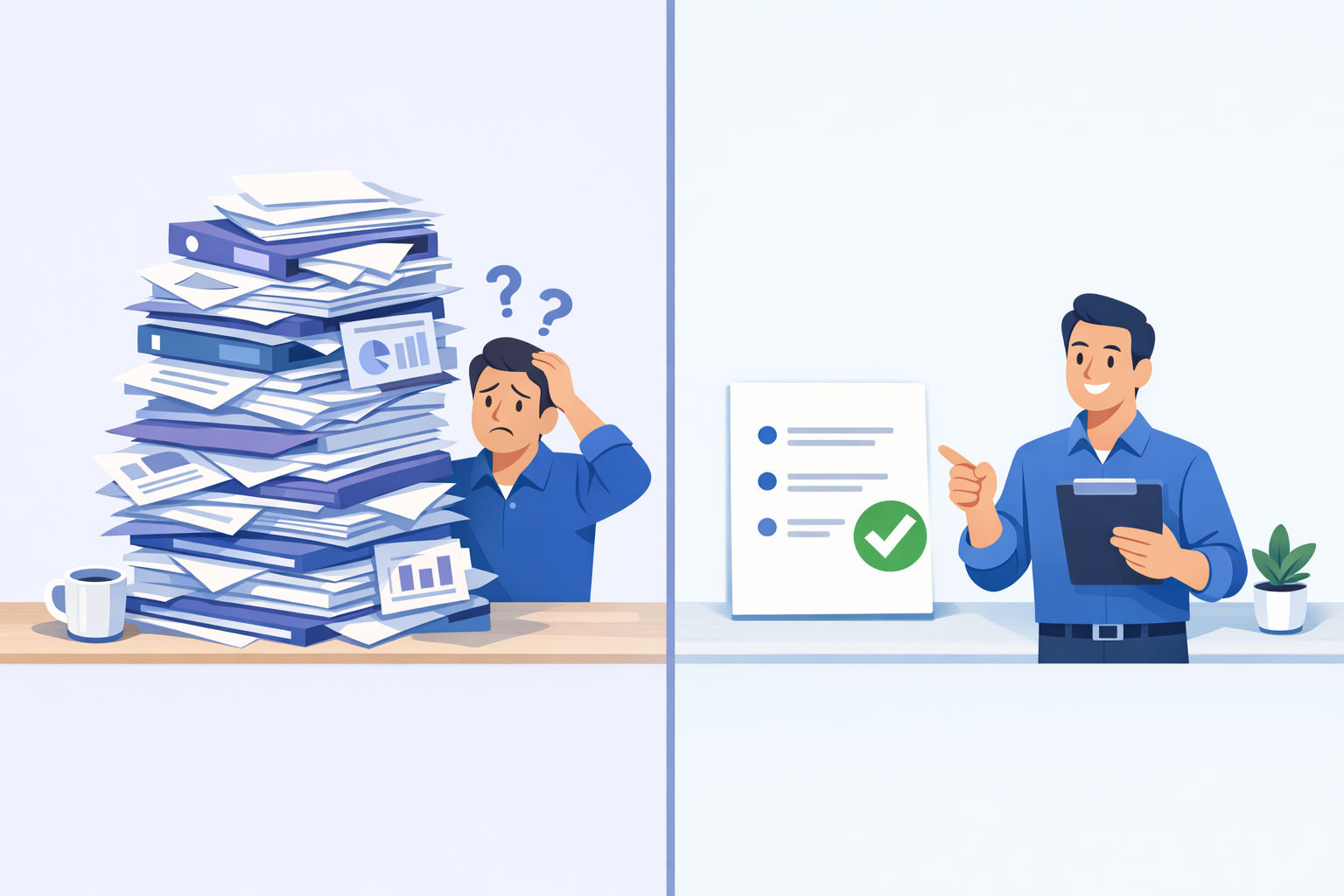
Your client said they wanted "an AI strategy." So you delivered one — 62 slides, a maturity model, competitive benchmarks, three scenario analyses, and an appendix nobody will ever open.
The deck looked impressive. The client said "thank you." And then nothing happened.
This is the most common failure mode in AI consulting deliverables, and it kills more engagements than bad scoping or wrong pricing ever will. Not because the work was bad — but because the deliverable didn't bridge the gap between knowing AI matters and knowing what to do Monday morning.
The data backs this up. According to S&P Global (2025), 42% of companies scrapped most of their AI initiatives last year — up from 17% the year before. BCG found that 74% of companies struggle to achieve and scale AI value. These aren't technology failures. They're implementation failures. And a significant chunk of them start with a deliverable that told the client what but not how.
Delivering the right artifacts is only half the equation. You also need to know how to prove AI ROI to a client before the results fully materialize — and how to build the case study that turns those results into your next deal.
If you're an AI consultant figuring out what to actually hand over at the end of an engagement, this is the piece that'll save you from building either a doorstop or a napkin sketch.
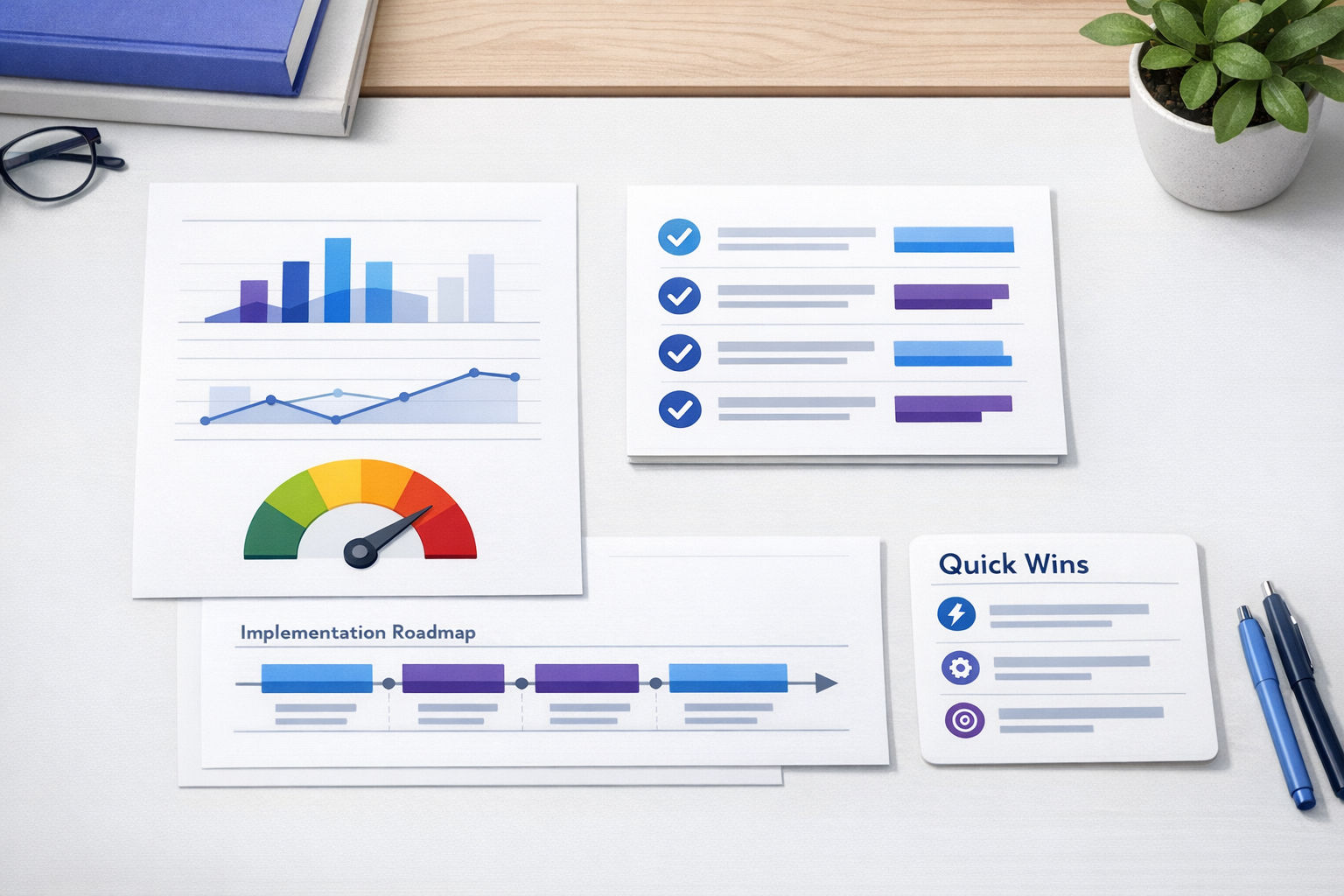
The 4 AI Consulting Deliverables That Actually Move Clients to Action
After researching how top-performing consultants structure their engagements — and studying what makes the difference between a project that ends with a polite email and one that generates a referral within 30 days — the pattern is clear. Four deliverables consistently bridge the strategy-to-implementation gap.
These aren't add-ons. They're the core of what makes your AI consulting project delivery worth paying for.
1. AI Readiness Score
Clients don't need to be told AI is important. They need to know where they actually stand. A scored assessment across 5 dimensions — data infrastructure, technology stack, team capabilities, process maturity, and organizational culture — gives them something concrete to react to.
Hyperion Consulting's 2026 benchmark across 200+ European enterprises found the average AI readiness score is just 42 out of 100. Organizations with a clearly defined AI strategy scored 2.3x higher overall. That's the kind of data point you should be delivering in context, not in a footnote.
The readiness score becomes the anchor for every subsequent conversation. It tells your client: here's why we're recommending these specific things and not others.
2. Prioritized Use Case List
Every client has a dozen possible AI use cases. Most consultants list them all and let the client decide. That's not consulting — that's a menu.
The deliverable that earns trust is a ranked list of 5–8 use cases scored on three dimensions: business impact, technical feasibility, and implementation effort. The ranking should be defensible — backed by the data from your discovery interviews and readiness assessment, not by which use case sounds most exciting.
Cabin Consulting recommends including 90-day feasibility flags on each use case — which ones can ship a working pilot in the first quarter. This is what separates a useful recommendation from an academic exercise.
3. Implementation Roadmap
A roadmap without timelines, owners, and dependencies is a wish list. Yours should be a 12-month phased plan that answers: What happens first? Who's responsible? What needs to be true before we move to phase two?
Practitioners who structure engagements around a 5-phase model (discovery → diagnosis → design → delivery → handoff) consistently report higher implementation rates because each phase produces a tangible artifact the client can validate before moving forward.
Include milestones, resource requirements, and go/no-go decision points. The roadmap should be something a client's internal team can execute against — even without you in the room.
4. Quick-Win Action Plan
This is the deliverable most consultants skip, and it's the one that generates the most immediate client trust. Identify 2–3 things the client can implement in the first 2 weeks with minimal technical lift.
Maybe it's deploying a customer service summarization tool using their existing CRM data. Maybe it's automating a weekly report that currently takes someone 4 hours. The point isn't that these are transformative — it's that they're visible. They create internal momentum and give your champion something to show their leadership before the big-ticket items land.
If you want to understand how this fits into the broader engagement lifecycle, our guide on the first 30 days of an AI consulting engagement walks through the week-by-week cadence.
New consultants consistently confuse thoroughness with value. An 80-page deck signals that you're billing for time, not outcomes. Clients don't refer the consultant who gave them the most pages — they refer the one who made the path forward obvious. If your deliverable can't be summarized in a 15-minute executive briefing, it's too long.
What to Include in Your AI Audit Report (Specific Sections, Not Generic Headers)
The four deliverables above are the what. Now let's talk about the how — specifically, what an AI consulting report template should actually contain. Here's the section-by-section breakdown that works:
Executive Summary (1 page max): The readiness score, the top 3 opportunities, the estimated timeline, and the single biggest risk. Write this for the person who'll never read the rest of the document.
Current State Assessment: Map existing tools, data flows, and processes. Include what's working, not just what's broken. Cisco's framework research found that 73% of companies face data integration issues between sources, tools, and platforms — surface these specific gaps.
Readiness Score Breakdown: Score each dimension (data, tech, people, process, culture) individually with evidence. Don't just say "data maturity is low" — say "customer data lives in 4 disconnected systems with no shared identifier, which blocks any cross-functional AI use case."
Prioritized Use Case Matrix: Your ranked list with scoring rationale. Include a simple 2x2 (impact vs. effort) visualization so leadership can see the trade-offs at a glance.
Quick Wins (First 30 Days): Specific, named actions with owners and expected outcomes. "Implement email triage classification for support team using existing Zendesk data — estimated 6 hours/week saved."
Implementation Roadmap (12 Months): Phased timeline with dependencies, budget ranges, and success metrics per phase.
Risk Register: What could go wrong, what it would cost, and what mitigation looks like. Clients don't expect you to eliminate risk — they expect you to have thought about it.
Governance Recommendations: Even for SMB clients, a lightweight data governance section shows you're thinking beyond the pilot. With the EU AI Act now in enforcement and US regulatory attention increasing, this section has gone from optional to expected. Our post on selling AI governance to SMB clients covers how to frame this without overwhelming smaller organizations.
What Clients Ask For vs. What Makes Them Refer You
Here's the uncomfortable truth about AI consulting project delivery: the deliverable your client requests and the deliverable that earns you a referral are usually different things.
Clients ask for a strategy — a document that validates their intuition that AI matters and gives them political cover to invest. That's reasonable. But the consultants who build referral engines don't just deliver strategy. They deliver clarity.
91% of B2B buyers are influenced by word-of-mouth when making purchasing decisions (McKinsey). And 61% of IT buyers say colleague recommendations are their top factor. What triggers those recommendations isn't a beautiful deck — it's a client telling a peer: "They didn't just tell us what to do. They made it so clear that we actually did it."
The difference comes down to three things:
The pattern is simple: clients ask for information. What earns referrals is action clarity. Every section of your deliverable should pass one test: does this help someone make a decision or take a step? If it's background context that doesn't inform a specific recommendation, cut it.
If you're building out a systematic referral process, our referral engine guide covers the operational side — how to time the ask, what to say, and how to make it easy for clients to introduce you.
Format Guidance: What Should Be a PDF, a Live Doc, and a Dashboard
Format matters more than most consultants realize. The wrong format turns a great deliverable into something that gets filed and forgotten. Here's the breakdown:
| Deliverable | Best Format | Why |
|---|---|---|
| Executive Summary + Readiness Score | **PDF** | Gets forwarded to stakeholders who weren't in the room. Needs to look polished, stand alone, and not require login access. |
| Prioritized Use Case Matrix | **Live spreadsheet** (Google Sheets / Airtable) | Clients will want to re-sort, filter by department, and add internal notes. Static PDFs kill collaboration. |
| Implementation Roadmap | **Live doc** (Notion, Google Docs) with PDF export | Needs to be updated as phases complete. The live version is the working tool; the PDF export is for board updates. |
| Quick-Win Action Plan | **Single-page PDF or Slack/email-ready summary** | This needs to be frictionless to share. If the champion can't paste it into a message to their team, it won't get acted on. |
| Risk Register + Governance | **Appendix in the main PDF** | Important for the record. Rarely referenced after initial review — but critical when something goes sideways. |
| Ongoing Metrics / KPIs | **Dashboard** (Tableau, Power BI, or simple Notion) | Only relevant for implementation-phase engagements. Real-time visibility keeps the client engaged and justifies retainer pricing. |
Match your deliverable format to how clients actually use each artifact.
For every major deliverable, provide two formats: the working version (live, editable, collaborative) and the presentation version (polished PDF for leadership and board meetings). This takes 15 minutes of extra formatting and dramatically increases how often your work gets referenced.
How to Package AI Consulting Deliverables Into Tiers
Not every client needs — or can afford — the full deliverable stack. Tiered packaging lets you serve different budget levels while creating a natural upgrade path. If you've already read our guide on how to write an AI consulting proposal that wins, this is the deliverable-side complement to that pricing structure.
| Tier | What's Included | Typical Price Range | Best For |
|---|---|---|---|
| **Discovery** | AI Readiness Score, Current State Assessment, Quick-Win Action Plan (2–3 recommendations) | $5K – $15K | Clients who aren't sure if AI is right for them yet. Also works as a paid audit that leads to a strategy engagement. |
| **Strategy** | Everything in Discovery + Prioritized Use Case Matrix, 12-Month Implementation Roadmap, Risk Register, Governance Recommendations | $15K – $50K | Clients ready to commit but need internal alignment. This is the most common engagement tier. |
| **Full Implementation** | Everything in Strategy + Hands-on build of first 1–2 use cases, Vendor selection/integration, Change management support, Dashboard with KPI tracking | $50K – $150K+ | Clients who want end-to-end delivery. Often transitions into a retainer. |
The three-tier model gives clients options while creating a natural path from discovery to implementation.
The Discovery tier is strategically important. It's low-risk for the client, gives you a paid way to qualify and diagnose the opportunity, and creates the natural on-ramp to the Strategy tier. 73% of clients prefer outcome-tied pricing, so frame each tier around what the client gets — not what you do.
For how to scope these tiers without getting burned on delivery, that guide covers the exclusions, change order triggers, and margin protection you need.
Stop Formatting. Start Strategizing.
The biggest time sink in building these deliverables isn't the thinking — it's the assembly. Scoring readiness dimensions, building buyer profiles, formatting the assessment into something presentable. It's hours of work that doesn't require your expertise.
This is where ConsultKit fits. It generates the AI readiness scoring and buyer profile components automatically — pulling from your discovery inputs to produce scored, formatted outputs you can drop straight into your deliverable. You spend your time on the strategic layer — the use case prioritization, the roadmap sequencing, the governance framing — while the structured components get built for you.
It won't write your strategy. That's your job. But it eliminates the formatting and scoring busywork that keeps most consultants stuck in production mode when they should be in advisory mode.
Before you send any AI consulting deliverable, ask yourself three questions:
- Can the client's champion summarize it to their CEO in 2 minutes? If not, your executive summary needs work.
- Does it name specific next steps with owners and timelines? If the answer is "they'll figure it out," you haven't finished the job.
- Would the client forward this to a peer who asks "know anyone who does AI consulting"? If the deliverable isn't impressive enough to share, it's not good enough to deliver.
