

Here's the real reason you're losing AI consulting deals: your prospects don't know what they're buying.
You hop on a discovery call. They're interested. You talk about what you could do. Then you send a proposal that reads like a choose-your-own-adventure novel — custom scope, vague deliverables, a number at the bottom that feels arbitrary. And they go quiet.
This isn't a pricing problem. It's a packaging problem. And learning how to package AI services into clear, compelling tiers is what separates consultants who close at 20% from those closing at 50%+.
The data backs this up: 69% of consultants have proposal win rates under 60%, and 90% of consulting firms deliver messaging so generic that prospects can't tell them apart. Meanwhile, tiered proposals drive up to 98% higher revenue than single-price offers and boost close rates by 35–40%.
The fix isn't writing better proposals. It's building AI consulting packages that let prospects see exactly what they're getting — and choose the option that fits.
Why Vague Proposals Kill AI Deals (And Tiers Fix This)
When a prospect gets a single-option proposal, they're making a binary decision: yes or no. The burden is on you to convince them that your price is right, your scope is adequate, and the risk is worth it. Every doubt they have becomes a reason to say no.
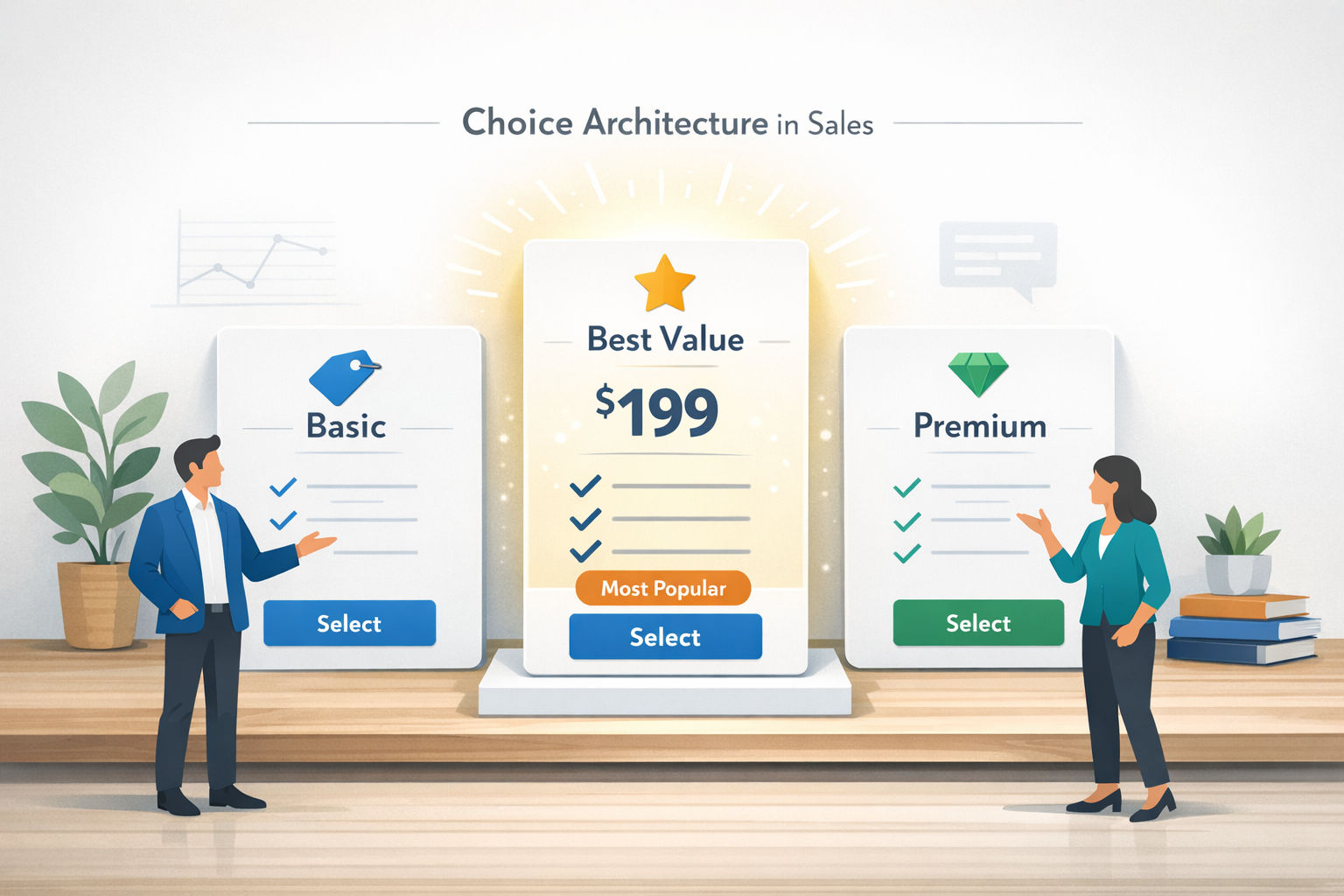
Tiered AI service packages flip this entirely. Instead of yes/no, prospects are choosing which one. That's a fundamentally different psychological dynamic.
This is the compromise effect — a well-documented cognitive bias where people presented with three options gravitate toward the middle. Research from Frontiers in Psychology confirms that anchoring to a high-end option makes the mid-tier feel like the smart, balanced choice. Your premium tier does the selling for your core offer.
But there's a second, more practical benefit specific to AI consulting: tiers match the messy reality of how businesses buy AI.
Some prospects are ready to implement. Others barely know what AI can do for their business. And some are stuck in analysis paralysis with a mandate from leadership to "do something with AI." A single proposal forces you to guess where they are. Three tiers let them self-select.
This is where knowing your prospect's readiness before the call matters enormously — but more on that later.
When you send a single-option proposal, there's a 50% structural bias toward "no" — the prospect only needs one reason to decline. When you present three tiers, the mental frame shifts to comparison shopping between your options, not deciding whether to hire you at all.
The 3-Tier Framework for AI Consulting Packages
Forget generic Bronze/Silver/Gold. Here's a framework built specifically for how AI consulting engagements actually work: Insight → Blueprint → Build.
Each tier maps to a natural stage of AI adoption — and each one is a standalone deliverable that provides real value, not just a stepping stone to upsell.
| Tier 1: Insight (AI Audit) | Tier 2: Blueprint (Strategy + Roadmap) | Tier 3: Build (Implementation) | |
|---|---|---|---|
| **What it is** | A diagnostic that tells the client exactly where they stand and where AI fits | A complete strategic plan with prioritised use cases, ROI projections, and a 90-day roadmap | Hands-on implementation of 1–3 AI workflows or systems, plus team training |
| **Price range** | $3,500 – $8,000 | $12,000 – $25,000 | $25,000 – $75,000+ |
| **Duration** | 1–2 weeks | 3–5 weeks | 6–12 weeks |
| **Core deliverables** | AI readiness scorecard, workflow audit (5–8 processes), opportunity matrix, executive summary | Prioritised use case catalog, vendor/tool recommendations, integration architecture, ROI models, 90-day implementation roadmap | Configured AI systems, API integrations, SOPs + documentation, team training (2–4 sessions), 30-day post-launch support |
| **Ideal client** | Curious but uncommitted. Needs proof that AI applies to them. | Bought in on AI but needs a clear plan before spending on implementation. | Ready to move. Budget approved. Wants results, not more strategy. |
| **Your time investment** | 8–15 hours | 30–50 hours | 80–150+ hours |
The Insight → Blueprint → Build framework for packaging AI consulting services into tiers
Why This Specific Structure Works
The magic of this framework is that each tier naturally feeds the next — but none of them require it.
A client who buys an Insight audit gets a deliverable they can use immediately, even if they never hire you again. But the audit creates the business case for the Blueprint. And the Blueprint creates the scope for the Build.
This is the gateway strategy that Consulting Success documents extensively: a $2,000–$5,000 diagnostic routinely leads to $20,000+ follow-on engagements because the client experiences your thinking before committing to a larger investment.
If you want to go deeper on what goes into each deliverable, we've broken that down in detail in our guide on what to actually include in an AI consulting deliverable.
For the pricing strategy that underpins your tiers — including how to run a value conversation and anchor fees to client outcomes rather than hours — see the step-by-step guide to value-based pricing for AI consultants.
How to Name Your Tiers (Without Sounding Like Every Other Consultant)
Naming matters more than most consultants realise. "Basic, Standard, Premium" signals commodity. "Starter, Growth, Enterprise" signals SaaS. Neither signals expertise.
The best AI consulting tier names do three things:
- Describe the outcome, not the effort
- Signal progression without implying the lower tiers are incomplete
- Sound like you — not like a pricing page template
Here's what works and what doesn't:
If you've chosen a vertical niche, make your tier names niche-specific. An AI consultant serving accounting firms might use: Scan → Map → Automate. A consultant serving agencies could use: Audit → Architect → Activate. Specificity signals that you've done this before — and that these packages were built for their industry.
What to Include vs. Exclude (This Is Where Your Margins Live)
The biggest pricing mistake in AI consulting isn't charging too little — it's including too much. Scope creep costs consultants 20–40% of project margin when boundaries aren't enforced. And in AI projects — where clients constantly discover new use cases mid-engagement — the risk is even higher.
Every tier needs two lists: what's included and what's explicitly not.
The "not included" section isn't negative. It's protective. Clients actually appreciate it because it shows you've scoped carefully and that there won't be surprise charges. More importantly, exclusions create natural upsell paths.
| Tier | Always Include | Always Exclude (Upsell or Add-On) |
|---|---|---|
| **Insight (Audit)** | AI readiness score, process audit (5–8 workflows), opportunity matrix, executive summary presentation, 1 live readout call | Implementation of any recommendations, custom tool evaluation, vendor negotiations, staff training, ongoing advisory |
| **Blueprint (Strategy)** | Prioritised use case catalog, integration architecture, ROI projections, 90-day roadmap, 2 revision rounds, tool/vendor shortlist | Building or configuring any tools, data migration, hiring support, change management program, ongoing retainer advisory |
| **Build (Implementation)** | Configuration of 1–3 AI systems, API integrations, documentation/SOPs, team training (2–4 sessions), 30-day post-launch support | Additional systems beyond agreed scope, ongoing maintenance, model retraining, expansion to new departments, 24/7 support |
What to include and explicitly exclude in each AI consulting service tier
The most dangerous scope creep in AI consulting sounds like this: "While you're in there, could you also look at [adjacent process]?" This is where your consulting contract and explicit exclusions save you. Every "quick addition" that isn't in the agreed scope gets a documented change order with a price attached — or it becomes part of the next tier.
How Tiers Change the Sales Conversation
This is where the real leverage lives. Tiered AI consulting packages don't just make your proposals cleaner — they fundamentally restructure the sales conversation.
Without tiers, a typical discovery call goes like this:
- Prospect describes their situation
- You listen, take notes, try to figure out the right scope
- You go away and write a custom proposal
- You send it and hope
- They ghost or come back with objections about scope/price
With tiers, the conversation becomes:
- Prospect describes their situation
- You map their needs to a tier: "Based on what you've shared, most clients in your position start with our Blueprint engagement. Some who are further along jump straight to Build. Let me walk you through what each includes."
- They ask clarifying questions about the options, not about whether to work with you
- The call ends with them choosing a tier, not waiting for a custom proposal
The psychology here is powerful. You've moved from selling to advising. You're the expert helping them pick the right option — not a vendor trying to justify a number.
Assess readiness before the conversation
Lead with the tier, not the price
Present all three tiers, anchor high
Let them self-select
Pricing Your Tiers: Real Numbers, Not Theory
Let's talk actual money. Based on current AI consulting market benchmarks and practitioner data, here's where solo consultants and small agencies should be pricing their AI consulting packages:
A few pricing principles to keep in mind:
- Price spacing matters. Maintain a 1.5×–2.5× multiplier between tiers. If Insight is $5,000, Blueprint should be $10,000–$12,500, and Build should be $20,000–$30,000. This makes the jumps feel proportional, not arbitrary.
- Your Insight tier should be priced high enough to signal expertise but low enough that a single decision-maker can approve it without a committee. The $3,500–$8,000 range hits this sweet spot for mid-market B2B.
- Don't compete on price at the Insight level. This tier isn't where you make most of your revenue. It's where you earn the right to propose the bigger engagement. Price it for margin, not volume.
- Value-based pricing kicks in at Build. At the implementation level, 73–74% of clients prefer to pay based on value delivered rather than hours worked. Frame your Build pricing around the ROI the client will achieve, not the hours you'll invest. For a deeper dive on pricing models — hourly vs. project vs. retainer — and which pays most over time, see AI consulting pricing models compared.
- Your most advanced engagements can use performance-based structures. If you're confident in the ROI you'll deliver, outcome-based pricing for AI services lets you earn a share of the measurable value you create — and often commands higher fees than fixed-rate tiers.
For a deeper dive on handling the inevitable price objections, check out our guide on the 5 AI sales objections you'll hear every week.
Build Your Tiers This Week
You don't need months to productize your AI consulting services. You need a focused afternoon and the discipline to actually publish your packages.
Here's your move:
- Pick your vertical. Tiers only work if the deliverables are repeatable. If you're serving everyone, you can't standardize anything. (Not sure how to pick? Start here.)
- Draft three tiers using the Insight → Blueprint → Build framework. List 4–6 deliverables per tier and 3–5 explicit exclusions.
- Name them using outcome-based language specific to your niche.
- Set your prices using the 1.5×–2.5× spacing rule and the ranges above as benchmarks.
- Test it on your next three discovery calls. Present all three tiers and track which one prospects choose and how the conversation feels different.
Once your tiers are ready, the next step is converting them into a proposal that wins. The AI consulting proposal structure that closes deals shows exactly how to frame three-tier pricing in a proposal that prospects sign — not stall on.
The AI consulting market is projected to hit $34 billion in 2026, but 42% of companies still abandon AI initiatives before production. The consultants who win aren't necessarily the most technical — they're the ones who make it easy for prospects to say yes. Clear tiers do exactly that.
Stop writing custom proposals for every lead. Start packaging your expertise into tiers that sell themselves.
