You've been in this room before. You crushed the technical presentation. The CTO nodded along. The VP of operations asked for your card.
Two weeks later: they went with Deloitte. Not because Deloitte had a better answer — because the CFO wanted the safe brand name and nobody got fired for hiring a Big Four firm.
Most independent consultants respond by lowering rates or trying to sound more like the big firms. Both are mistakes.
Here's what changes the conversation: boutique AI advisory firms outscore Big Four consultancies 4.28 to 2.78 on a 5-point scale across 10 weighted factors that predict AI transformation success. That's a 30% performance differential on speed to value, senior practitioner involvement, change management, and knowledge transfer — the exact dimensions clients now prioritize.
Boutiques are growing 38% faster than Big Four incumbents in AI consulting and have captured roughly 25% of the addressable market, per Kenmei's 2026 competitive benchmark. Independent consultants deliver engagements for $75,000 versus $272,000 from traditional firms — a 72% cost advantage. 68% of clients now rate industry-specific expertise as their top selection criterion, and 78% report higher satisfaction with boutiques than large firms.
This isn't motivational. It's structural. The question of how to build ai consulting firm that wins against larger competitors comes down to understanding four advantages that big firms physically cannot replicate.
The Four Structural Advantages
1. Speed: Compress Weeks Into Hours
Big consulting firms run on a partner-manager-analyst pyramid designed for 1990s ERP migrations. Every layer adds time. A junior analyst takes three days to research benchmarks that an AI-assisted solo consultant synthesizes in three hours.
AI tooling collapses the gap between hearing a problem and presenting a credible answer. Research shows AI compresses the research and first-draft phases by 40% to 50%. Consultants report cutting proposal time from six hours to 45 minutes, with AI handling 70–80% of the first draft.
When a VP needs AI results before the next board meeting, and the big firm says "discovery report in 12 weeks" while you say "scored readiness assessment and 90-day roadmap in two weeks" — you win. Not on price. On physics.
Justin McKelvey puts it directly: implementation boutiques "ship faster and cost 2–5x less than Big 4 firms for the same work." Forrester's 2024 report confirms boutique firms demonstrate 43% faster response times to changing client requirements.
2. Specialization: Be the Obvious Answer
A 500-person generalist firm sells AI strategy to banks, hospitals, manufacturers, and retailers using the same frameworks. The healthcare partner might have five years in pharma — or might have been reassigned from retail last quarter.
You don't have that problem. Vertical specialists command 30–50% pricing premiums and close deals 40–60% faster than horizontal competitors, per Zimt.ai. They spend 70–80% less on customer acquisition because referrals travel inside industry networks.
Instead of being an "AI consultant," you're the person who builds AI document review systems for mid-market litigation firms. Instead of "AI strategy," you sell patient intake automation for specialty practices with 5–20 providers. As we've covered in our guide to choosing an AI consulting niche, a defensible niche sits at the intersection of existing expertise, validated market demand, and direct access to decision-makers.
3. Embedded Delivery: Get Closer Than Any Big Firm Can
The big-firm pattern is predictable: partner sells, manager scopes, analysts you've never met run interviews. Six weeks later, a strategy deck arrives — thoughtful, well-formatted, and completely divorced from how anything actually works inside the organization.
Boutique firms stay embedded. You're in the client's Slack. You're in their weekly ops meetings. You catch the real problems — the legacy system nobody mentioned in discovery, the stakeholder quietly blocking automation — because you're close enough to see them.
Fast Company's 2026 analysis noted: "Clients are not handed off to junior teams after the pitch. Instead, they engage with seasoned professionals who bring decades of experience to every conversation." Bosio Digital's research found boutiques "solve the two structural problems that plague Big Four mid-market engagements: they stay through implementation, and they right-size the solution." As explored in our post-implementation check-in framework, the embedded relationship compounds into renewals and referrals.
4. Proof Over Credentials: Replace the Logo With Outcomes
Big firms sell brand. It's their oldest weapon. The Deloitte logo signals safety to a risk-averse CFO in ways your name cannot — until the buying criteria shifts.
Accenture CEO Julie Sweet said on the company's Q1 2026 earnings call: "Clients cannot simply experiment. They have to know that when they're investing with a partner, they're going to deliver results." When the question changes from "who has the biggest brand?" to "who can show me the most relevant outcome?" the big firm's structural advantage evaporates.
Your advantage becomes documented, specific results:
- Named outcomes in case studies. Not "helped a Fortune 500 company improve efficiency" but "reduced patient intake from 14 minutes to 3.5 minutes for a 12-provider dermatology practice."
- Pattern recognition across similar clients. Show three law firms who solved similar document review problems with similar architectures, and the buyer stops wondering if you can do the work.
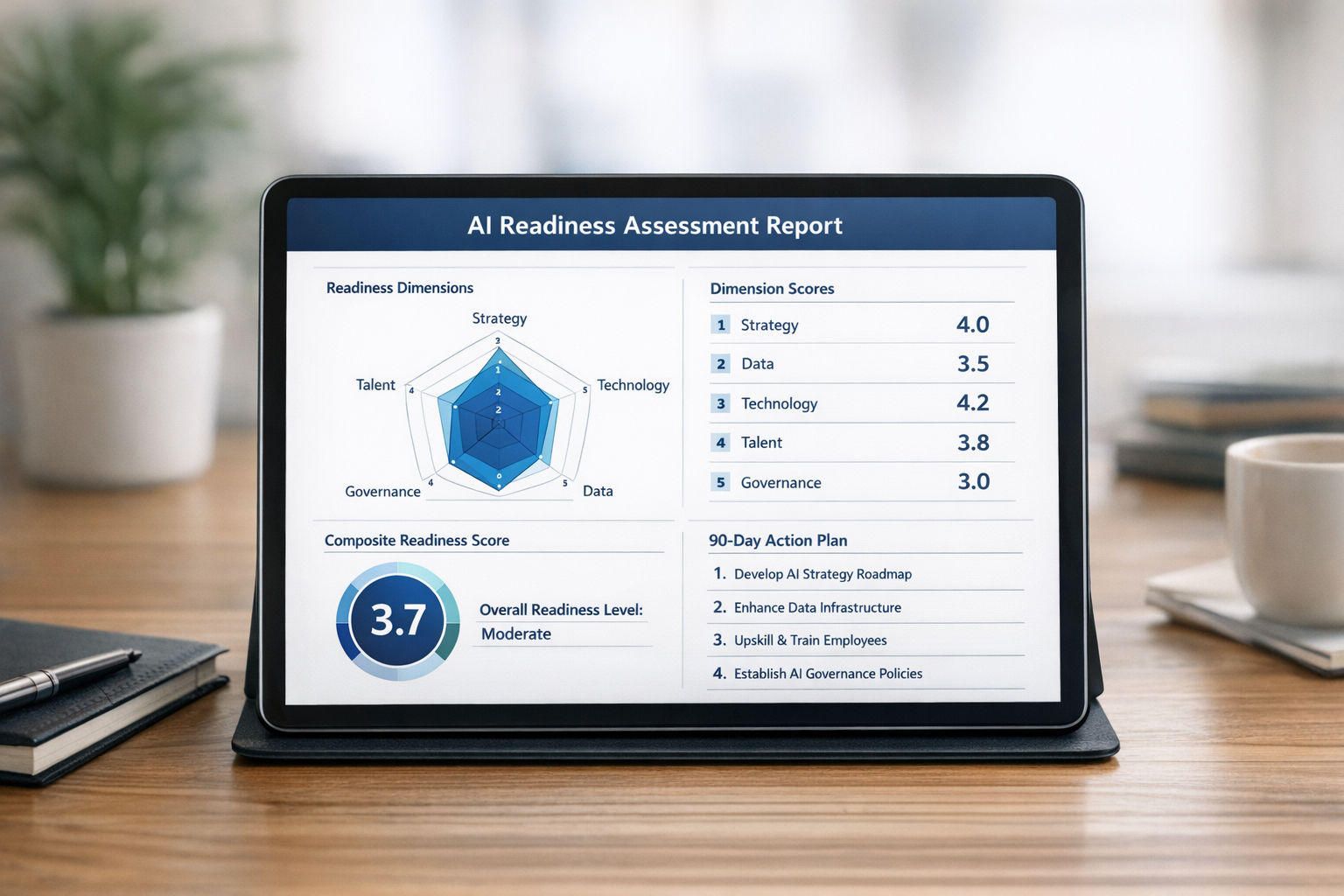
- The first-meeting artifact. Big firms charge $20K–$50K for a discovery engagement. You show up with a professional, data-backed AI readiness report — dimensional scoring, gap analysis, prioritized 90-day action plan — before they've signed anything.
A credible readiness report includes a composite score across 5–6 dimensions, radar chart visualizations, gap analysis ranked on severity and business impact, a use-case readiness matrix, and a 90-day action plan with named owners. The report becomes the sales conversation: instead of "here's what we could do," you're saying "here's exactly where you are, here's what's blocking you, and here's the sequence that fixes it."
In our breakdown of how independent AI consultants win against big firms, the winning positioning is never "we're just like them, but cheaper." It's "we're a fundamentally different kind of engagement" — where proof replaces pedigree.
Your Positioning Statement
The four advantages only work if communicated before the client has decided. Most independents lose in the first 30 seconds because their positioning is vague.
Bad: "I'm an independent AI consultant who helps companies implement AI."
Better: "I help mid-market accounting firms deploy AI-powered document processing that cuts client onboarding from weeks to hours."
Best: "I build AI-native audit workflows for mid-market accounting firms — and unlike big generalist firms, I deliver a working system in six weeks, not six months, with a readiness assessment you can take to your partners on day one."
That version communicates three advantages implicitly: speed, specialization, and proof.
Publish it on your LinkedIn headline, website hero, email signature, proposal cover pages, and every case study you produce. Consistency compounds.
The Big Picture
Global multi-country rollouts with regulatory complexity? That's still big-firm territory. Board-level politics where the McKinsey logo matters? Let them have it.
But the fastest-growing segments — mid-market companies, PE-backed firms, professional services — are exactly where your four structural advantages create a mathematical edge. Big firms can't match your speed, specialization depth, embedded closeness, or relevant documented outcomes.
The AI consulting market is on track for 8x growth in a decade. The 25% already held by AI-native boutiques is growing — because how AI is bought and delivered structurally favors small, specialized, fast operators. The question isn't whether you can beat big firms. It's whether you'll position yourself to do it deliberately.

Speed: AI tooling compresses research, proposals, and analysis by 40–50%. Deliver in two weeks what big firms scope in two months.
Specialization: Vertical focus commands 30–50% pricing premiums and 40–60% faster close rates.
Embedded Delivery: Stay on the engagement from first call to final deliverable. No handoffs, no orphaned strategies.
Proof Over Credentials: Replace the brand logo with documented outcomes. Show up with artifacts big firms charge $20K for.
Implementation boutiques ship faster and cost 2–5x less than Big 4 firms for the same work. For most businesses, the best fit is a boutique with 3–15 people, a track record of recent shipped work, transparent pricing, and the people you talked to staying on your project.
— Justin McKelvey, AI Consultant & Practice Lead