
Here's a problem most AI consultants don't see coming.
You land a client. You scope the engagement. You use every AI tool in your stack — Claude for analysis, Cursor for prototyping, automated workflows for data processing. You deliver. It's good work. The client is happy.
And you just made less money than you would have six months ago.
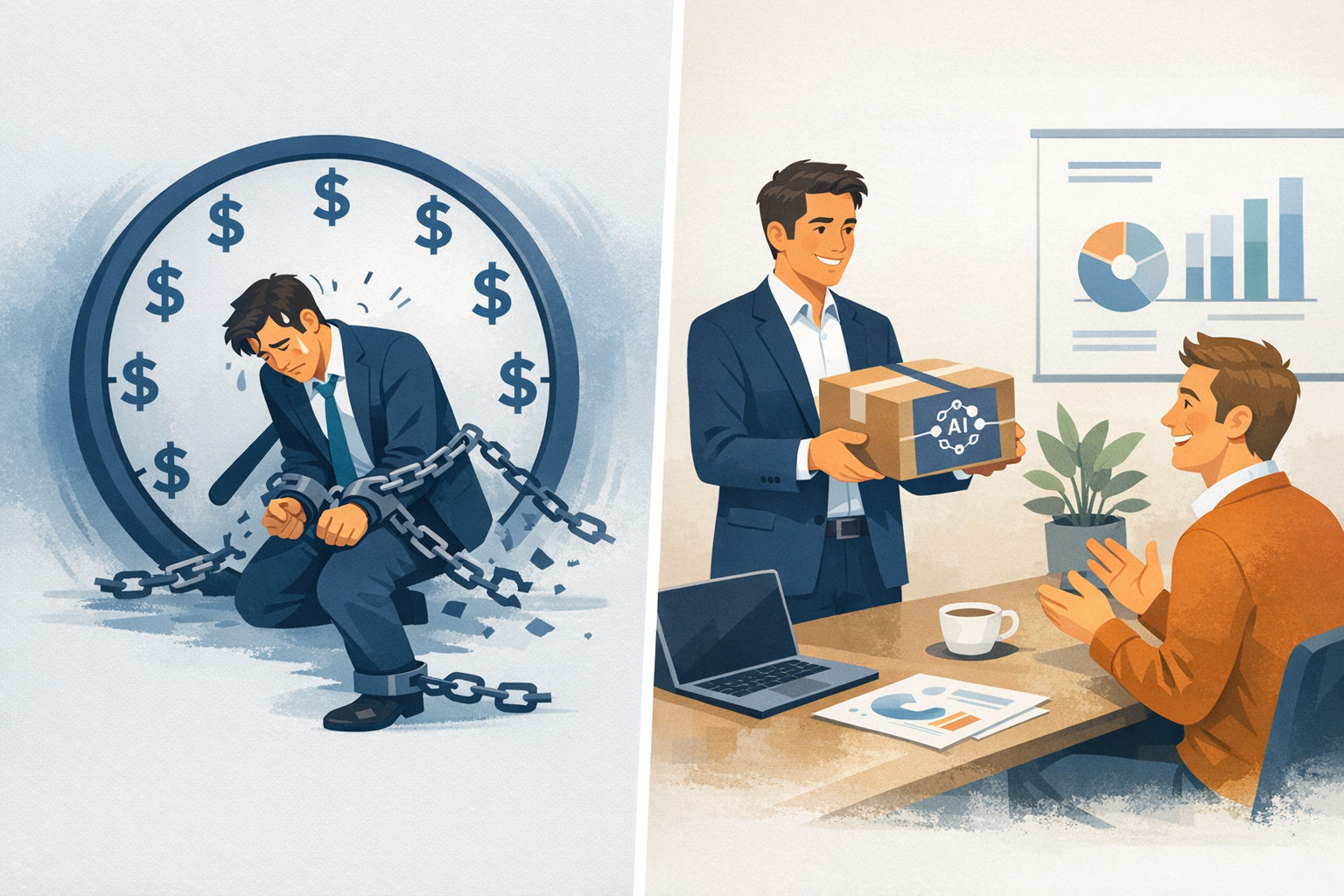
Why? Because the same deliverable that used to take 40 hours now takes 15. You're billing by the hour. The math is unforgiving: the better you get at using AI, the less you earn.
This isn't a hypothetical. It's the AI consulting efficiency penalty — and it's accelerating.
Ken Yarmosh, a consultant who's been writing about this shift, puts it bluntly: "Hourly billing breaks down in an AI-driven world because efficiency reduces revenue instead of increasing it. AI isn't labor — it's leverage that collapses the relationship between time and output."
A junior consultant who used to bill 60 hours for research and deck-building can now do it in 6 with AI. Under an hourly model, that's 90% of the revenue, gone. Same outcome. Same client value. Dramatically less income.
The solution isn't to hide your AI tools or slow yourself down. It's to change the game entirely.
The Hidden Structure You're Already Using
Here's the thing most AI consultants miss: you already have a productized business — you're just not packaging or pricing it that way.
Look at your last five AI consulting engagements. I'll bet they followed some version of this pattern:
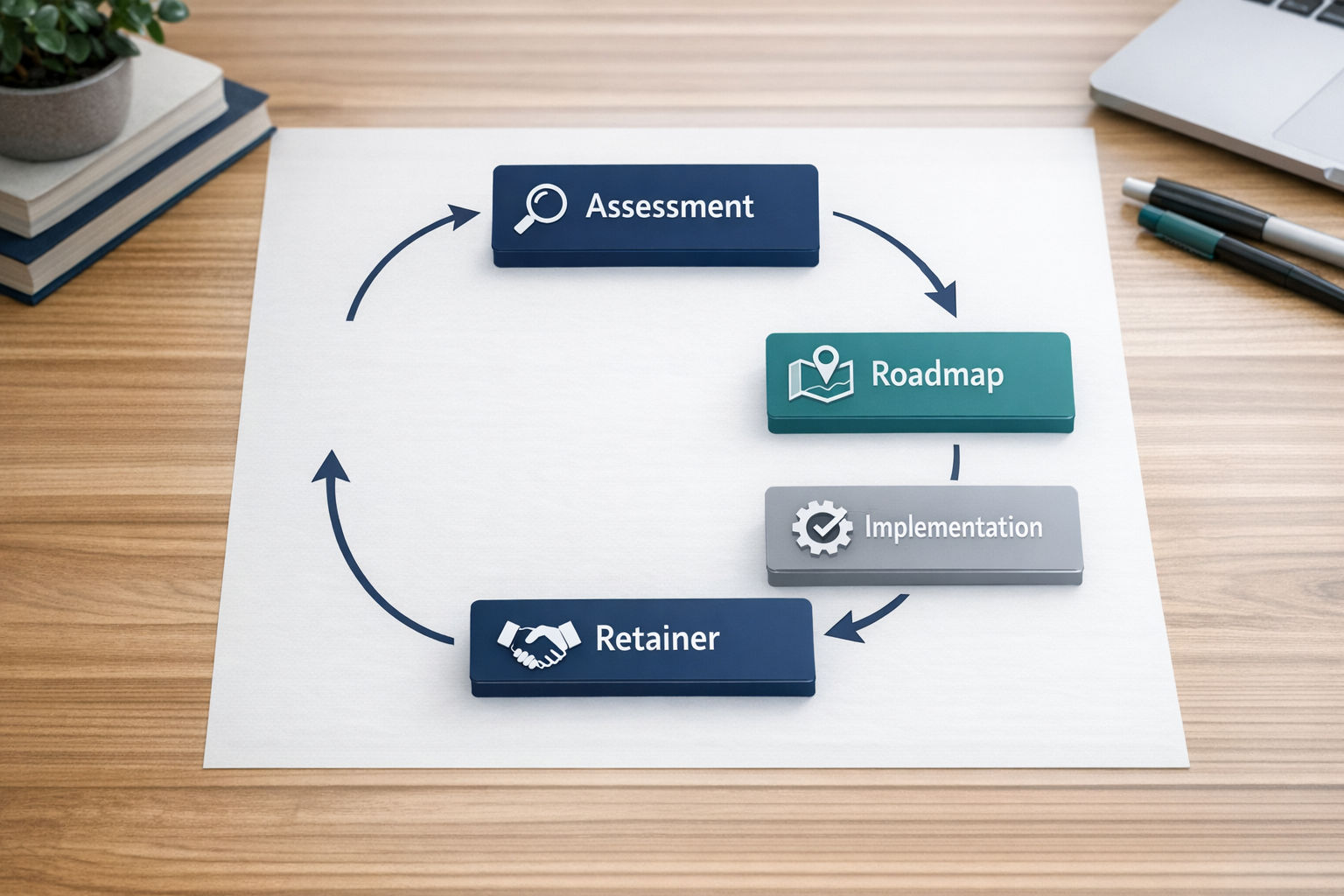
- Assessment — You audit their data, systems, workflows, and readiness
- Roadmap — You identify the highest-ROI use cases and sequence them
- Implementation — You build the solution (automation, agent, integration, model)
- Retainer — You stick around for optimization, governance, and the next use case
That's not a coincidence. AI consulting naturally follows this pattern because AI adoption itself is a structured, repeatable process. The work changes — a law firm needs different automations than a dental practice — but the delivery architecture is nearly identical across clients.
This is the insight that separates AI consultants who scale from those who stall: the repeatable 80% of your work — the diagnostic questions, the maturity scoring, the prioritization logic, the deployment checklist — that's your product. The bespoke 20% is your premium advisory layer.
As Alex Kwon, founder of TheAX, frames it: "The IP that appears in eighty percent of your projects — the diagnostic questions you always ask, the maturity criteria you always apply, the prioritisation logic you always follow — is your productisable core."
Once you see this, the path forward isn't mysterious. It's systematic.
Harvard Business Review (2023) found that consultants with productized offerings report 55% more predictable monthly revenue than those billing exclusively on time and materials. McKinsey data shows standardized service delivery yields up to 40% higher profit margins. And outcome-based packages command a 20-35% price premium over comparable hourly work.
The 3 Productization Models (And Which One Fits You)
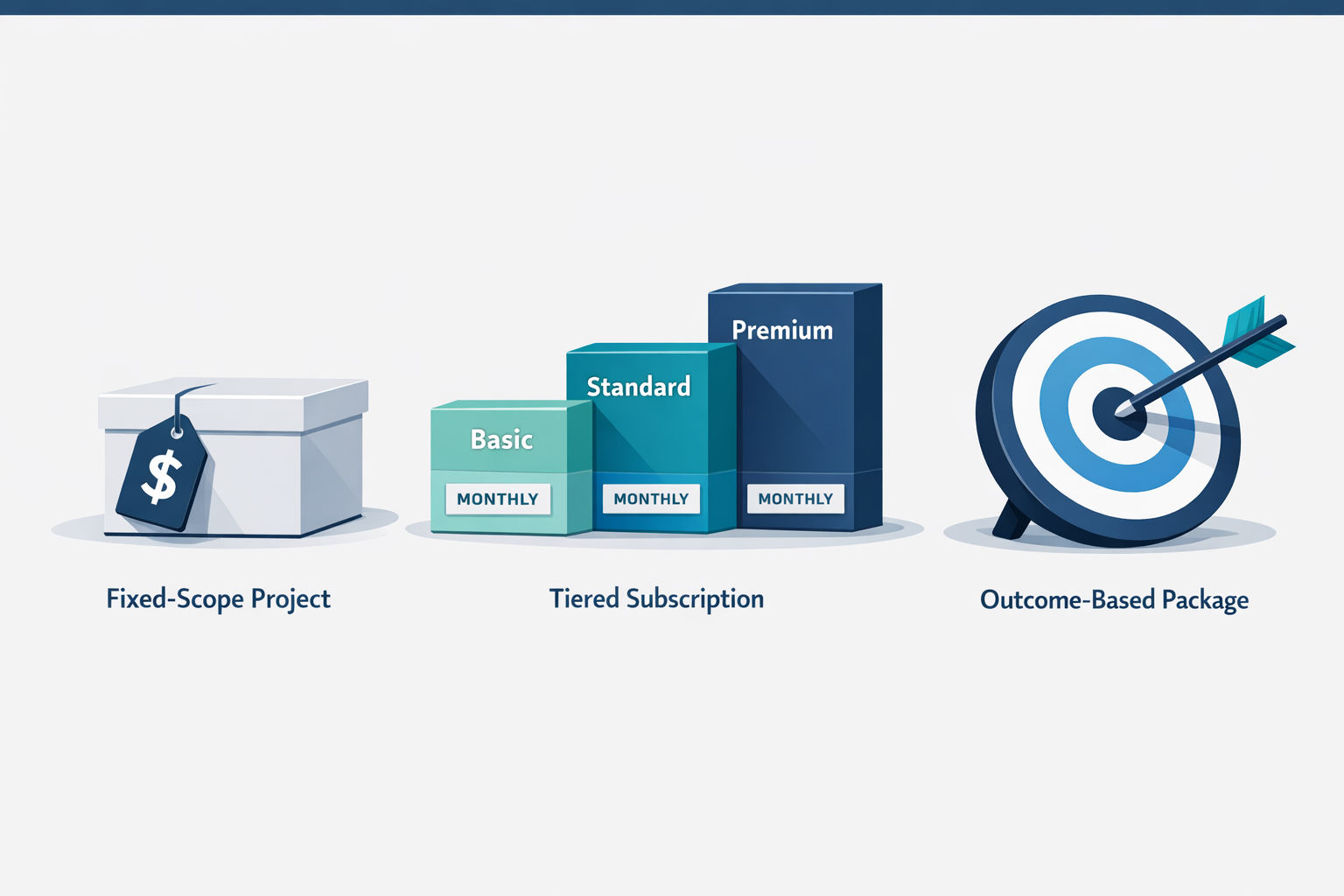
Not all productized AI consulting looks the same. There are three viable models — and the one you choose depends on your expertise, your clients, and how you want to work.
Model 1: Fixed-Scope Project
What it is: A one-time engagement with clearly defined deliverables, timeline, and price. The client knows exactly what they're getting and what it costs before you start.
Real example: An "AI Readiness Audit" — 2 weeks, $7,500 fixed price. Delivers a scored assessment across 5 dimensions (data foundation, infrastructure, org readiness, use-case viability, governance), a gap analysis with severity ratings, and a prioritized 90-day roadmap with cost estimates.
Firms like MLDeep publish this price publicly: $15,000 for a 2-week AI Stack Audit. Petronella sells a 10-day AI Readiness Assessment at $7,500. NetAesthetics offers a 2-week deep dive at $25,000. These aren't loss leaders — they're the primary product.
Best for: Consultants who excel at diagnosis and strategy. If your superpower is walking into a business, understanding their operation in two weeks, and telling them exactly where AI will move the needle — this is your model.
The upside: Fast sales cycle. Easy to understand. No long-term commitment required from either side. Delivers a clean, standalone asset.
The risk: One-and-done revenue. You're back to selling after every engagement. Mitigate this by building a natural upgrade path to Model 2 or 3.
Model 2: Tiered Subscription / Retainer
What it is: A recurring monthly engagement with defined deliverables across 2-3 pricing tiers. Clients pay for ongoing access, not hours.
Real example: A "Fractional AI Officer" engagement — $4,000/month for the Foundation tier (strategy check-ins, roadmap updates, vendor reviews), $8,500/month for Growth (includes implementation oversight, team training, quarterly deep-dives), $15,000/month for Scale (embedded leadership, dedicated sprint capacity, governance program).
Stack.Expert reports real-world AI consulting retainers clustering at $2,000-$5,000/month for essential advisory, $5,000-$15,000/month for standard support, and $15,000-$50,000/month for comprehensive partnerships. Fractional CAIO roles in 2026 are landing at $15,000-$40,000/month for 20-40% of a full-time executive's time.
Best for: Consultants who want predictable income and long-term client relationships. If you find yourself doing ongoing work for the same clients anyway, you're already delivering a retainer — you're just not pricing it as one.
The upside: Monthly recurring revenue. Deep client relationships. Natural expansion as clients grow their AI maturity.
The risk: Scope creep is the enemy. You need ironclad boundaries on what's included. More on that below.
Model 3: Outcome-Based Package
What it is: Pricing tied to measurable results — a base fee plus a success component linked to cost savings, revenue uplift, or performance thresholds.
Real example: An "AI Automation Sprint" — $5,000 base fee plus 15% of documented cost savings in the first 6 months post-implementation. Or a flat $12,000 engagement with a $3,000 bonus if specific KPIs are met within 90 days.
This model is growing fast. McKinsey now derives 25% of its total fees from outcome-based contracts. BCG reports that AI-driven work will represent 40% of its revenue by 2026, almost entirely structured around measurable results rather than consulting hours. Across the market, 73% of consulting clients now prefer value-based or outcome-driven pricing.
Best for: Consultants confident in their ability to deliver measurable impact. If you can point to specific cost savings or revenue gains from your AI implementations, you can price against them.
The upside: Your ceiling disappears. If you save a client $200,000 a year, charging 20% of that ($40,000) makes your old hourly rate look like pocket change.
The risk: Measurement disputes. Attribution problems. Clients who don't implement your recommendations and then blame you for the lack of results. This model requires clear baseline metrics, agreed-upon measurement methodology, and a client who will actually execute.
What to Productize First: The 80/20 Diagnostic
Most consultants fail at productization because they try to package everything at once. Don't. Start with one offer. Make it the right one.
Here's the framework. Grab your last 10 client engagements and ask yourself four questions:
1. Where do I deliver the most consistent, measurable results?
Not where you enjoy working the most. Where you move the needle the most. If three of your last ten clients saw a 30%+ reduction in operational costs after your implementation, that's your signal.
2. What deliverables do I recreate from scratch every time?
Audit reports, readiness scorecards, use-case prioritization matrices, implementation roadmaps, governance frameworks — these are almost certainly 80% identical across clients. That 80% is your product. Stop rebuilding it.
3. Which part of my process has the clearest before/after transformation?
Productized offers sell when the outcome is vivid. "I'll audit your workflows and tell you where AI fits" is vague. "In two weeks, you'll have a scored assessment of 8 AI readiness dimensions, a ranked list of your top 5 automation opportunities with projected ROI, and fixed-price quotes to implement each one" — that sells.
4. What do clients ask for most often?
Simple but powerful. If 7 out of 10 prospects ask "can you just tell us where to start with AI?" — you have your first productized offer. The demand already exists. You just need to package it.
Once you've identified your candidate, run it through a validation filter:
- Can I define the scope in one paragraph, with clear inclusions and exclusions?
- Can I deliver this profitably at a fixed price without my constant, hands-on involvement?
- Does this position me as a specialist rather than a generalist?
If the answer to any of these is no, refine the scope. Narrow it. Make it smaller, not bigger. The most successful productized AI offers are surprisingly tight.
The smartest play: launch with a fixed-scope diagnostic (Model 1), deliver it brilliantly, then offer the implementation and retainer (Models 2 or 3) as natural next steps. Your $7,500 AI Readiness Audit becomes the top of a funnel that leads to $25,000 implementations and $5,000/month retainers. As Arsh Singh notes, "the first productized offer is rarely the last — it's the beachhead."
How to Price a Productized AI Service (Anchor to Outcomes, Not Hours)
Here's the pricing mistake almost every consultant makes when they productize: they calculate the price by estimating hours and multiplying by their rate.
That's not productized pricing. That's hourly billing in disguise.
The correct approach: price against the outcome you're delivering, then check that the effective rate makes sense.
The Outcome-First Pricing Method
-
Define the transformation. What changes for the client after your engagement? Be specific. Not "better AI strategy" but "a prioritized roadmap of 5 AI initiatives, each with projected cost, timeline, and ROI, approved by the board within 30 days."
-
Estimate the economic value. If your AI automation roadmap identifies $150,000 in annual savings, your work is worth some meaningful fraction of that. Industry norms put productized consulting fees at 10-25% of the first year's value for strategy work, or 1-2x the annual cost of the problem for cost-reduction work.
-
Set the price, then check the floor. A $15,000 AI Readiness Audit that takes you 30 hours to deliver is a $500/hour effective rate. That might feel high compared to hourly billing — and that's exactly the point. You're pricing the outcome, not the labor.
-
Anchor high with tier options. Always present a premium tier. A $25,000 comprehensive assessment makes your $12,000 standard assessment feel reasonable. This isn't manipulation — it's giving clients a genuine choice about depth and involvement.
The 500k.io productized service framework captures this well: start your first 1-2 clients at a validation price ($1,500-$2,000/month for a retainer, or $3,000-$5,000 for a fixed-scope project), build case studies, then raise prices for clients 3-5. By clients 6-10, you're charging a niche premium. By client 10+, you're charging a selectivity premium because you're turning most leads away.
"If you can say your price out loud without flinching, you're under-priced. The buyer is more comfortable with a $3K/month retainer than you think. The discomfort is yours, not theirs."
The Scope Creep Problem (And How Fixed Scope Actually Fixes It)
70% of professional service firms say scope creep is their biggest profitability killer. For productized consulting, scope creep isn't just annoying — it destroys the entire model.
The good news: productization is actually the best defense against scope creep, if you build it right.
The Scope Protection Playbook
1. Define exclusions as clearly as inclusions.
Every productized offer should have a section that says "This engagement does NOT include" — and it should be as detailed as the "includes" section. Examples:
- Does not include implementation of recommended tools
- Does not include training sessions beyond the final debrief
- Does not include data cleaning or migration work
- Does not include ongoing support after the 30-day post-delivery window
2. Build a change control process into your contract.
When a client asks for something outside scope, the answer is never "no" — it's "yes, here's the change order with the adjusted price and timeline." This transforms scope creep from a profitability drain into a revenue opportunity.
Agencies that master this use a weekly "Out of Scope" slide in status meetings, listing everything the client has asked for that falls outside the agreement. Then they ask: Do you want a change order estimate? Move it to a future phase? Or drop it?
3. Price high enough that you don't feel pressure to absorb extras.
One of the most practical insights from seasoned productized consultants: higher pricing reduces the psychological pressure to give away free work. When you're charging $3,500 for an audit, you feel obligated to say yes to extra requests. At $12,000, you're comfortable saying "that's a separate engagement."
4. Pre-discuss common scope creep scenarios during the sale.
During your discovery call, say: "Here are three things clients often ask for mid-engagement that fall outside this package. If any of them come up, here's how we handle them." This sets expectations before there's emotion attached to a specific request.
This is also where platforms built for productized AI consulting create structural advantages. When your discovery process, assessment framework, and package tiers are pre-built and standardized, scope boundaries are embedded in the system — not something you have to negotiate from scratch every time.
Productized consulting is how you stop selling time and start scaling your consulting without hiring endlessly. Instead of billing by the hour or scoping every project from scratch, you sell defined outcomes on a subscription or retainer basis.
— ManyRequests, Productized Consulting Guide
The Systems That Make Productization Actually Work
Productization isn't just a pricing decision — it's an operational one. You need the infrastructure to deliver consistently, efficiently, and without your hands on every lever.
What You Actually Need
Standardized discovery. Every engagement should start the same way: the same intake form, the same diagnostic questions, the same data collection process. This isn't about being rigid — it's about not reinventing the wheel 30 times a year. When your discovery process is systematized, you can also delegate it or automate parts of it without losing quality.
Repeatable assessment frameworks. Your AI readiness scoring, your use-case prioritization matrix, your ROI projection model — these should exist as templates, not as things you build from scratch in Notion every engagement. The strongest AI consultancies have digitized their assessment methodologies into tools that produce consistent outputs regardless of who runs them.
Pre-built tiered packages. When a prospect asks what you offer, you should be able to send them to a page with three clearly defined options — not schedule a call to "scope something custom." The call still happens, but now it's about choosing the right package, not inventing one.
Delivery playbooks. For each phase of your engagement, there should be a documented workflow. Not a 40-page SOP — a checklist that ensures nothing gets missed and everything meets your standard.
This is where purpose-built platforms earn their place. Rather than stitching together a CRM, a proposal tool, a project management board, and a billing system — and hoping they talk to each other — platforms like ConsultKit are designed specifically for productized AI consulting. Standardized discovery flows, repeatable assessment frameworks, pre-configured tiered packages, and integrated billing that ties to deliverables, not time. The operational overhead of productization drops dramatically when your systems are built for it from day one.
Learn more about how ConsultKit helps AI consultants productize and scale their practice.
What Productized AI Consulting Packages Look Like in the Wild
Let's get concrete. Here are four productized AI consulting offers you could build today, based on real pricing data from firms operating right now:
1. The AI Readiness Assessment + Roadmap
Format: Fixed-scope project
Price: $7,500 - $25,000 (depending on org size and depth)
Timeline: 2-3 weeks
Deliverables: Scored AI readiness across 5-8 dimensions, gap analysis with severity ratings, prioritized 90-day roadmap with cost estimates, board-ready summary
Who buys: Mid-market companies ($5M-$150M revenue) that know AI matters but don't know where to start
Natural upsell: Implementation of the top-priority use case
Real firms selling this: MLDeep ($15K), Petronella ($7.5K), NetAesthetics ($25K), Tributary AI ($25K-$35K)
2. The AI Automation Sprint
Format: Fixed-scope project with optional outcome bonus
Price: $12,000 base + $3,000 performance bonus
Timeline: 4-6 weeks
Deliverables: One fully deployed AI automation (workflow mapped, tool selected, built, tested, documented), measured baseline vs. post-deployment metrics, team training session
Who buys: Operations-heavy SMBs that want to see AI work before committing to a broader program
Natural upsell: Monthly optimization retainer + additional automation sprints
3. Fractional AI Officer (3-Month Engagement)
Format: Tiered subscription / retainer
Price: $6,000 - $18,000/month (depending on tier)
Timeline: 3-month minimum, then month-to-month
Deliverables: Monthly AI strategy sessions, vendor/tool evaluation and selection, implementation oversight, team capability building, governance framework development, board-ready quarterly reports
Who buys: Companies at $10M-$100M revenue that need AI leadership but can't justify a full-time CAIO ($300K+)
Natural upsell: Expanded scope, additional implementation capacity
Fractional CAIO roles are one of the fastest-growing segments in AI consulting. Hyperion Consulting reports these landing at $15,000-$40,000/month for mid-market and enterprise clients.
4. AI Governance Package
Format: Fixed-scope project or ongoing retainer
Price: $15,000 (one-time framework) or $3,000-$5,000/month (ongoing governance-as-a-service)
Timeline: 4 weeks (one-time) or ongoing
Deliverables: AI governance policy suite, risk assessment framework, compliance mapping (EU AI Act, sector-specific regs), monitoring and audit protocols, team training
Who buys: Regulated industries (healthcare, legal, financial services) deploying AI and needing compliance infrastructure
Natural upsell: Ongoing governance monitoring and updates
We've written about how to sell AI governance as a standalone service — it's one of the most under-priced opportunities in AI consulting right now.
The Real Shift: You're Not Selling Less. You're Selling Differently.
Let's address the fear that holds most consultants back from productization: "If I charge a fixed price and the work takes less time, am I leaving money on the table?"
This is the wrong question. The right question is: "If I keep billing hourly while AI makes me 3x faster, what happens to my income over the next three years?"
The answer: it shrinks. Every quarter. As AI tools improve, your hour becomes worth less — not because your expertise is worth less, but because your pricing model is designed for a world where time and value were correlated. They aren't anymore.
Productized AI consulting isn't about working less and charging the same. It's about capturing the value of the outcome, not the labor of the process. It's about building a business where getting more efficient makes you more profitable, not less.
The consultants who thrive over the next five years won't be the ones with the best AI stack. They'll be the ones who figured out how to price what they actually deliver.
And that starts with recognizing that the repeatable structure you're already using — assessment, roadmap, implementation, retainer — isn't just how you work. It's what you sell.
