

You closed a $12,000 AI automation deal. The client's excited. You're ready to build. Then three weeks in, they want you to add "just one more chatbot" to the scope. Six weeks later, they're disputing your invoice because GPT's outputs changed after an API update.
And your contract? It's the same Word doc you've been using since your web design days — maybe updated with a find-and-replace from "website" to "AI solution."
You're not alone. Research shows that 33% of freelance consulting projects operate without formal contracts, and those without contracts collect only 67% of full payment compared to 94% with them. Scope creep hits 54% of uncontracted projects versus just 12% with proper agreements.
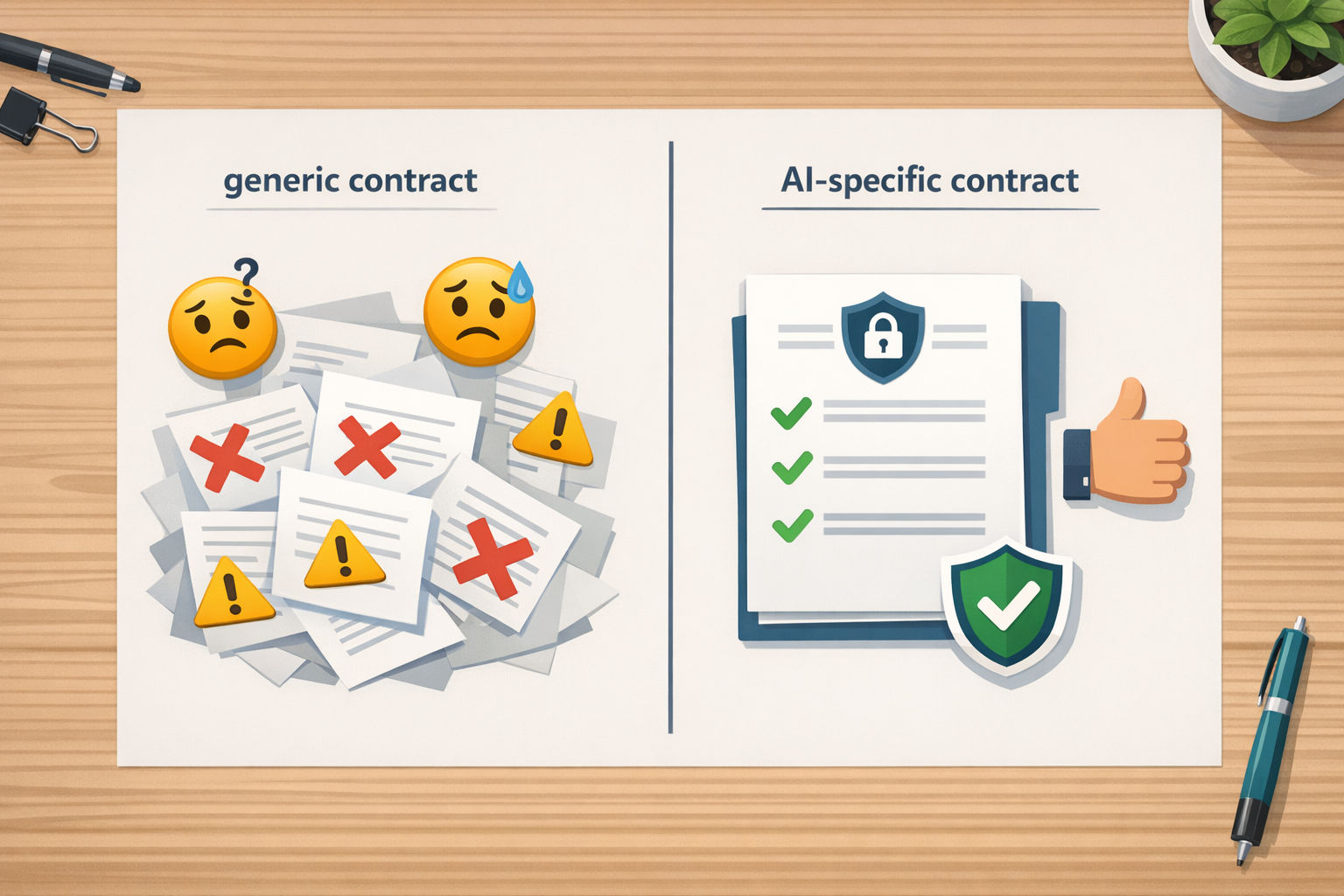
Here's the problem: even if you do have a contract, a generic consulting agreement doesn't cover the risks unique to AI work. And those risks are where the real exposure lives.
This isn't legal advice — you need a lawyer for that. But this is the framework that tells you exactly what to ask your lawyer to draft, so you walk into every AI consulting engagement protected.
Before you reach the contract stage, a well-structured AI consulting proposal should already have established the scope, phased timeline, and success criteria that your contract will formalise. The contract works best when it's confirming what was already agreed in the proposal — not introducing surprises.
And before you're even writing proposals, you need to know what you're selling. Packaging your AI services into clear tiers makes the scope conversation — and therefore the contract conversation — dramatically easier, because both parties are working from a defined menu of deliverables from the start.
This post provides a practical framework for understanding what belongs in an AI consulting contract. It is not a substitute for qualified legal counsel. Use this as your checklist when working with your attorney to draft or review your agreements.
Why Generic Consulting Contracts Fail for AI Work
Traditional consulting contracts assume predictable deliverables. You promise a strategy document. You deliver it. Done.
AI consulting operates in a probabilistic world where the same prompt can produce different outputs tomorrow — and where the tools you're building on can change their terms of service overnight. That creates four categories of risk your standard freelance contract doesn't touch:
1. Model hallucinations get blamed on you. When an AI system you implemented generates inaccurate outputs, the client doesn't call OpenAI. They call you. Without explicit language addressing the limitations of third-party AI models, you're the one holding the liability.
2. Deliverables are impossible to define the old way. "Build an AI chatbot" isn't a deliverable — it's the beginning of thirty follow-up questions. What accuracy rate? What data sources? What happens when the model's behavior changes after an update you didn't control?
3. IP ownership is a minefield. Who owns the custom prompts you wrote? The fine-tuned model? The training data the client provided? The outputs that the AI generated using that data? These questions didn't exist five years ago, and your boilerplate "all work product transfers to client" clause creates more problems than it solves.
4. Data access creates privacy exposure. AI implementations typically require access to proprietary client data — customer records, financial information, internal processes. A VendorBenchmark analysis of 218 enterprise AI agreements found that data usage rights are the #1 source of post-signature disputes, with 44% of companies discovering training data clauses they hadn't properly negotiated.
The 8 Non-Negotiable Clauses in Every AI Consulting Contract
Think of these as your contract checklist. Each clause addresses a specific risk that's unique to — or amplified by — AI consulting work. We'll cover what each clause does in plain English, so you can explain it to clients without sounding defensive.
If you're wondering how to scope your AI projects properly before the contract stage, start there. Good scoping makes every clause below easier to write.
Scope Definition With Explicit Exclusions
Deliverable Format and Acceptance Criteria
Data Use and Confidentiality
IP Ownership of Outputs
AI Liability Limitations
Revision Limits
Payment Terms Tied to Milestones
Termination With Kill Fee
The Clauses Most Consultants Forget (That Come Back to Bite Them)
The eight clauses above cover the fundamentals. But there are two areas that trip up even experienced AI consultants — usually because they seem unnecessary until they're not.
Holland & Knight attorneys warn that AI performance guarantees risk being classified as regulated insurance arrangements. And Shumaker Law puts it plainly: "A model that seems accurate in a vendor demo can yield very different results on your hardware with your data, terminology, and workflows." Your contract should include benchmark expectations (e.g., 80% accuracy on test data), not absolute guarantees. State explicitly that AI model performance depends on data quality, model updates from third-party providers, and environmental factors beyond your control.
Result Guarantees and Outcome Promises
This is the big one. Clients will push for guarantees — "We want 50% cost reduction" or "The chatbot needs to resolve 90% of tickets." Your contract must draw a hard line between what you'll build and the results it will produce.
Include language like: "Consultant commits to delivering the specified system to the agreed specifications. Business outcomes depend on client adoption, data quality, and operational factors outside Consultant's control."
This isn't about dodging accountability. It's about being honest that proving AI ROI takes time and depends on factors beyond your implementation. For specific language and framing, the complete guide to scoping AI consulting projects shows how to bake these expectations into your SOW before the contract is even drafted.
Third-Party Platform Dependencies
Your automation probably depends on OpenAI, Anthropic, Make, Zapier, and multiple APIs. Any of these can change their pricing, deprecate features, or modify their terms overnight. Your contract needs a clause stating: "Consultant is not liable for changes to third-party platforms, services, or APIs that affect system functionality after delivery. Remediation of third-party changes constitutes a new scope of work."
Regulatory Compliance Responsibilities
With the EU AI Act now imposing obligations on both AI providers and deployers, your contract must clarify who handles compliance. If the client operates in a regulated industry — finance, healthcare, legal — spell out that regulatory compliance for AI outputs is the client's responsibility, while you'll deliver implementations that support compliance requirements as specified in the scope. Consultants selling into law firms or financial services should read the AI governance consulting playbook for SMBs to understand how to frame compliance obligations in a way that adds value rather than creating fear.
80% of enterprise AI initiatives fail to deliver expected business value, and the primary driver is poor project scoping — not technology failure. Every clause above exists to force better scoping conversations upfront.
| Clause | What It Protects Against | Plain-English Explanation for Clients |
|---|---|---|
| Scope + Exclusions | Scope creep, unpaid extra work | "This defines exactly what we're building and — just as importantly — what falls outside this project so there are no surprises." |
| Acceptance Criteria | Infinite revision loops | "This is how we'll both know the work is complete, with clear metrics and a review window." |
| Data Use & Confidentiality | Privacy liability, data misuse claims | "Your data stays yours. This spells out exactly how we'll handle it and when we'll delete it." |
| IP Ownership | Disputes over who owns what | "You own everything custom-built for you. We keep our general tools and methods so we can serve you better." |
| AI Liability Limits | Blame for model hallucinations | "We build and configure the system to spec. We can't control what the underlying AI models do, so this sets realistic expectations." |
| Revision Limits | Unpaid rework cycles | "We include [X] rounds of revisions. Anything beyond that gets scoped and quoted separately." |
| Milestone Payments | Late or missing payment | "Payments are tied to progress, not the calendar. We both stay motivated to keep things moving." |
| Termination + Kill Fee | Sudden project cancellation, pipeline gaps | "Either of us can end this, but the terms are fair. If you stop early, we're compensated for the gap." |
Use these plain-English explanations when walking clients through your AI consulting agreement.
How to Talk Clients Through These Clauses
Most consultants dread the contract conversation because they think it makes them look defensive or difficult. Flip the frame: a thorough contract signals professionalism, not distrust.
When clients push back on specific clauses, lead with their interest:
- On scope exclusions: "This protects your budget. Without clear boundaries, projects tend to expand — and that costs you more."
- On AI liability limits: "This sets honest expectations. I'd rather be upfront about what AI can and can't guarantee than overpromise and underdeliver."
- On milestone payments: "This keeps us both accountable. You only pay when you see progress."
The consultants who close the biggest deals aren't the ones who skip the contract. They're the ones who use the contract conversation to demonstrate they've thought through the deliverables and the risks — which makes the client more confident, not less.
The single best way to reduce contract friction is to nail the discovery phase before you ever draft a contract. When you walk into the contract stage with detailed data on the client's current workflows, pain points, and AI readiness, scope disputes evaporate because both sides are working from the same baseline. A structured readiness assessment — like the ones you can run through ConsultKit — turns the contract conversation from a negotiation into a formality.
Don't treat this as a one-time exercise. Build your AI consulting contract once with these eight clauses, then refine it after every engagement. The consultants scaling to six and seven figures aren't the ones with the fanciest proposals — they're the ones with the tightest onboarding processes and the clearest contracts.
Once the engagement is complete and trust is established, your contract framework also sets the foundation for transitioning clients onto a retainer — the contract's milestone structure and change-order language makes that conversation significantly easier.
And when you're ready to expand beyond a single project, the same contract structure that protected your scope can be adapted to upsell AI services systematically — with clear change order protocols that let you grow the engagement without renegotiating from scratch.
Of course, the best contracts are built on engagements that were scoped correctly from the start — and that starts with a sharp discovery call. The AI consulting discovery call framework shows you how to surface scope requirements, budget signals, and decision-maker structure before you ever open a contract document.
Take this checklist to your lawyer. Get AI-specific language drafted for each of the eight clauses. And next time a client says "let's just get started and figure out the details later," you'll know exactly why the answer is no.
