

Here's a scenario that will keep you up at night: your AI-generated strategy report cites a regulation that was repealed two years ago. Your client's CFO catches it in the board meeting. The call you get afterward isn't about revisions — it's about whether they should continue the engagement.
AI consulting deliverable quality control isn't a nice-to-have process. It's the difference between a $15K/month retainer that renews and a LinkedIn post about how "you can't trust AI consultants." In high-stakes verticals — legal, finance, healthcare — a single hallucinated statistic or fabricated citation doesn't just embarrass you. It can expose your client to regulatory risk and expose you to professional liability claims.
The data backs this up. Stanford's RegLab found that general-purpose LLMs hallucinate on 69–88% of legal queries. OpenAI's own system card admits that o3 hallucinated on 33% of factual prompts. A Columbia Journalism Review–linked study found AI search tools mis-attribute sources 37–94% of the time. These aren't edge cases — they're baseline behavior.
Yet most AI consultants treat verification as a quick skim before hitting send. That's how hobbyists work. This framework is how professionals work.
The Five AI Failure Modes That Actually Matter in Consulting
Forget generic "AI can hallucinate" warnings. In consulting delivery, there are five specific failure categories that damage client relationships. Each requires a different detection approach.
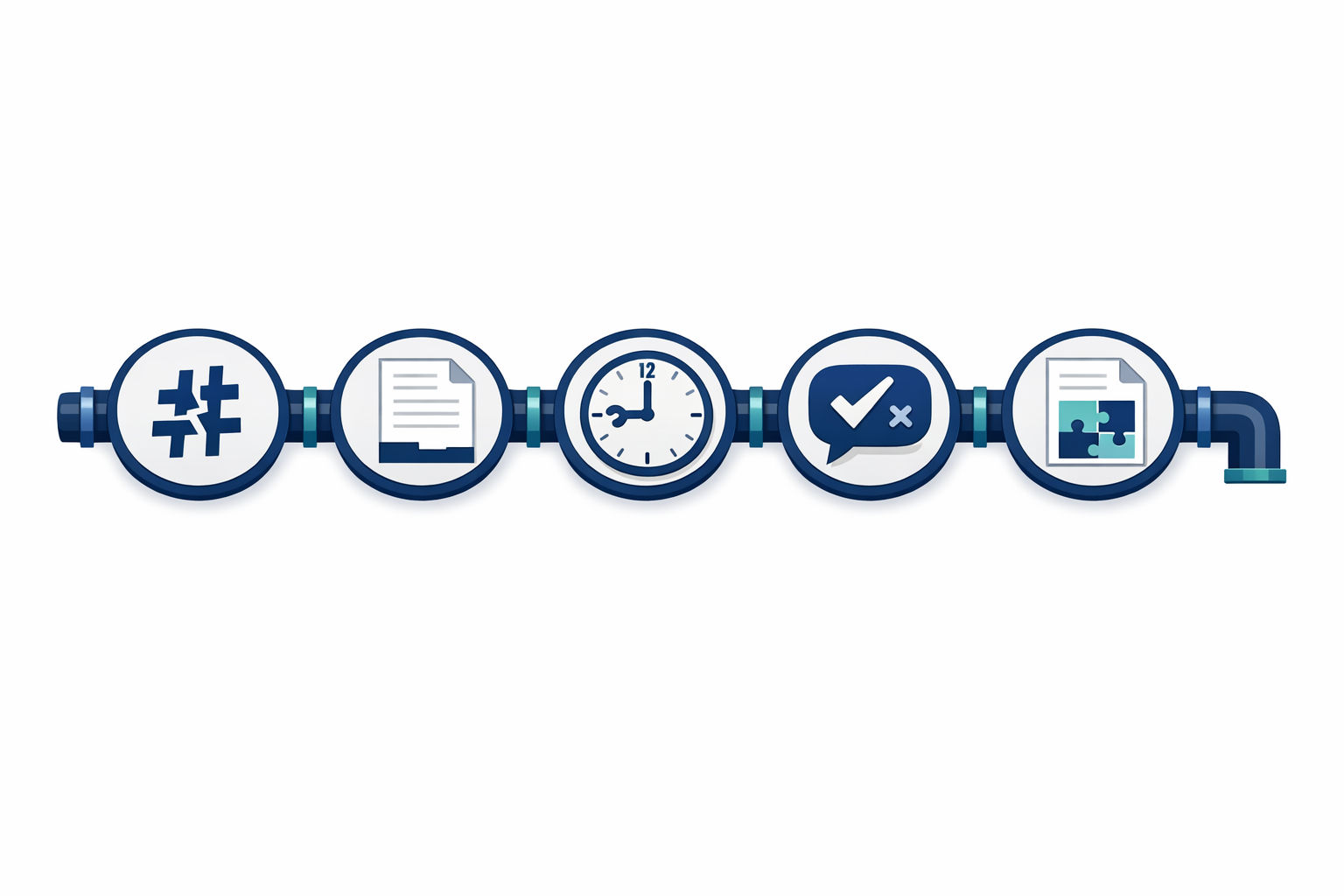
1. Factual hallucinations with false precision. AI doesn't say "the market is growing quickly." It says "the market is growing at 14.3% CAGR" — a number that sounds sourced but was invented. A peer-reviewed study on medical systematic reviews found GPT-4 hallucinated 28.6% of generated references, with precision (actually correct references) at just 13.4%. GPT-3.5 was worse at 39.6%. These outputs pass a skim test because they look authoritative.
2. Silent truncation in long outputs. This is the one most consultants never catch. When an AI processes a 50-page document, it can silently stop reading once the context window fills — without telling you. OpenAI Codex truncates tool outputs at 10 KiB or 256 lines in head-and-tail form. Your 30-page analysis might be based on the first 12 pages. If you're not validating coverage, you're shipping partial work.
3. Confident-but-wrong numerical outputs. AI will perform a calculation, present the result with decimal precision, and be completely wrong. This is especially dangerous in financial models, ROI projections, and pricing recommendations — exactly the deliverables where your clients rely on your accuracy most.
4. Outdated data presented as current. Model training cutoffs mean AI can cite 2022 regulatory frameworks as current policy or use pre-pandemic market data in a 2025 strategy recommendation. In regulated verticals, this isn't just inaccurate — it's potentially non-compliant.
5. Misapplied templates and frameworks. AI loves to apply the MECE framework, Porter's Five Forces, or a SWOT analysis to everything — even when the framework doesn't fit the client's situation. The output looks professional. The strategic logic is wrong. This is the failure mode that erodes your reputation for judgment, not just accuracy.
When you chain multiple AI steps together — research → analysis → recommendations → formatting — accuracy compounds downward. UC Berkeley research shows that even 92% accuracy per step drops to just 44% accuracy over a 10-step pipeline. Google DeepMind measured an error amplification factor of 17.2× in multi-agent setups. The more complex your AI workflow, the more rigorous your QA must be.
The Pre-Delivery QA Checklist (By Output Type)
Generic checklists are useless. AI output verification requires different checks depending on what you're delivering. Here's what to verify for each deliverable type before it reaches your client.
| Deliverable Type | Critical QA Checks | Common Failure Mode |
|---|---|---|
| Strategy Reports & Recommendations | Verify every cited statistic against primary source. Check that recommendations logically follow from the evidence presented. Validate that frameworks match the client's actual situation. | Hallucinated statistics, misapplied frameworks |
| Financial Models & ROI Projections | Manually recalculate key outputs. Cross-check assumptions against client-provided data. Verify formulas and unit consistency. | Confident-but-wrong calculations, outdated baseline data |
| AI Readiness Assessments | Confirm scoring criteria match the client's industry context. Validate that gap analysis reflects actual current state, not generic patterns. | Template misapplication, generic recommendations |
| Automation Logic & Workflow Designs | Test edge cases the AI may not have considered. Verify error handling exists. Confirm integration points are technically feasible. | Missing edge cases, silent truncation of complex logic |
| Executive Summaries & Briefings | Compare against full source material for completeness. Check that no key findings were dropped. Verify tone matches client expectations. | Silent truncation, omission of unfavorable findings |
Pre-delivery QA checklist organized by deliverable type
The non-negotiable across every type: every specific number, citation, or factual claim gets verified against a primary source. If you can't verify it, remove it or flag it explicitly. As one QA framework puts it: "Never assume the model is right."
This is especially critical if you're building a client AI data strategy before implementation — the accuracy of your initial assessment sets the ceiling for everything that follows.
When to Use Human QA vs. AI-Assisted QA (And How to Prompt the Adversarial Review)
The tempting shortcut: use a second AI model to review the first. The uncomfortable reality: research shows this works far less reliably than most consultants assume.
The ReaLMistake benchmark — the first error-detection benchmark built from realistic LLM-generated mistakes — found that GPT-4 and Claude 3 detect AI-made errors with very low recall, performing "much worse than humans" across the board. In a medical domain study, GPT-4's accuracy at detecting adversarially manipulated outputs fell below 1%.
This doesn't mean AI-assisted QA is useless. It means you need to use it correctly.
Pass 1: AI-Assisted Structural Review
Pass 2: Adversarial AI Challenge
Pass 3: Human Expert Review (Non-Negotiable)
Galileo's research found 93% of teams struggle with LLM-as-a-judge approaches. The most common mistake: asking AI to score outputs on a 1-5 or 1-100 scale. This produces unreliable, inconsistent results. Always use binary, targeted questions ("Is this claim supported by the cited source? YES or NO") instead of broad quality scores. And never treat a single AI opinion as ground truth.
Document Your QA Process — It's a Competitive Differentiator
Here's where ai consulting quality assurance stops being overhead and starts being a revenue driver.
Most AI consultants treat QA as invisible backstage work. The professionals who command $275-600/hour turn it into a visible, documented process that clients can see, audit, and trust. This is what winning deals against big firms actually looks like in practice — not competing on price, but on demonstrable rigor.
What to document for every deliverable:
- Verification log: What was checked, by whom (human vs. AI), and when
- Source trail: Primary sources for every factual claim, with links or document references
- Model provenance: Which AI models were used, version numbers, and what human oversight was applied
- Change history: What the AI generated vs. what was modified during review
- QA pass/fail record: Any items flagged during review and how they were resolved
This documentation does three things simultaneously:
- Protects you legally. If a client challenges a deliverable, you have an audit trail showing due diligence.
- Justifies premium pricing. Clients in regulated industries (legal, finance, healthcare) will pay significantly more for a consultant who can demonstrate a verification process — because they're buying risk reduction, not just outputs.
- Creates switching costs. Once a client sees your QA documentation, the alternative — hiring someone who just emails over raw AI outputs — looks reckless by comparison.
Handling QA Failures After Delivery
Even with a rigorous process, something will eventually slip through. The difference between a recoverable mistake and a terminated engagement is how you handle it.
Set expectations in your contracts upfront:
- Include a revision window (e.g., 5 business days post-delivery for factual corrections at no additional charge)
- Specify that deliverables are AI-assisted with human oversight — don't hide the methodology
- Define a version control protocol so both you and the client always know which version is current
- Include a limitation of liability clause specific to AI-generated content — your lawyer should draft this
When an error is caught post-delivery:
- Acknowledge immediately. Don't minimize. "We identified an inaccuracy in the market sizing data on page 12" is better than "there might be a small issue."
- Ship the corrected version within 24 hours with a clear changelog showing what was modified and why.
- Update your QA process to catch this category of error going forward. Document the update.
- Communicate the process improvement to the client. This turns a mistake into evidence that your quality system is self-correcting.
Clients don't expect perfection. They expect professionalism. A documented QA failure that leads to a process improvement actually builds trust — because it proves your system works.
Start the Engagement With Rigor — And Clients Will Extend Trust Throughout
The best time to establish your quality bar isn't at delivery — it's at the start of the engagement.
When your first deliverable is a structured, scored AI readiness assessment with clear methodology, sourced data, and documented scoring criteria, you're making a statement: this is how we work. Clients who see that level of rigor in the first week extend more trust throughout the engagement. They push back less on recommendations. They expand scope instead of questioning invoices.
That's also why helping clients choose the right AI vendor works best when it follows a structured assessment — the methodology carries forward.
A tool like ConsultKit's AI readiness assessment gives you that structured starting point: a scored, branded report that demonstrates process discipline from day one. It's not about the tool — it's about what the tool signals to your client about how seriously you take quality.
Reviewing ai outputs for clients isn't defensive busywork — it's the highest-leverage activity in your consulting practice. It protects your reputation, justifies your rates, and creates the kind of documented rigor that makes clients say "we need to keep working with this person." Build the process. Document it. Make it visible. That's what separates a $150/hour AI consultant from a $400/hour one.
