

Accounting firms are drowning. Over 300,000 U.S. accountants left the profession since 2019 — a 17% workforce decline — and CPA exam candidates just hit the lowest level since tracking began in 2008 (NASBA). Meanwhile, the firms that remain are buried in repetitive data tasks they can't hire their way out of.
You'd think that makes AI for accounting firms an easy sell. It's not.
Accounting is one of the most risk-averse, compliance-conscious verticals you'll ever pitch into. Partners don't want "AI transformation." They want to know how many hours per month they'll get back, what it costs, and whether it'll create a liability problem. If you walk in talking about large language models and digital transformation, you'll get a polite meeting and no follow-up.
But if you understand the buyer psychology, sell task-specific automation, and frame everything around measurable ROI, this vertical becomes one of the highest-LTV niches in AI consulting. Here's exactly how to do it.
Why Accounting Is a Top-Tier AI Consulting Vertical Right Now
Three forces are converging that make accounting firms unusually motivated buyers — if you time your approach correctly.
The talent crisis is structural, not cyclical. Roughly 75% of active CPAs are Baby Boomers approaching retirement. U.S. accounting degrees hit a 20-year low in 2023-2024 (55,152 — down ~30% from the 2014-2015 peak). More than 90% of finance leaders say they cannot find enough qualified accounting professionals (Auxis). Firms aren't just short-staffed during busy season anymore. They're permanently capacity-constrained.
The Big Four are spending billions, creating downstream pressure. Deloitte, PwC, EY, and KPMG have collectively committed over $6 billion to AI in roughly the past 18 months. EY alone has deployed 150 AI agents supporting 80,000 tax professionals. EisnerAmper — a top-15 firm — built a custom audit AI agent running across 18,000+ engagements. When your prospect's largest competitors are automating at scale, the conversation shifts from "should we?" to "how fast?"
Adoption is accelerating, but strategy is lagging. According to the Wolters Kluwer 2025 Future Ready Accountant report, AI adoption at accounting firms quadrupled from 9% to 41% in a single year. Yet only 14% have a defined AI strategy (Thomson Reuters). That's your gap. These firms are buying tools but have no roadmap — which is exactly the service you sell.
79% of accounting professionals expect AI to have a high or transformational impact on their industry — but only 14% have a defined AI strategy. That 65-point gap between awareness and action is where consultants build six-figure verticals.
The 6 Use Cases That Actually Close
Accounting firms don't buy "AI." They buy solutions to specific workflow bottlenecks. Here are the six use cases that consistently convert because they map to real pain points every managing partner already feels.
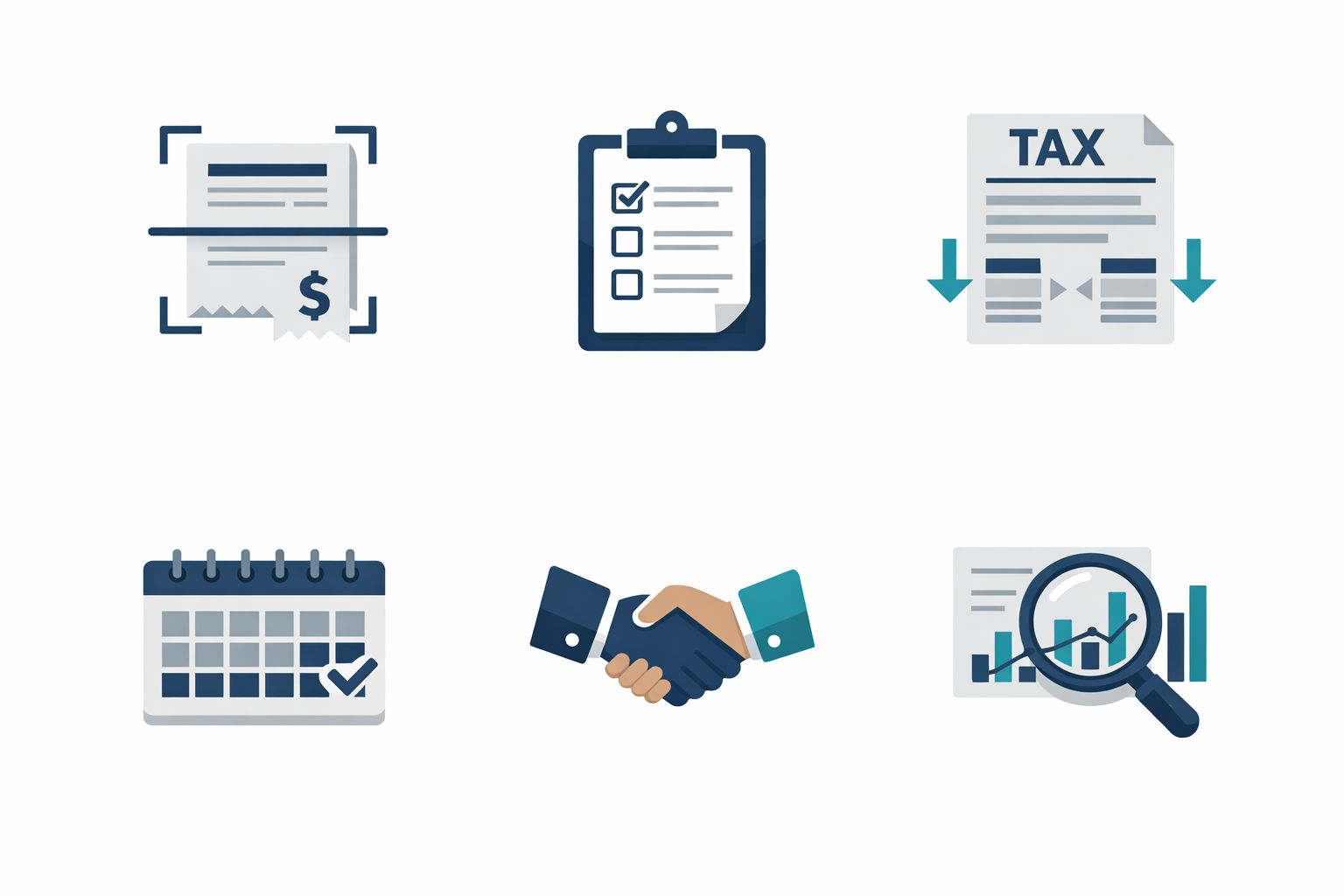
1. Invoice and Receipt Processing Automation
This is usually the easiest first sale. AI-powered OCR tools can extract data from invoices and receipts and push clean, categorized data into accounting systems like QuickBooks or Xero. Best-in-class setups achieve "no-touch" invoice processing rates of ~49% at around $3 per invoice. For firms handling hundreds of client invoices monthly, the time savings are immediate and obvious.
Sell this as: "Eliminate 80% of manual data entry time in AP/AR workflows."
2. Audit Prep Workflows
Audit fieldwork is labor-intensive and repetitive — journal entry testing, sample selection, evidence gathering, workpaper assembly. AI tools can automate full-population analytics (instead of sampling), flag anomalies, and pre-populate workpapers. KPMG's AI-powered audit tools reportedly reduced errors by 25% and streamlined reconciliations.
Sell this as: "Cut audit prep time by 40-60% while improving sample coverage from statistical to full-population."
3. Tax Document Extraction
During tax season, firms manually process thousands of W-2s, 1099s, K-1s, and bank statements. Document AI tools like SurePrep, GruntWorx, or custom OCR pipelines can scan, extract, and map data to return fields. Thomson Reuters reports that tax return preparation is one of the top five GenAI use cases in accounting firms already.
Sell this as: "Reduce tax prep data entry by 75% and free your senior staff for review and advisory."
4. Month-End Close Acceleration
The month-end close is a recurring bottleneck. AI can automate bank reconciliation (achieving 80%+ automation rates in tools like Xero JAX), auto-categorize transactions, and generate draft financial statements. For CAS (Client Advisory Services) practices, this is a direct capacity multiplier.
Sell this as: "Take your close from 8 days to 3 days — every single month."
5. Client Onboarding Automation
New client intake is a surprisingly high-friction process: engagement letters, KYC checks, document collection, system setup, §7216 consent. AI-powered portals (Liscio, TaxDome, Canopy) can automate document requests, chase missing items, and auto-populate practice management systems.
Sell this as: "Onboard new clients in 2 days instead of 2 weeks — with zero missing documents."
6. Anomaly Detection for Bookkeepers
ML tools can flag unusual transactions, duplicate entries, and potential misclassifications in real time — before they cascade into larger problems. Peer-reviewed research confirms that ML in accounting firms is "predominantly employed for assurance-oriented tasks like transaction scoring, anomaly detection, and testing" (ScienceDirect). For bookkeeping practices, this directly reduces error correction time and improves client trust.
Sell this as: "Catch errors automatically before they hit financial statements — reduce corrections by 95%."
Do not pitch "AI strategy," "digital transformation," or vague "AI-powered advisory" to accounting firms. Partners will nod politely and never call back. Accounting buyers want task-specific time savings with measurable ROI — not a vision deck. If you can't answer "how many hours per month does this save and what does it cost?" you're not ready for this vertical. Read more on framing conversations for SMB buyers.
How to Position the Engagement
Accounting partners care about three metrics. Frame every conversation — from the first email to the final proposal — around these:
- Hours saved per month. This is the primary currency. A managing partner mentally converts this to "how many staff members' worth of capacity am I recovering?" If your automation saves 120 hours/month, that's nearly a full-time employee.
- Error reduction rate. In accounting, errors create cascading problems — restatements, client complaints, regulatory scrutiny. Position AI as a quality control layer, not just a speed tool.
- Staff capacity recovered. With 86% of firms struggling to hire, you're not competing against "do nothing" — you're competing against the partner's alternative of paying overtime, turning away clients, or outsourcing to an offshore provider.
Never lead with technology. Don't explain how the model works. Don't mention "tokens" or "embeddings." Talk about outcomes in language the managing partner already uses.
As one practice technology consultant put it: "A year ago, partners were asking me whether AI was going to displace their juniors. Now they're asking which workflow they should automate first." (Rebecca Kahn, AWSCPA Journal). The question has become operational. Meet them there.
Pricing Benchmarks for Accounting Firm AI Engagements
Pricing AI consulting for accounting firms follows a predictable tiered structure. Here's what the market actually looks like, based on current practitioner data and industry pricing guides.
| Engagement Type | Scope | Price Range | Timeline |
|---|---|---|---|
| Paid Discovery / AI Readiness Assessment | Workflow audit, readiness scoring, prioritized roadmap, executive brief | $5,000 – $15,000 | 1–2 weeks |
| Single Workflow Automation | One automation pipeline (e.g., invoice processing, tax doc extraction) | $25,000 – $65,000 | 4–6 weeks |
| Multi-Workflow Implementation | 2-3 workflows with cross-system integrations, dashboards, and training | $75,000 – $120,000 | 6–8 weeks |
| Full Practice Automation Package | End-to-end automation across tax, audit, and CAS with custom interfaces | $120,000 – $180,000 | 10–14 weeks |
| Retained Advisory | Ongoing optimization, new use case identification, governance support | $3,000 – $8,000/mo | 6–12 month contracts |
AI consulting pricing benchmarks for accounting firm engagements (2025-2026 market data)
A few important notes on pricing this vertical:
Start with a paid discovery — always. The readiness assessment is your highest-leverage move. It builds trust, surfaces real data about the firm's workflows, and positions you as a diagnostic expert rather than a vendor. A $5K–$15K fixed-fee assessment that delivers a scored readiness report and prioritized roadmap is the single best way to open an accounting firm engagement. More on building this into your qualification process in our guide on prospect scoring for AI consulting.
Price on outcomes, not hours. Accounting partners instinctively compare your hourly rate to their own billing rate (typically $200-400/hr). Fixed-fee project pricing sidesteps this comparison entirely and lets you capture the value of the automation, not just the labor of implementing it.
The retained advisory locks in LTV. Once you've built automations, the firm needs ongoing support: optimizing prompts, adding new use cases, monitoring accuracy, updating governance policies. A $3K-$8K/month retainer on a 12-month contract turns a one-time project into a $36K-$96K annual relationship — and firms rarely churn because switching costs are high. That's the kind of engagement structure we see among the most successful consultants building repeatable consulting verticals.
Handling the Three Objections That Kill Accounting Deals
Every consultant targeting this vertical will hit the same three objections. Here's how to address each one without being defensive.
Objection 1: "We can't put client data into AI tools."
Why they say it: 70% of accounting professionals are concerned about data security related to AI (Ace Cloud Hosting). They've heard horror stories about staff pasting client tax data into ChatGPT. And 23% of firms report AI has already negatively affected their data security.
How to handle it: Acknowledge the concern as legitimate — because it is. Then explain the difference between consumer AI tools and enterprise deployments. Your implementation uses encrypted, SOC 2-compliant environments where client data is never used for model training. You help them build an AI usage policy that specifies approved tools, prohibited data inputs, and mandatory human review for client-facing work.
The line: "You're right to be cautious — 58% of firms don't even have security policies for AI yet. That's exactly what our engagement builds before any automation goes live."
Objection 2: "What about client confidentiality and our professional obligations?"
Why they say it: CPAs have specific ethical obligations under the AICPA Code of Professional Conduct and Circular 230. They're worried about malpractice liability if AI-generated work product contains errors.
How to handle it: Position your solution as human-in-the-loop, not human-replacement. AI handles the extraction, categorization, and first-pass work. A qualified professional reviews every output before it reaches a client. You also help them document their AI governance framework — which, if regulators or insurers ever ask, becomes a defense rather than a liability. For contract protection specifics, see our guide on AI consulting liability and contracts.
The line: "AI doesn't sign the return. Your CPA does — after reviewing AI-assisted work that's already more accurate than manual entry. We build the review checkpoints and audit trails that make that workflow defensible."
Objection 3: "We tried [software X] and it didn't work."
Why they say it: Many firms have already bought tools that underdelivered. Only 13% of CAS practices actively build their own automation — the rest rely on vendor tools that often don't integrate cleanly with existing systems.
How to handle it: This is actually your best opening. Failed tool adoption means the firm has budget, intent, and pain — they just lacked implementation expertise. Position yourself as the integration layer between their existing tech stack and the AI tools that actually work for their specific workflows. You're not selling another tool. You're making their existing tools finally deliver on the promise.
The line: "You don't have a technology problem — you have an integration problem. That's exactly what we solve."
The Engagement Opener: Lead with an AI Readiness Assessment
The single best way to start an accounting firm engagement is a formal AI readiness assessment with a scored report. Here's why this works better than any other approach for this vertical:
It matches their buying psychology. Accounting partners are analytical. They want data before they commit. A structured assessment that scores their firm across dimensions like data quality, process standardization, tech stack maturity, and team readiness gives them exactly what they need to make a decision.
It surfaces the real opportunities. You can't scope a meaningful engagement from a 30-minute discovery call. A 1-2 week readiness assessment lets you actually observe workflows, interview staff, and identify the highest-ROI automation targets. The roadmap you deliver becomes the natural SOW for the implementation phase.
It builds trust before you propose scope. When you present findings with a professional, scored readiness report — covering where they stand, what to prioritize, and what to defer — you demonstrate competence before asking for a larger commitment. Partners who see this kind of rigor in the assessment assume the implementation will be equally rigorous.
It de-risks the engagement for both sides. The firm gets clarity and a documented plan for $5K-$15K before committing to a $50K+ implementation. You get qualified data to scope accurately and avoid the scope-creep disasters that kill profitability. As we've written about in our guide on building an AI data strategy before implementation, the consultants who diagnose before they prescribe are the ones who build sustainable practices.
The Bottom Line
Accounting is a vertical where the macro tailwinds — a permanent talent shortage, Big Four competitive pressure, and exploding client demand for efficiency — are all pushing in your direction. Firms at the highest technology maturity levels already report 39% more revenue per employee (Rightworks). The ones that haven't gotten there yet need exactly what you sell.
But you won't win these deals by talking about AI. You'll win them by talking about hours saved, errors eliminated, and staff capacity recovered. Lead with a paid readiness assessment. Sell specific workflow automations. Price on outcomes. Handle the data security conversation proactively. And build a retained advisory relationship that compounds over time.
The accounting firms that move now will create a permanent competitive advantage. The consultants who help them get there will build one too.
