

Here's what most AI consultants get wrong about healthcare: they think it's too regulated, too slow, and too complex to be worth the effort.
Meanwhile, private practices are getting squeezed from every direction. PE-backed groups are buying up competitors at a 600% faster rate than a decade ago. Physician shortages are projected to hit 86,000 by 2036 — and 47 states will have primary care deficits by 2037. The average physician now spends two hours on administrative work for every one hour of patient care, according to AMA data.
These practices don't have the margins to hire their way out of the problem. But they do have budget for technology that works — and a desperation level that shortens sales cycles considerably.
The global healthcare AI market hit $36.7 billion in 2025 and is growing at a 38.9% CAGR. But that figure includes enterprise EHR deployments, imaging AI, and hospital-system rollouts that most independent consultants will never touch. The real money for solo consultants and small agencies sits in private practices: clinics with 3–15 providers, specialty groups, dental practices, and small ambulatory surgery centers.
These buyers have three things that matter:
- Real, measurable pain. A practice with 8 physicians is collectively losing 96–160 hours per week to paperwork, prior authorizations, and charting.
- Discretionary budget. Practice owners control their own spending decisions — no 18-month hospital procurement cycles.
- Competitive urgency. Every quarter an independent practice stays manual, the PE-backed group across town gets more efficient.
43% of medical groups added or expanded AI in 2024, up from just 21% in 2023 (MGMA). But the majority still haven't — and they're actively looking for guidance. That's the window.
But here's the catch: healthcare will punish you if you walk in with the same pitch you used for marketing agencies. You need to know what sells, what doesn't, what to charge, and how to talk about compliance before they ask.
57% of physicians say automating administrative burdens is the biggest AI opportunity (AMA, 2024). Specifically:
- 80% want AI for billing codes, charts, and visit notes
- 71% want AI for insurance prior authorization
- 72% want AI for discharge instructions and care plans
Frame your pitch around these numbers — not model architecture.
The 5 Use Cases That Actually Get Bought
There are dozens of AI applications in healthcare. Only a handful close consistently with private practices. Here's what they are, why they sell, what the ROI looks like from the buyer's side, and the approximate deal size you should target.
These use cases have one thing in common: none of them touch clinical decision-making. They're all about removing friction from the business of running a practice — and that's exactly where practices feel the pain most acutely.
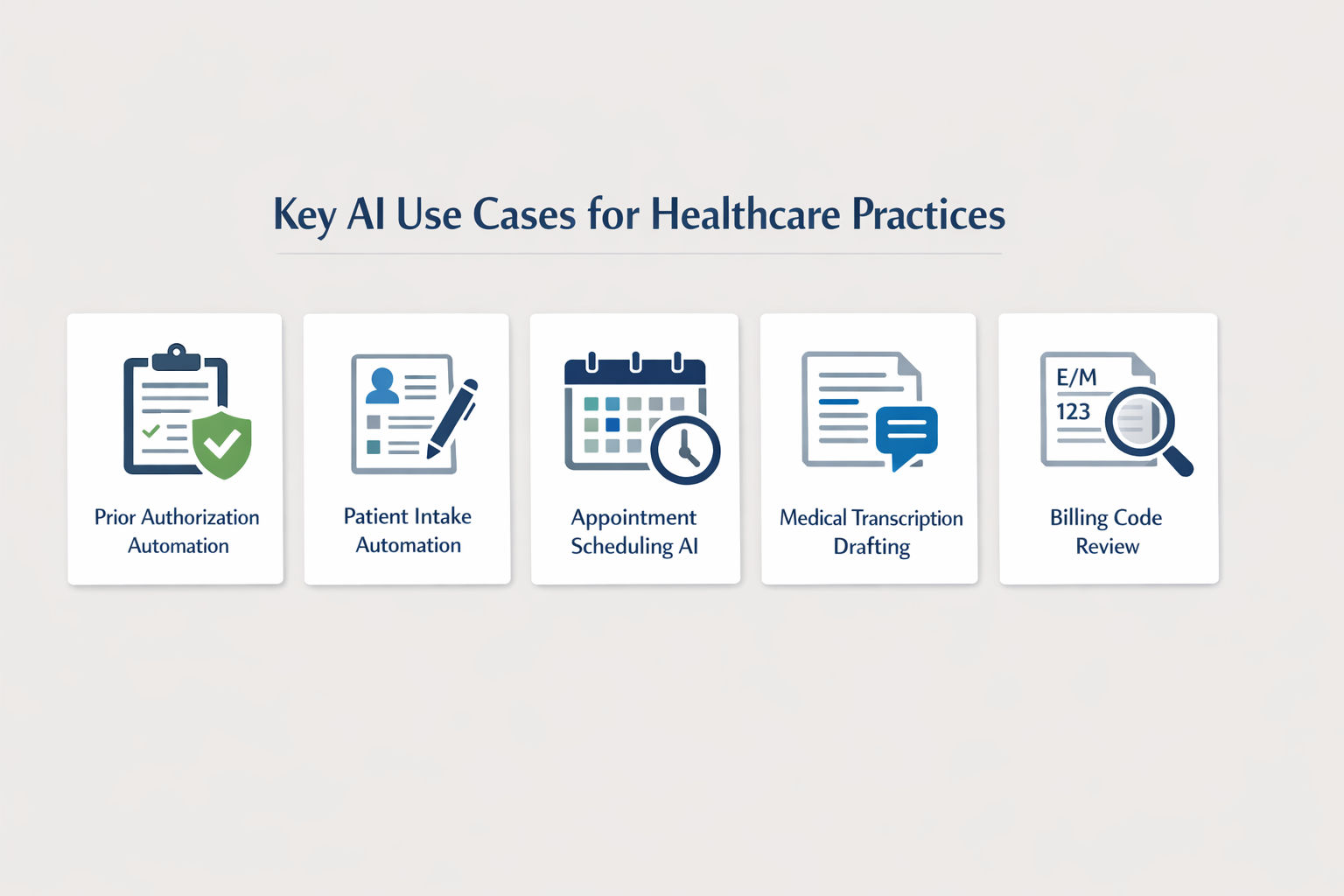
1. Prior Authorization Workflow Automation
The pain: Physicians spend 12–14 hours per week on prior authorizations, handling 39–43 requests per physician per week. Each manual request takes roughly 20 minutes. That's nearly two full workdays per physician, per week, lost to insurance paperwork. The collective labor cost is staggering — provider staff spend the equivalent of more than 100,000 full-time registered nurses per year on prior authorization alone.
What the solution looks like: AI-driven workflow tools that automatically pull relevant chart data, complete clinical forms, check payer requirements, and flag missing documentation before submission. Not decision-making — just intelligent automation of the mechanical steps.
The ROI framing for the buyer: A practice with 5 physicians losing 60+ hours/week to prior auth. AI can cut per-case time from 20 minutes to 7–10 minutes — a 50–65% reduction. That's 30+ physician-hours recovered per week. At a blended rate of $150–$200/hour, you're talking about $4,500–$6,000 in weekly productivity recovery. AI-enhanced authorization workflows have been shown to reduce claim holds by 35% and insurance-related denials by 10.6% (athenahealth, 2024).
Approximate deal size: $25K–$75K for assessment + implementation with a single practice. Ongoing support at $3K–$8K/month. This use case scales well across multi-location groups.
2. Medical Transcription & SOAP Note Drafting
The pain: Physicians spend 40% of their time on documentation. Chart review alone consumes 32.1% of EHR time. After-hours charting is a primary driver of burnout — 22.5% of physicians spend more than 8 hours on the EHR outside regular work hours.
What the solution looks like: Ambient AI scribes that listen to patient conversations and automatically generate structured SOAP notes (Subjective, Objective, Assessment, Plan). These are plug-and-play tools — most run $99–$299/month/provider from vendors like Suki, DeepScribe, Commure, and Twofold. As a consultant, you're not building the scribe. You're selecting, configuring, training, and integrating.
The ROI framing for the buyer: Human scribes cost $33,000–$55,000 per year per FTE. AI scribes cost $99–$299/month — roughly 90–95% less. A randomized controlled trial at UCLA found ambient AI scribe users spent 9.5% less time on notes. A JAMA study at UCSF found AI scribe users generated 5.8% more work units and $3,044 in additional revenue per physician per year. For a 6-physician practice, that's $18,264 in additional annual revenue from the revenue side alone — plus the documentation time savings.
Approximate deal size: $15K–$35K for vendor selection, configuration, EHR integration, and staff training. Monthly management retainer at $2K–$5K.
3. Patient Intake Automation
The pain: Paper forms, duplicate data entry, illegible handwriting, missing insurance information, and front-desk staff spending 40% of their day on data entry instead of patient-facing work. This is the operational bottleneck that patients hate and staff resent.
What the solution looks like: AI-powered digital intake forms with intelligent field extraction, insurance card scanning and verification, and automated EHR population. Patients complete forms on a tablet or phone before arrival. Data flows directly into the practice management system.
The ROI framing for the buyer: Front-desk staff typically spend 15–20 minutes per patient on intake paperwork. For a practice seeing 80 patients/day, that's 20–27 hours of staff time daily. Automation can cut that by 60–70%. AI-based intake also reduces data entry errors — which cascade into billing problems downstream. The no-show rate improvement alone (from 19.3% to 15.9% in one study, by combining AI intake with smart reminders) translates to thousands in recovered revenue monthly for a busy practice.
Approximate deal size: $20K–$50K for workflow redesign, tool implementation, and EHR integration. This use case often gets bundled with scheduling (below) for a larger engagement.
4. Appointment Scheduling AI
The pain: Practices lose 15–20% of appointment slots to no-shows. The manual rescheduling dance — phone tag, voicemail, missed calls — consumes hours of front-desk time daily. And when patients can't easily find open slots, they go elsewhere.
What the solution looks like: AI scheduling tools that predict no-show probability, automatically trigger reminders via SMS/email, offer self-service rescheduling, and optimize provider calendars based on visit type, complexity, and historical patterns.
The ROI framing for the buyer: AI-based scheduling strategies reduce combined waiting times and overtime costs by 15–40%. No-show rates drop 3–4 percentage points — for a practice with 200 appointments/week at $150 average revenue per visit, that's $3,600–$4,800 in recovered revenue monthly. Plus front-desk hours freed for higher-value work.
Approximate deal size: $15K–$30K for standalone scheduling AI. Often more valuable when bundled with intake automation at $35K–$65K combined.
5. Billing Code Review & Revenue Cycle Optimization
The pain: Medical billing errors cost practices 5–10% of annual revenue. Coding mistakes trigger denials, rework, and delayed payments. NLP-assisted coding has been shown to improve accuracy by up to 22% and reduce compliance violations by 18% (HFMA, 2024). RPA-driven revenue cycle automation saves 1,500–3,000 staff hours annually per hospital — and while private practices are smaller, the proportionate impact holds.
What the solution looks like: AI tools that review billing codes against clinical documentation before submission, flag potential under-coding or up-coding risks, and identify patterns in denied claims. This is not autonomous billing — it's an intelligent review layer that catches what human reviewers miss.
The ROI framing for the buyer: A practice with $3M annual revenue losing 5–7% to billing errors is leaking $150K–$210K per year. AI-assisted review can recover 40–60% of that leakage. One practice-level report documented $155K in annual savings, 82% reduction in processing time, and $2.3M additional revenue from improved coding accuracy.
Approximate deal size: $30K–$60K for initial audit, tool implementation, and workflow redesign. Monthly optimization retainer at $4K–$10K depending on practice size.
What NOT to Pitch: Stay Out of Clinical Decision-Making
This is where consultants blow up their credibility — and potentially their liability exposure.
Anything that touches diagnosis, treatment recommendations, risk stratification for clinical outcomes, medication dosing suggestions, or image interpretation falls into FDA-regulated territory. The FDA's Clinical Decision Support guidance (revised January 2026) draws the line: if your AI tool is intended to make a specific clinical recommendation that a clinician would primarily rely on — it's potentially a medical device requiring FDA clearance.
Even if you technically fall outside FDA jurisdiction under the revised guidance, the liability doesn't disappear. As one analysis put it: "The space between 'not a device' and 'not liable' is considerably larger than most teams appreciate." If your AI suggests a treatment path and something goes wrong, you're in the chain of liability — with no regulatory safe harbor to point to.
The practical rule: If a physician could reasonably say "the AI told me to do it" as a defense — don't build it, don't sell it, don't touch it.
Safe to pitch (operational/admin):
- Prior auth workflow automation
- SOAP note drafting from conversation
- Appointment scheduling and reminders
- Patient intake and form processing
- Billing code review against documentation
- Claims denial pattern analysis
Do not pitch (clinical decision-making):
- Diagnostic suggestions based on symptoms
- Medication or dosage recommendations
- Radiology or pathology image interpretation
- Patient risk scoring for clinical outcomes
- Treatment pathway recommendations
- Anything a malpractice attorney could describe as "the AI told the doctor what to do"
How to Price Healthcare AI Engagements
Healthcare has budget — but it's also the most risk-averse vertical you'll sell into. Practices have been burned by software that overpromised and underdelivered. They won't write a $100K check on a handshake.
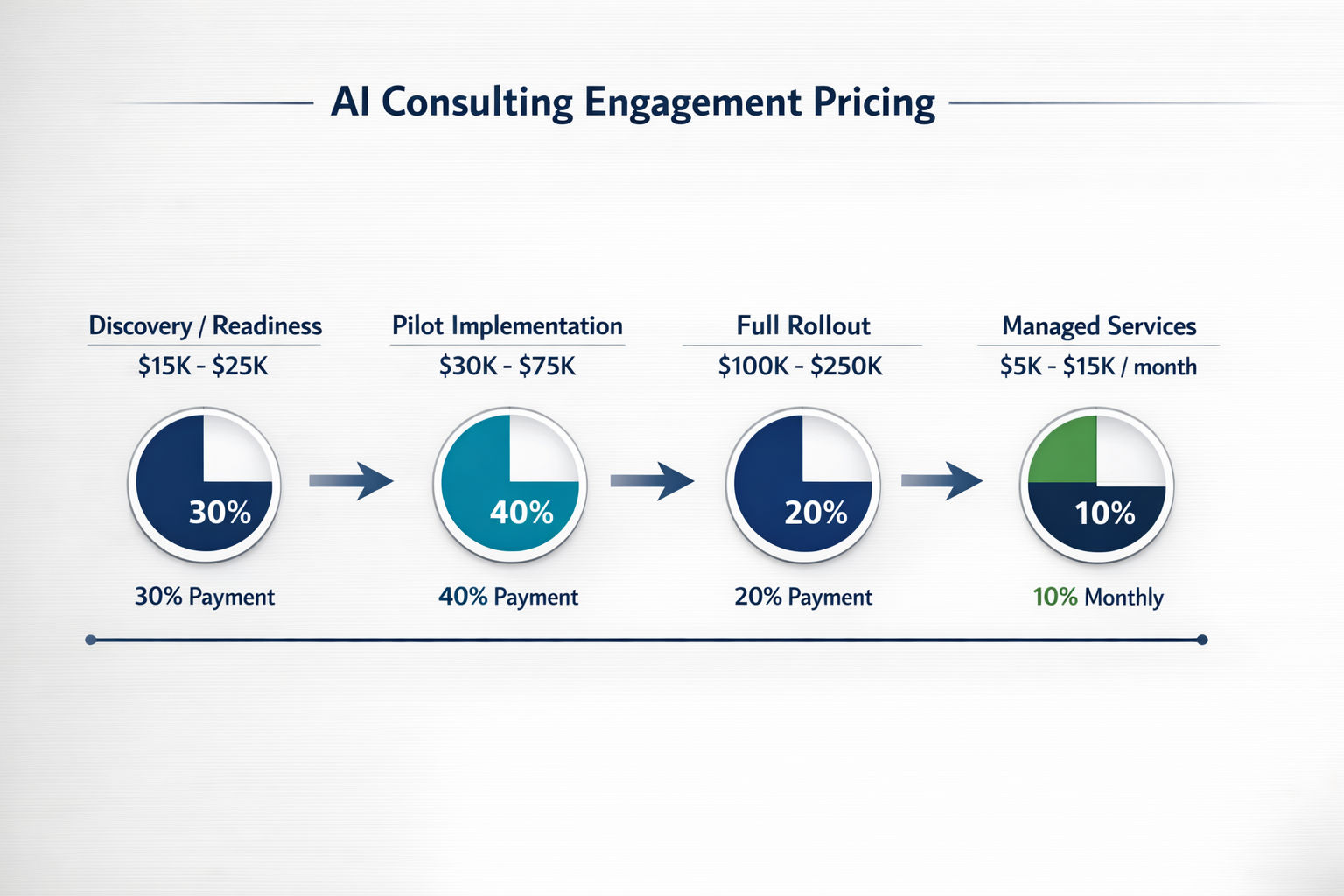
The pricing model that works best is milestone-based with clear deliverables at each stage. This mirrors how practices buy everything else — equipment, EHR modules, even associate buy-ins. They want to pay for progress, not promises.
Here's the structure that consistently closes:
Phase 1: Readiness Assessment & Roadmap
$15K–$25K | 2–4 weeks
Deliverables: HIPAA compliance posture review, data readiness audit, workflow mapping, use case prioritization, vendor shortlist, ROI projections per use case. This is your foot in the door — and it's profitable on its own.
Phase 2: Pilot Implementation (1–2 Use Cases)
$30K–$75K | 6–12 weeks
Deliverables: Tool configuration, EHR integration, staff training, compliance documentation, 30/60/90-day performance benchmarks. Payment split at 20% upfront, 30% at configuration complete, 30% at go-live, 20% at 90-day review.
Phase 3: Full Rollout or Additional Use Cases
$100K–$250K | 3–6 months
For practices that proved ROI in the pilot and want to scale. Multi-location groups, larger specialty practices, or practices adding adjacent use cases.
Phase 4: Managed Services & Optimization
$5K–$15K/month ongoing
Ongoing monitoring, model retraining, compliance updates, vendor management, quarterly performance reviews. This is where you build real LTV.
Why hourly billing fails here: Practices don't budget for "hours of consulting." They budget for outcomes — reduced denial rates, fewer staff overtime hours, faster patient throughput. Price against the outcome, not the input. A practice losing $200K/year to billing errors will pay $60K to recover $120K. But they won't approve "200 hours at $300/hour" — it sounds like an open-ended liability.
For a deeper dive on pricing models and how to structure discovery into a paid engagement, read our AI for Accounting Firms playbook — the milestone structure translates directly to healthcare.
The Compliance Framing That Unlocks the Conversation
Most consultants treat HIPAA as a checkbox at the end of the sales process. In healthcare, that's backwards.
Leading with compliance is the single fastest way to differentiate yourself. Practice managers have been burned by software vendors who didn't understand HIPAA — or worse, said they were compliant but couldn't produce a BAA. When you bring up compliance before they ask, you signal that you're not another tech generalist winging it in a regulated industry.
This matters because the enforcement landscape has shifted dramatically. AI-related HIPAA enforcement actions rose 340% in 2025. The largest HIPAA settlement that year — $12.5 million — was tied to AI-related data risk and inadequate vendor management. OCR now expects covered entities to conduct AI-specific risk analyses, not just generic HIPAA checklists. Standard BAAs are no longer considered sufficient for AI tools.
What you need to know (and say):
"We'll execute a BAA before any patient data touches the system." A Business Associate Agreement is the legal prerequisite for processing PHI. If you can't produce one — or don't know what it is — stop and fix that before taking another healthcare meeting. Your BAA needs AI-specific language addressing model training data, data retention, and sub-processor access.
"The AI tools we deploy operate with minimum necessary access to PHI." HIPAA requires that only the data essential for the function be accessed. Your architecture needs to demonstrate least-privilege access — and you need to be able to explain it in plain English.
"All PHI processing happens in HIPAA-compliant environments with BAAs from every sub-processor." That means your cloud provider, your analytics tools, your monitoring stack — anyone who can see PHI needs a BAA. This is where most consultants get tripped up. If you're using a non-HIPAA-compliant AI platform to process clinical notes, you're the liability.
"We document every AI interaction with PHI for audit purposes." Audit logging isn't optional. If OCR investigates, you and the practice need to produce a clear record of what data was processed, by which system, for what purpose, and with what outcome.
For a deeper regulatory briefing before your first healthcare conversation, read AI for Healthcare: What Consultants Need to Know Before Selling In.
How to Run a Discovery Call with a Practice Manager
Practice managers and office administrators are your primary buyers — not the physicians. The docs have veto power, but the practice manager owns the operations budget and lives in the administrative pain you're solving.
Here are the questions that separate consultants who understand healthcare from those who don't:
Don't ask: "What AI problems are you trying to solve?"
They don't think in terms of AI. They think in terms of broken workflows.
Ask instead:
"Walk me through what happens when a prior authorization gets denied. Who touches it, how long does it take, what's the financial impact?"
This surfaces the real pain — not the sanitized version they'd tell a vendor. Listen for the number of staff touches, the turnaround time, and whether denials are tracked or just absorbed.
"What's the one administrative task that makes your best staff member threaten to quit?"
Every practice has one. It's usually prior auth, charting, or insurance verification. This question gets a visceral answer that tells you where the urgency lives.
"How many hours per week are your physicians spending on the EHR outside of patient-facing hours?"
If they don't know the number — but they know it's bad — that's your opening. Frame your solution around recovering those hours.
"What's your denial rate on first-pass claims? Do you track it by reason code?"
Practices that track this are ready for revenue cycle AI. Practices that don't — but wince when you ask — need an assessment first. Either way, the question demonstrates domain expertise.
"Who handles your HIPAA compliance, and when was your last risk analysis conducted?"
This does double duty: it surfaces the compliance maturity of the practice and signals that you operate at a level most vendors don't. If they can't answer, you've just created urgency around the compliance component of your engagement.
"If we recover 30 hours of physician time per week and reduce your denial rate by 15%, what does that mean for this practice financially?"
Don't tell them the ROI. Make them calculate it. When they say the number out loud, they're selling themselves.
The goal of the discovery call isn't to pitch AI. It's to get them to articulate the cost of doing nothing — in their own words and numbers. Once that number is on the table, your engagement fee looks cheap.
For the full sales conversation playbook — including how to handle the "my doctors won't use it" objection — read How to Sell AI to a Medical Practice Without the Jargon.
Getting Your Foot in the Door: Start with Readiness
The biggest mistake consultants make in healthcare is leading with a solution before the practice knows what they need — or what they're ready for.
Practices that jump straight into AI implementation without assessing their workflow readiness, data quality, and HIPAA posture routinely waste $100K–$500K on tools that don't fit. A structured readiness assessment does three things: it de-risks the engagement for the buyer, surfaces compliance gaps they didn't know they had, and positions you as the strategic advisor — not just another vendor.
ConsultKit's AI Readiness Assessment adapts to healthcare clients with compliance-specific modules that surface HIPAA readiness gaps, data handling maturity, and staff preparedness — before the first tool is ever discussed. When you can walk into a discovery call and say "here's exactly where your practice stands on AI readiness, including your compliance posture," you're not selling anymore. You're advising. And that's the consultant who closes.
