
You're on a discovery call with a 200-person logistics company. They're excited about automating invoice processing. You scope the project, talk timelines, quote a number. Somewhere around minute 40, someone asks: "What about compliance? Do we need an AI governance framework?"
You give a vague answer. Something about best practices and revisiting it later. The call ends. You never bring it up again.
That question was worth $15,000–$50,000 in standalone revenue — and you just let it evaporate.
Here's what most AI consultants get wrong about governance: they treat it as a conversation, not a product. An afterthought tacked onto the end of an implementation project, or worse, something they discuss for free during a sales call to "build trust." Meanwhile, the AI governance consulting market is projected to grow at 28–35% CAGR through 2029, according to McKinsey — and only 25% of organizations have fully implemented governance programs (AuditBoard, 2025).
The gap between demand and supply is enormous. And the consultants who productize governance now — as a standalone, billable service with clear deliverables — will own this category before the Big 4 even look downstream.
Governance Is Now a Buyer-Initiated Conversation
Two years ago, you had to convince clients that AI governance mattered. Today, they're bringing it up themselves. Here's why the market shifted:
The EU AI Act is no longer theoretical. The penalty regime became applicable on August 2, 2025. Fines run up to €35 million or 7% of global annual turnover for prohibited AI practices. Even for less severe violations — like failing to meet transparency or high-risk system obligations — penalties reach €15 million or 3% of turnover. Your mid-market clients with European customers or employees are now in scope, whether they realize it or not.
SEC pressure is building. The SEC's Investor Advisory Committee formally recommended AI-specific disclosure guidance in December 2025, including requirements for companies to disclose board oversight of AI deployment. Approximately 61% of SEC staff comment letters addressing AI asked companies to clarify how AI is used and what risks it creates (Harvard Law School Forum on Corporate Governance). If your clients have investors, board members, or public reporting obligations, governance isn't optional — it's a disclosure requirement in the making.
Agentic AI changed the risk calculus. When AI just generated text, the worst case was a bad email. Now AI agents move money, modify records, and trigger multi-step workflows autonomously. McKinsey highlights that the "key shift" is from systems that enable interactions to systems that "drive transactions that directly affect business processes." Credo AI warns that agents often operate with "more effective permissions than your human staff and far less scrutiny" — turning AI into an organization's "biggest unmanaged super-user." This isn't hypothetical risk. Stanford HAI documented 362 AI incidents in 2025, up 55% from 233 the year before.
- Only 43% of organizations have an AI governance policy. 29% have none at all (PEX Report 2025/26).
- 62–68% of mid-market organizations lack a dedicated AI governance role (Gartner, 2024).
- ~50% of small businesses using AI have made zero investment in training, integration, or governance (SBA, 2025).
- AI incidents rose 55% year-over-year in 2025 (Stanford HAI).
What this means for you: Your clients are Googling "AI governance framework" right now — not because you told them to, but because their lawyers, board members, insurers, and trading partners are asking questions they can't answer. If you're not the one who fields that call, someone else will be.
How to Productize Your AI Governance Framework Into a Sellable Service
Governance isn't vague. It's a structured set of deliverables that solves a specific, urgent problem. The consultants who make the most from ai governance consulting treat it exactly like they'd treat any other productized offer: defined scope, concrete outputs, fixed timeline.
Here are three tiers that work — modeled on pricing benchmarks from industry reports (Helium 42, Trussed AI) and real consulting engagements.

| Service Tier | What You Deliver | Timeline | Price Range |
|---|---|---|---|
| **Tier 1: Governance Audit** | AI use inventory, risk register (scored & prioritized), regulatory gap analysis, 12-month remediation roadmap | 4–6 weeks | $15,000–$50,000 |
| **Tier 2: Full Framework Buildout** | AI Acceptable Use Policy, Risk Classification System, Incident Response Protocol, Decision Rights Matrix, Board Reporting Template, Staff Training Curriculum | 8–16 weeks | $40,000–$150,000 |
| **Tier 3: Governance Retainer** | Quarterly risk register reviews, policy updates for new regulations, new AI use case approvals, incident response support, board-ready reports | Ongoing (monthly) | $3,000–$8,000/mo |
Governance service tiers based on 2025 industry pricing benchmarks (Helium 42, Trussed AI, Gartner)
What's Actually in the Box?
Let's get specific about the deliverables that justify these prices, because your client isn't buying "governance" — they're buying artifacts they can show a board, a regulator, or an insurer.
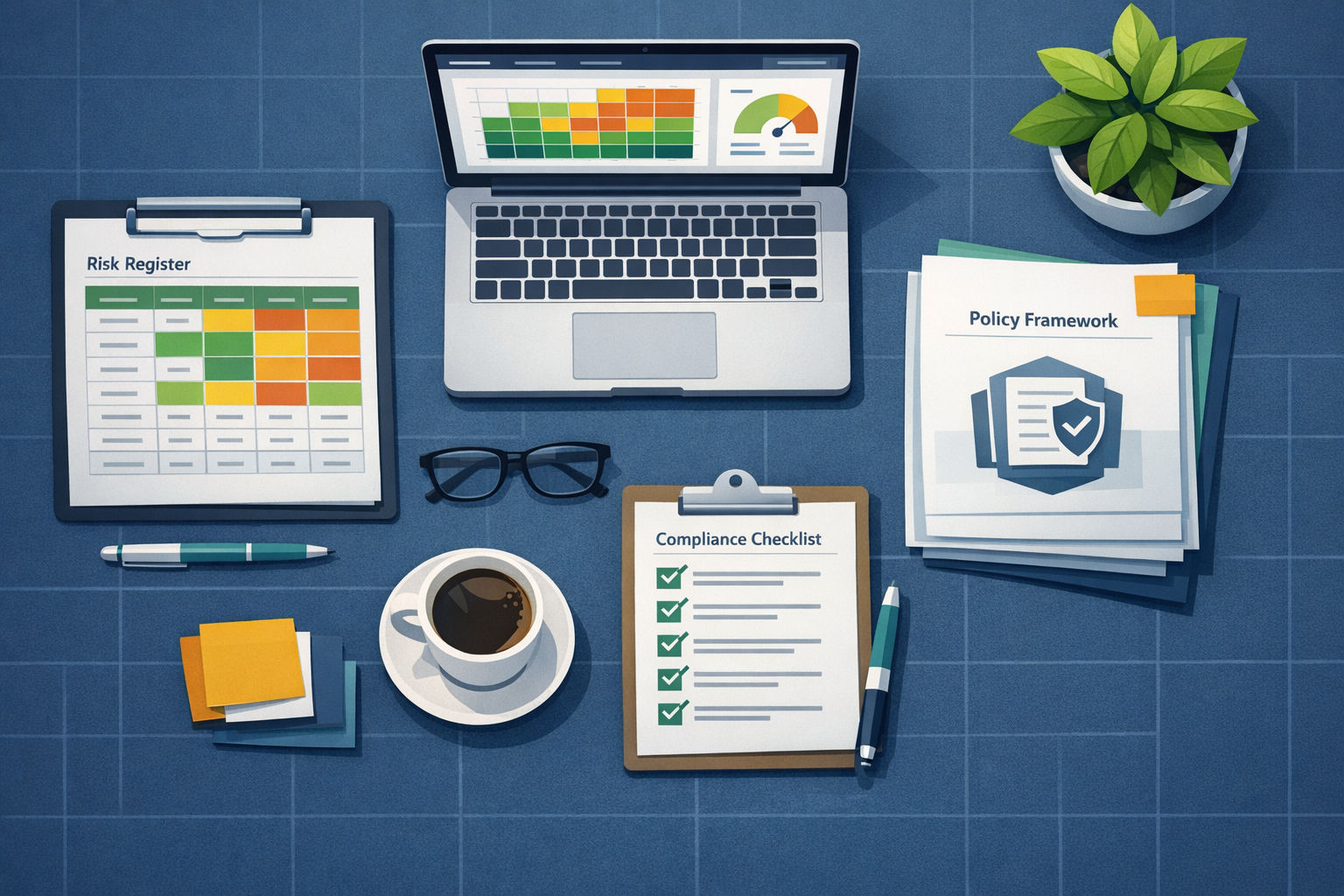
AI Risk Register: A scored, prioritized document listing every AI system in use, its risk category (data privacy, bias, security, operational disruption, regulatory compliance), likelihood and impact scores using a standard 1–5 scale, named owners, and mitigation plans. Use RAG-banded scoring: green (monitor), amber (mitigate on schedule), red (prioritize now), critical (immediate action, board visibility). Every risk gets one named owner — not a department. A risk owned by "the team" is owned by nobody.
AI Acceptable Use Policy: Plain-language rules about what AI can and can't be used for, data handling requirements, human oversight triggers, and escalation paths. This isn't a 60-page compliance tome — it's a 5–10 page document your client's ops manager can actually follow.
Incident Response Protocol: What happens when an AI system produces a biased output, leaks sensitive data, or makes an autonomous decision that causes financial harm? Define response SLAs (critical issues escalated within 15 minutes, minor deviations within 24 hours), communication chains, and remediation procedures.
Decision Rights Matrix: Who can approve deploying a new AI system? Who can expand an agent's permissions? Who reviews model retraining? This is especially critical for agentic AI deployments, where agents may operate across finance, HR, and customer systems without explicit human sign-off.
Notice that every deliverable is tangible, auditable, and referenceable. Your client can hand the risk register to their insurance broker. They can show the policy to a regulator. They can present the board reporting template at their next quarterly meeting. That's what makes governance worth $15K–$150K — it's not advice, it's infrastructure.
The Pricing Math: Why Governance Commands a Premium
Governance consulting carries a 20–40% price premium over standard AI implementation work, according to multiple industry surveys. Here's why that premium is justified — and how to position it:
Risk-based ROI is enormous. Deloitte data (via Helium 42) shows that governance engagements in the £80K–£150K range deliver 200–2,000%+ ROI in avoided regulatory risk within 12 months. When the EU AI Act penalty for a high-risk violation is €15 million, a $40K framework buildout isn't a cost — it's insurance that pays for itself 375x over.
The comparison isn't other consulting — it's the cost of not having governance. Frame your pricing against the cost of a regulatory fine, a data breach, or a failed AI project. MIT research found that one in four AI projects fail due to weak governance. Companies with strong governance see 27% higher efficiency gains from their AI investments.
For smaller clients, your Tier 1 audit at $15K–$25K sits in the same budget line as a fractional CFO engagement. For mid-market, the full framework at $40K–$100K costs less than one quarter of a full-time compliance hire. Position governance alongside what they're already spending, not against your other AI services.
A governance audit at $20K that converts to a full framework at $75K and then an ongoing retainer at $5K/month is worth $155K in year one — from a single client. That's more than most consultants make from the implementation project itself. And unlike implementation, governance has almost no tooling costs. Your margins are 70–85%+. This is the kind of service stacking that turns a paid AI strategy workshop into the opening move of a six-figure relationship.
How to Introduce Governance During Discovery (Not as an Upsell)
The biggest mistake consultants make with governance isn't the packaging — it's the timing. If you bring up governance after you've already scoped and priced an implementation project, it feels like an upsell. The client's defenses go up. They mentally categorize it as "nice to have."
Instead, surface governance during discovery — before you've discussed any implementation. Here's a framework that works:
The Three-Question Governance Opener
During your initial discovery call, after you've identified the client's AI use cases or ambitions, ask:
-
"Who in your organization currently approves new AI tools or use cases before they go live?" (Most will say nobody — or "IT, I think." This reveals the governance vacuum without you naming it.)
-
"If one of your AI systems made a decision that led to a customer complaint or a regulatory question, what's your response process?" (Almost universally, the answer is silence. This is your incident response gap.)
-
"Have any of your clients, partners, or insurers asked about your AI policies in the last six months?" (Increasingly, the answer is yes — and the client had nothing to show them.)
These three questions do the selling for you. You're not pitching governance — you're letting the client discover they need it. After they've answered, you can say: "This is really common. Most of our clients are in the same spot. We actually have a structured governance audit that maps exactly where these gaps are and gives you a prioritized plan to close them. It's typically a 4–6 week engagement — want me to send over the scope?"
That's not an upsell. That's a diagnosis followed by a treatment plan.
Surface the Gap in Discovery
Send the AI Readiness Assessment Pre-Call
Position Governance as Phase Zero
Scope the Governance Audit Separately
Deliver the Audit, Then Upsell the Framework
Transition to Retainer
Handling the Two Objections You'll Hear Every Time
Governance isn't a hard sell in 2025. But there are two objections that still come up — and you need sharp, data-backed answers for both.
"We're too small to worry about this."
This is the most common pushback from SMBs. Here's your response:
"I hear that a lot. But the data says otherwise. 57–60% of small businesses are already using AI to some extent, according to the U.S. Chamber of Commerce. Meanwhile, about half of small firms using AI have made zero investment in any kind of training, integration, or oversight — that's from the SBA's own research. So you're using AI, you just don't have any guardrails around it. That's not 'too small to worry' — that's 'too exposed to ignore.' The EU AI Act doesn't have a small business exemption. And increasingly, your clients and insurers are asking about your AI policies. A governance audit for a company your size is $15K–$25K and takes four weeks. It's not an enterprise play — it's a risk management basic."
Gartner's finding that 62–68% of mid-market organizations lack a dedicated AI governance role means your prospect isn't unusual — they're the norm. That's precisely why external ai risk management consulting exists.
"We'll deal with it later."
This one is easier to counter, because "later" now has a deadline:
"I get it — it feels like something you can defer. But here's the timeline: EU AI Act penalties are live right now, as of August 2025. Most high-risk AI obligations become fully enforceable in August 2026. The SEC is moving toward mandatory AI disclosure guidance. And AI incidents are accelerating — up 55% year-over-year according to Stanford's AI Index. 'Later' used to be safe. Now it means you're building without a safety net while the regulatory window is closing. The audit takes four weeks. You'll have a risk register and a roadmap. And if nothing urgent surfaces, you've bought yourself documented proof that you're managing AI responsibly — which is exactly what an insurer, a client, or a regulator wants to see."
Surface Governance Gaps Before the First Call
The most effective way to sell governance isn't on a sales call — it's before the sales call.
ConsultKit's AI readiness assessment includes governance-specific questions that prospects answer before you ever get on the phone. Questions about existing AI policies, data handling procedures, incident response protocols, and risk ownership. By the time you open the call, you already have a scored snapshot of their governance maturity — and more importantly, they already know they have gaps.
This changes the sales dynamic completely. Instead of you raising governance and the prospect getting defensive, the prospect's own assessment results tell the story. You're not introducing a problem — you're confirming one they've already acknowledged.
Practically, this means:
- Your governance pitch is backed by their own data, not your opinion
- The audit feels like the logical next step, not a cold add-on
- You can qualify prospects faster by focusing on those with the widest governance gaps
- The assessment itself becomes a lead generation tool — embed it on your website, send it during outreach, use it in your cold outreach sequences
When governance gaps surface in a self-assessment, the client walks into the call already primed. That's the difference between selling governance and having governance sell itself.
A common trap: delivering a governance framework that sits in a drawer. Your deliverables need to be operational, not decorative. Build review cadences into the framework (monthly for active AI use cases, quarterly at the committee level). Make the risk register a living document — updated after incidents, vendor changes, or new deployments. If your client can't point to the register and show an insurer or regulator exactly who owns each risk and what's being done about it, you haven't delivered governance. You've delivered paperwork.
The Bottom Line: Governance Is a Product, Not a Paragraph
The AI governance market is approaching $1 billion. Your clients are already asking about it. Regulations are live and tightening. And the consultants who productize this — with clear tiers, defined deliverables, and a sales process that surfaces the need before the first pitch — will build practices that don't depend on the next implementation project to keep the lights on.
Stop treating governance as a talking point. Start treating it as a revenue line.
Here's what to do this week:
- Build your Tier 1 scope document. Define the audit deliverables, timeline, and price. Keep it to one page.
- Add governance questions to your discovery process. The three-question opener works immediately.
- Set up a pre-call assessment that includes governance-specific scoring. Let the data do the selling.
- Quote governance separately. Never bundle it into implementation. It has its own value.
Governance isn't an add-on. It's the foundation. And in a market where 29% of organizations have no AI governance policy at all, the consultant who shows up with a structured ai governance framework is the one who gets the contract.
