

You sat through the demo. The platform looked slick. The sales rep showed you a dashboard with your logo on it and said the words every consultant wants to hear: "Your clients will never know it's not yours."
So you signed. And then you tried to onboard your first real client.
The custom domain didn't work the way you expected. The reports still had the vendor's footer. The pricing that looked reasonable at 5 clients became margin-destroying at 15. And the data residency question your enterprise prospect asked? You didn't have an answer.
This is the pattern. Research from Parallel AI found that 67% of first-time white-label implementations fail in month two — not because the technology is bad, but because consultants evaluate platforms based on demos instead of delivery. They pick a white-label AI platform for consultants based on what it looks like rather than what it does under pressure.
This guide is the corrective. It's a buyer's framework — not a vendor comparison — built for consultants and agencies who already sell AI services and want to resell AI services at scale without building the tech. No product rankings. No affiliate links. Just the five criteria that predict success, the contract traps that destroy it, and the testing protocol that separates a platform you'll build your business on from one you'll regret in 90 days.
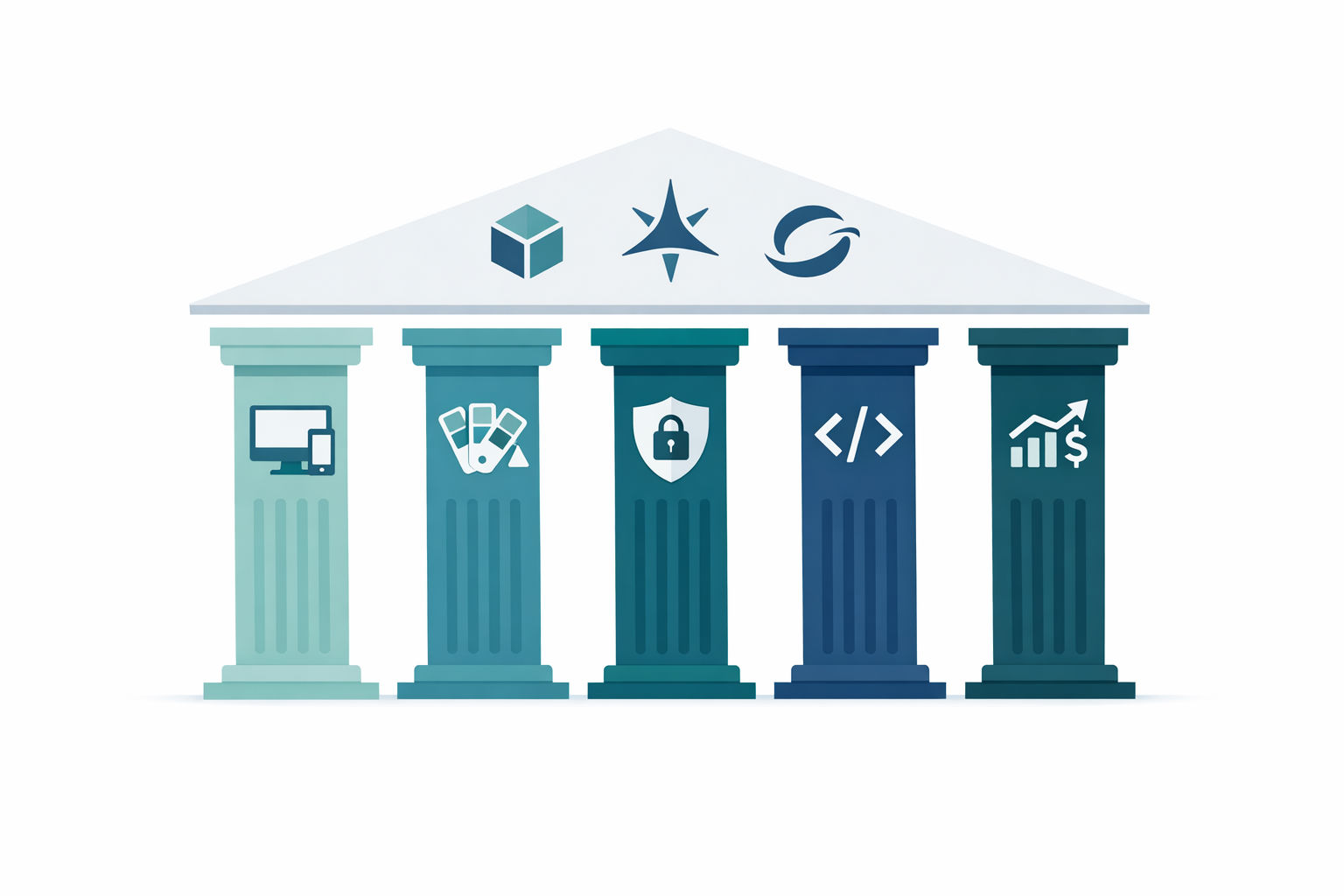
The 5 Evaluation Criteria That Actually Matter
Forget feature lists. Most white-label AI tools for agencies advertise dozens of capabilities that sound impressive in a comparison table but mean nothing once you're delivering to a paying client. Here are the five criteria that predict whether a platform will scale your practice or sabotage it.
1. Client-Facing UX — Not Your UX
The dashboard you see as an admin is irrelevant. What matters is the experience your client has when they log in, view a report, or interact with an AI-generated deliverable.
Ask yourself: if you removed every mention of AI and every trace of the vendor, would this interface feel like your product? Or would it feel like a generic SaaS tool your client doesn't recognise?
Specifically test:
- Login flow: Does the client see your brand from the first touchpoint, or does we get a generic third-party login page?
- Report and deliverable UX: Are outputs polished enough to present in a boardroom, or do they look like raw data exports?
- Mobile experience: Clients check things on phones. If the mobile view is broken or unbranded, your credibility takes the hit.
As one practitioner put it: "Show me a customer view of the reports tab, the URL bar, and the login screen — those three things tell me everything about how deep the white labelling actually goes."
2. White-Label Depth — The 'Zero Vendor Branding' Test
There's a massive gap between "white label" and true white label. Many platforms let you swap a logo and pick brand colours. That's surface-level branding. True white-label AI tools for agencies require:
- Custom domain (yourdomain.com, not app.vendorname.com/yourbrand)
- Zero vendor branding across every touchpoint: UI, emails, error pages, exported PDFs, help documentation, and mobile views
- Branded notifications and system emails sent from your domain
- White-labelled help centre or knowledge base (so your client never Googles the vendor's name)
The tell? Ask the vendor: "Can I do a full live demo for a prospect right now — with my branding — in under 10 minutes?" If the answer involves caveats, you don't have true white labelling.
Open the platform in an incognito browser. Navigate every client-facing page. Check the footer, the URL bar, the page title, the favicon, email headers, and PDF exports. If the vendor's name appears anywhere your client could see it, that's not white-label — it's co-branding. And co-branding positions you as a reseller, not a strategic advisor.
3. Data Privacy and Residency — The Enterprise Deal-Breaker
If you're targeting SMBs that don't ask about data handling, you might survive without this. But the moment you land (or pursue) a mid-market or enterprise client — especially in financial services, healthcare, or legal — data residency becomes a binary qualifier.
The EU AI Act, now enforcing penalties of up to 7% of global turnover or €35 million, requires documentation of data governance, model lineage, and processing location for high-risk AI systems. If your white-label platform can't answer where data is stored, how it's processed, and whether it crosses jurisdictional boundaries during inference, you're carrying compliance liability on behalf of your vendor.
Evaluate:
- Processing location: Can you guarantee EU-only or region-specific processing? Not just storage — inference.
- Data portability: Can clients export all data in standard formats? If not, you're locked in — and so are they.
- Controller-processor agreements: Does the vendor provide GDPR-compliant DPAs out of the box?
- SOC 2 / ISO 27001 certification: Table stakes for enterprise buyers. If the vendor doesn't have it, your prospects will walk.
This is also an opportunity to differentiate through governance — most of your competitors won't have answers to these questions either.
4. API Access for Customisation
A platform without API access is a product you're renting. A platform with robust APIs is infrastructure you're building on.
The difference matters when a client needs a custom integration, when you want to connect the platform to your CRM, or when you need to automate onboarding workflows across multiple clients. Iframe-only embedding with no context passing is a dead end.
Look for:
- RESTful APIs with comprehensive documentation
- Webhook support for event-driven automations
- SDK/embedding options beyond iframes (context passing, auth token integration)
- Multi-tenant management APIs so you can provision and manage client accounts programmatically
If you're trying to scale past $20K/month without hiring, API access is what makes that possible. Manual client setup for each account is the bottleneck that kills growth.
5. Pricing Model at Scale
This is where most consultants get burned. The platform costs $99/month at sign-up. But the pricing model is per-seat, per-token, or per-API-call — which means your costs grow faster than your revenue as you add clients.
The right pricing model for a reseller is usage-based or tenant-based with predictable caps — not per-seat, which penalises growth.
| Pricing Model | How It Scales | Reseller Risk |
|---|---|---|
| Per-seat | Cost rises with every client user added | High — margins shrink as clients grow |
| Per-token / per-API-call | Cost rises with usage volume | High — unpredictable; spikes destroy margin |
| Per-tenant (flat per client) | Cost rises linearly with clients | Medium — predictable, but negotiate volume tiers |
| Flat platform fee + usage tiers | Fixed base + capped variable | Low — most margin-friendly at scale |
How different vendor pricing models affect your margins as you scale
Research from industry analysis shows typical reseller markups of 100–300% on platform costs — but that range only holds if the underlying cost is predictable. Per-token pricing can flip a 70% margin into a 20% margin on a single high-usage client.
Before you sign, model your costs at 5 clients, 15 clients, and 50 clients. If the economics don't improve — or actively worsen — as you grow, walk away.

Red Flags to Watch for in Vendor Contracts
You've found a platform that checks the criteria above. Now the contract arrives. This is where the real evaluation happens — because vendor agreements for AI platform reseller programs are written to protect the vendor, not you.
Here are the three clauses that burn resellers most often:
Output Ownership Ambiguity
Volume Limits and Overage Traps
Auto-Renewal with Escalation Pricing
Ask yourself one question: "If this vendor changed their terms, doubled their prices, or shut down tomorrow — what happens to my clients?" If the answer is "everything breaks," you have a vendor dependency, not a platform partnership. Ensure your contract includes data export rights, reasonable termination clauses, and a transition period. As one enterprise AI analyst put it: "If your operations would stop functioning after losing access to one AI service, you are locked in."
What to Test Before You Commit
Demos are curated. Sandboxes are sanitised. The only way to know whether a platform will survive contact with real clients is to run real use cases through it before you sign a long-term contract.
Galileo AI's research found that 95% of AI pilots fail to reach production — and the failure point is almost never the technology itself. It's the gap between what the demo showed and what the delivery requires.
Here's the testing protocol:
Pick 2-3 Real Client Scenarios
Test the Full Client Journey, Not Just the Output
Stress-Test the Margins
Most vendors offer a free trial or pilot period. Use every day of it. Don't just explore — deliver. The goal is to simulate month one with a real client, not to evaluate features in isolation.
How to Price the Resold Platform Without Eating Your Margin
The pricing trap most consultants fall into: they take the vendor's per-client cost, add a small margin, and call it their price. Then delivery overhead, client management, and customisation time eat the rest.
The formula that works is loaded cost ÷ (1 - target margin):
- Loaded cost = vendor fee per client + your time (onboarding, support, reporting) + tool overhead
- Target margin = 50% minimum for growth; 40% minimum for sustainability
If your loaded cost per client is $700/month (vendor fee + your time), and you want 50% margin, your retail price is $1,400. Not $900. Not $1,000.
| Loaded Cost / Client | 40% Margin Price | 50% Margin Price | 60% Margin Price |
|---|---|---|---|
| $300 | $500 | $600 | $750 |
| $500 | $833 | $1,000 | $1,250 |
| $700 | $1,167 | $1,400 | $1,750 |
| $1,000 | $1,667 | $2,000 | $2,500 |
| $1,500 | $2,500 | $3,000 | $3,750 |
Monthly retainer pricing at different margin targets — use loaded cost, not just vendor fees
Two pricing strategies that protect your margin at scale:
1. Bundle the platform into a larger engagement. Don't sell "access to an AI tool" — sell an AI readiness assessment, a strategy engagement, or a managed AI service that includes platform access. This anchors the value to your expertise, not the software. When clients pay for outcomes, they don't comparison-shop the tool.
2. Structure setup fees separately. Charge $1,000–$5,000 for onboarding, configuration, and customisation. This covers your upfront time investment and creates revenue before the recurring retainer even begins. Agencies that do this report significantly higher first-year revenue per client.
If you're exploring how to structure deals that pay you more when you deliver results, outcome-based pricing layers naturally on top of a white-label platform — the platform delivers the baseline, and your strategic guidance is the multiplier.
The Bottom Line
The white-label AI platform you choose will shape every client engagement you deliver for the next 12-24 months. Gartner projects that 50% of agency AI platforms will be obsolete by 2029 — which means the platform you pick today needs to be defensible, not just functional.
Evaluate on the five criteria that actually predict success: client-facing UX, white-label depth, data privacy, API access, and pricing at scale. Read the contract like your margins depend on it — because they do. Test with real use cases before you commit. And price the resold platform as part of a value-driven service package, not a standalone subscription.
If you're looking for a platform that was built specifically for this — ConsultKit lets AI consultants deliver AI readiness assessments, strategy reports, and client-facing deliverables under their own brand, with white-labelled reports and zero ConsultKit branding visible to clients. It's designed for consultants who want to build a repeatable sales process and retain clients long-term, not just close a single deal.
But whatever you choose — evaluate like a practitioner, not a prospect. The demo is the vendor's best case. Your first real client onboarding is the truth.
