

You know the pitch is good. The automation works. The demo is clean. And then the SMB owner across the table says, "Let me think about it" — and you never hear back.
If you're selling automation services to small and mid-sized businesses, you've probably noticed: the problem isn't the product. It's the sale. SMBs want workflow automation — 73% plan to implement AI this year, according to the U.S. Chamber of Commerce — but only 12% have actually done it. That 61-point gap isn't a lack of demand. It's a wall of cost objections, scope confusion, and a single risk-averse decision-maker who doesn't understand what you're building.
This post breaks down what actually closes in the SMB AI workflow automation market right now: which use cases sell themselves, how to frame value in dollars (not "efficiency"), why fixed-price scoping changes everything, what to charge, and how to handle the three objections you'll hear every single time.
The Four Use Cases That Actually Close
Forget the aspirational stuff. SMB owners don't buy "AI transformation." They buy solutions to problems that cost them money every week. These four AI workflow automation projects have the highest close rates because the value is immediately obvious — no education required.
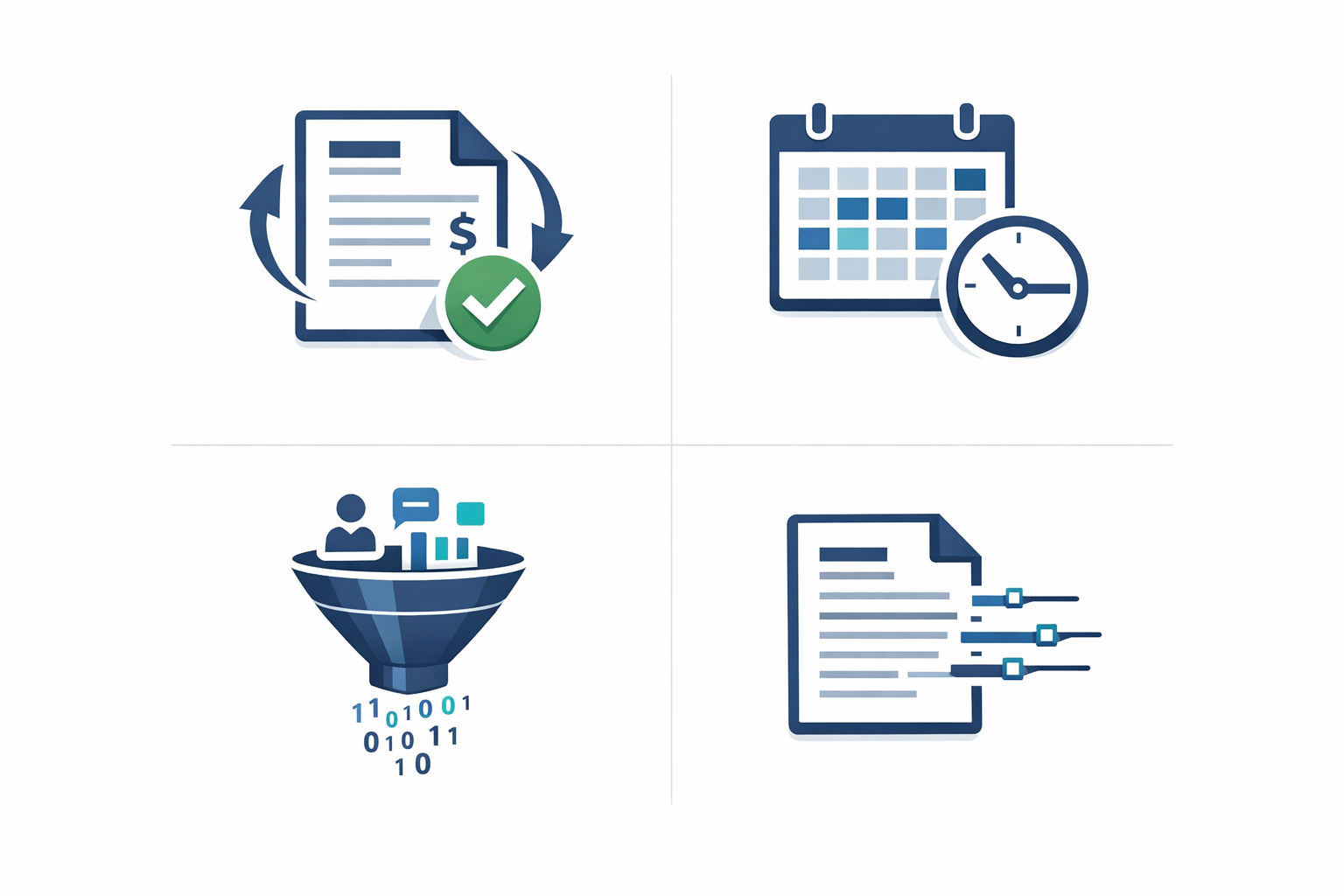
1. Invoice & Document Processing ($5K–$10K) Manual invoice processing costs $12.88 per invoice. AI-automated processing drops that to $2.36 — an 83% cost reduction (Parseur, 2025 benchmarks). For an SMB handling 200+ invoices per month, that's $2,000+ in monthly savings. The build takes 15–20 hours. The payback period is 3–5 months. This is the easiest ROI to put on paper.
2. Lead Qualification Workflows ($4K–$8K) A typical SMB receives 100–300 inbound leads per month. Manual qualification — reading submissions, looking up companies, scoring, routing — takes 10–15 minutes per lead. That's 25–75 hours of staff time per month. An automated workflow scores and routes leads in under 30 seconds. Payback: 1–3 months (Innovate247 client data).
3. Appointment Scheduling & Follow-Up ($3K–$5K) No-shows alone cost the average service business $800/month in lost revenue. An AI scheduling system that books, reminds, reschedules, and follows up cuts no-shows by up to 65%. Implementation cost: $3,000–$5,000. Monthly savings: $800–$1,500. Payback: 2–4 months.
4. Client Intake & Onboarding ($3K–$7K) For professional services — law firms, accounting practices, financial advisors — client onboarding is a hidden time sink. AI intake workflows collect documents, extract data, pre-populate systems, and trigger next steps. Saves 5–10 hours per week at the admin level. Payback: 4–8 months.
Notice the pattern: every pitch starts with a dollar amount the business is already losing, not a feature list of what you'll build.
SMB owners don't buy technology. They buy fewer hours wasted and less money lost. Every conversation should start with: "How much is this problem costing you right now?" — not "Let me show you what this automation does."
Stop Saying "Efficiency" — Start Saying Dollars
Here's where most AI automation consulting pitches die: you say "this will improve efficiency by 40%" and the SMB owner nods politely while mentally checking out. "Efficiency" is abstract. Dollars are concrete.
The reframe is simple. Instead of selling what the automation does, sell what the manual process costs.
IBM and Aerospike's 2025 analysis found that SMBs earn an average of $3.70 back for every $1 invested in AI automation. That's the number you lead with — not "we'll streamline your workflows."
Here's how this sounds in practice:
-
❌ "We'll automate your invoice processing to improve efficiency."
-
✅ "You're spending $2,576 per month on manual invoice entry. This automation brings that to $472. That's $25,000 back in your pocket over the next year."
-
❌ "AI lead scoring will optimize your sales funnel."
-
✅ "Your sales rep spends 60% of their time talking to leads who'll never buy. This system filters them so they only talk to the 40% who are ready — that's 30 extra hours a month for actual selling."
According to Capsule CRM's 2025 SMB study, 66% of small businesses using AI automation save $500–$2,000 per month, and 58% save 20+ hours monthly. Those are the stats that move SMB decision-makers — because they map directly to the owner's mental model of "payroll" and "wasted time."
If you want to sharpen how you present this, packaging your AI services into tiers gives SMBs a clear path from a small initial project to a larger ongoing engagement — without sticker shock.
Why Fixed-Price Beats Hourly Every Time for SMB Automation
Hourly billing kills SMB deals for one reason: uncertainty. A small business owner with a $5,000 budget needs to know the final number before they say yes. Hourly rates — even reasonable ones — trigger fear of an open-ended meter running. Research from US Tech Automations found that 41% of SMBs on usage-based or open-ended pricing face "bill shock" within six months.
Fixed-price project scoping solves this instantly. It signals confidence (you've done this before), removes purchase friction (they know the exact investment), and — critically — lets you capture the margin from your own efficiency. A project that takes you 12 hours to build can be priced at the value it delivers, not the time it consumes.
The hybrid model works well here: charge a small paid discovery or assessment upfront (see the qualification section below), then deliver a fixed-price build with a clearly defined scope.
| Automation Project | Typical Price Range | Build Time | Monthly Client Savings | Payback Period |
|---|---|---|---|---|
| Invoice / Document Processing | $5,000–$10,000 | 15–20 hours | $1,200–$2,000 | 3–5 months |
| Lead Qualification Workflow | $4,000–$8,000 | 10–15 hours | $720–$2,400 | 1–3 months |
| Appointment Scheduling & Follow-Up | $3,000–$5,000 | 10–15 hours | $800–$1,500 | 2–4 months |
| Client Intake & Onboarding | $3,000–$7,000 | 8–12 hours | $420–$900 | 4–8 months |
| AI Customer Support Chatbot | $3,000–$5,000 | 8–12 hours | $1,000–$3,000 | 2–5 months |
Realistic pricing ranges for common SMB automation projects. Sources: Innovate247, BetOnAI, Business-Automation-AI.com (2025–2026 data).
Always present three options when scoping: a starter build (single workflow, $3K–$5K), a recommended build (multi-workflow + integrations, $5K–$10K), and a full system ($10K–$15K+). Anchoring to three tiers increases average deal size by 35–40% compared to a single-price proposal (Digital Applied, 2025). Most buyers pick the middle option.
Don't forget the retainer. Monthly maintenance and optimization retainers ($300–$800/month) are where the recurring revenue lives. Position them as "keeping it running and getting smarter" — not optional add-ons. Your tool costs (API fees, hosting, platforms) typically run $25–$120/month, so the margin is strong.
For a deeper dive into structuring the post-build engagement, our guide on what an AI implementation roadmap actually looks like covers the phased delivery model that turns one-off builds into long-term client relationships. And if you want to structure payment around results rather than project milestones, outcome-based pricing for AI services is the model that lets you capture a share of the dollar savings you generate for the client.
The Three Objections You'll Always Hear (and How to Kill Each One)
If you've been in the b2b AI sales process long enough, you know these are coming. Every time. The key isn't avoiding them — it's having a response ready that reframes the conversation.
Pros
Cons
For a full objection-handling playbook with exact scripts, check out the 5 AI sales objections you'll hear every week — it covers these and two more you'll run into during discovery calls.
The Qualification Step Most Consultants Skip
Here's the uncomfortable truth: not every SMB is ready to buy automation. And if you pitch a $5,000 build to a business that has no clean data, no documented processes, and a team that's hostile to change — you're going to lose the deal and waste 3 hours on a proposal that goes nowhere.
The fix is qualifying before you pitch. An AI readiness assessment — a structured diagnostic you run before scoping a project — does three things:
- Filters out low-fit prospects. If their data is a mess, their processes aren't documented, or there's no budget authority in the room, you find out in 30 minutes instead of 3 meetings.
- Gives you data to anchor the sales conversation. When you can say, "Based on your assessment, you're spending 40 hours/month on manual invoice processing — here's what that costs you," the pitch writes itself.
- Positions you as the expert. Running an assessment before proposing a solution separates you from every other consultant who shows up with a generic demo.
The readiness gap is real: 76% of SMBs plan to increase their AI use, but only 19% feel prepared (Jiegou AI, 2025). That 57-point gap is your opportunity to walk in with structure, not a sales pitch.
If you're looking for a way to get AI consulting clients without a big audience, leading with a free or low-cost readiness assessment is one of the highest-converting outbound plays available right now — it provides value before asking for anything.
Once the engagement kicks off, make sure you have a plan for the first 30 days. The AI consulting onboarding checklist protects your scope, sets the right expectations, and keeps the client relationship solid during the critical post-sale window. And once you've delivered a successful SMB automation project, that engagement naturally becomes the foundation for a retainer transition — the $300–$800/month maintenance model is the most natural recurring revenue play in the SMB automation space.
Consultants who pitch automation without qualifying first report longer sales cycles and more ghosting. The assessment isn't a freebie — it's the most important step in your b2b AI sales process. It filters out tire-kickers, generates the data you need for your proposal, and builds trust before money changes hands.
What This Looks Like End-to-End
Put it all together and the selling motion is straightforward:
Lead with the problem, not the product
Run a readiness assessment
Scope a fixed-price project with three tiers
Deliver, then retain
The Bottom Line
Selling AI workflow automation to SMBs isn't a technology problem — it's a framing problem. The businesses are there. The budgets exist ($3K–$10K is within reach for most SMBs with 10+ employees). The demand is surging. What's missing from most consultants' approach is the discipline to qualify before pitching, price in fixed dollars instead of hours, and frame every conversation around what the manual process costs — not what the automation does.
Fix those three things, and SMB automation becomes the most predictable, repeatable revenue stream in your AI consulting practice.
