

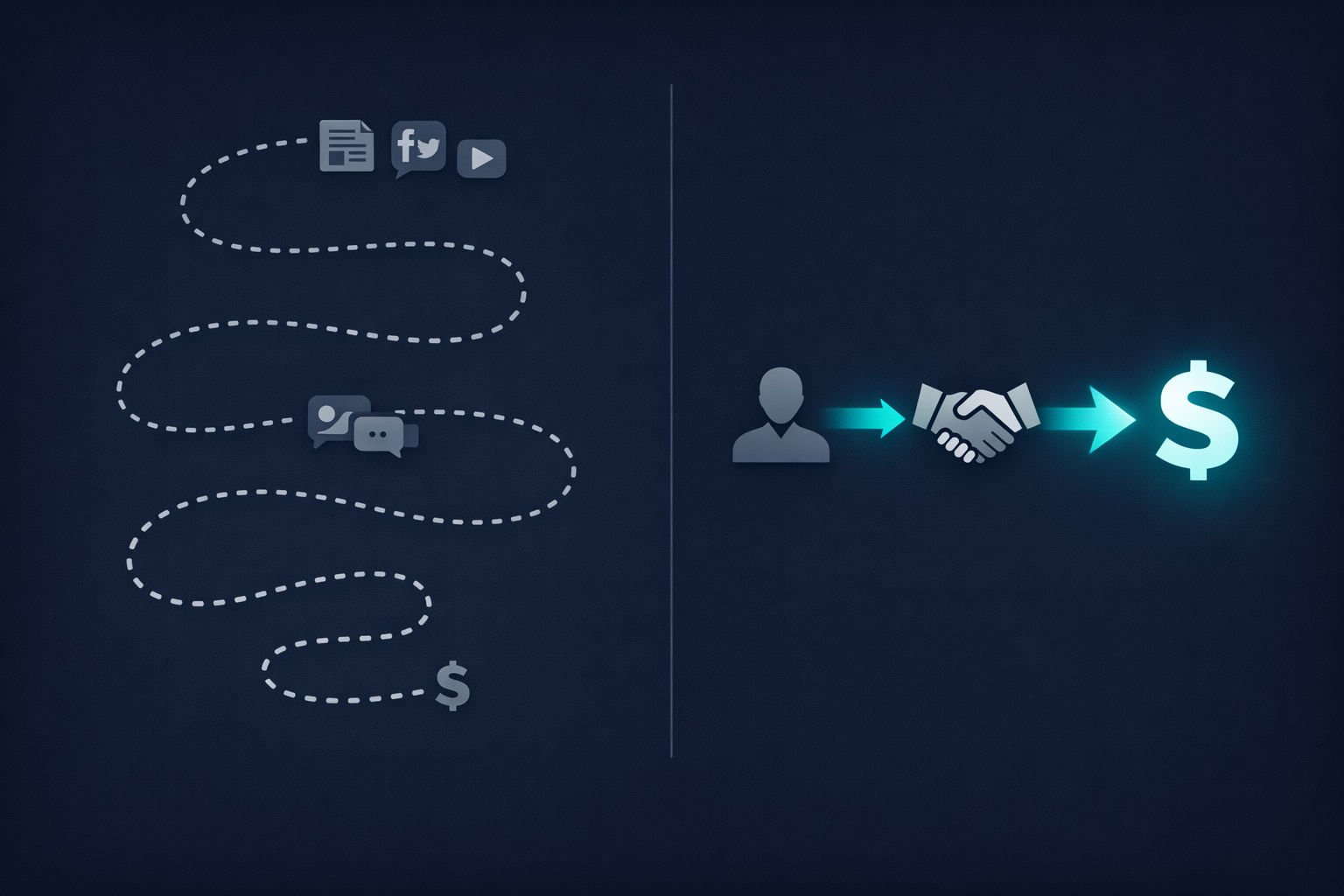
Here's the lie that keeps most AI consultants stuck: *"I need to build an audience first."
So they spend months writing LinkedIn posts nobody reads. They agonize over a newsletter that has 47 subscribers. They convince themselves that once the content machine is running, clients will come to them.
Meanwhile, the consultants actually closing ai consulting for small business engagements? They're sending 5 targeted messages a day and booking calls within weeks.
The market is screaming for help. 58% of U.S. small businesses now use generative AI (U.S. Chamber of Commerce, 2025), and 96% plan to adopt emerging technologies — but only 27% discuss AI in strategic planning. That gap between "we know we should" and "we have no idea how" is your entire addressable market. And you don't need a single follower to reach them.
This is the playbook for how to get AI consulting clients using outbound — no audience, no list, no referral network required. Once you start landing calls, make sure you're running them with a tight framework — our guide on how to run an AI consulting discovery call that closes gives you the exact structure to qualify prospects and advance deals from minute one.
Why Outbound Beats Audience-Building When You're Starting Out
Let's be blunt about the math.
Content marketing — the "build an audience and they'll come to you" approach — is a compounding asset. It's excellent at month 12. It's essentially worthless at month 1. If you need revenue in the next 30-60 days, posting thought leadership is like planting oak trees when you need firewood tonight.
Outbound is different. It's direct, it's fast, and the conversion benchmarks actually hold up for solo consultants:
| Metric | Benchmark | What It Means for You |
|---|---|---|
| Personalized cold email response rate | 8–18% | 5 daily emails = 2–5 replies per week |
| Generic cold email response rate | 2–5% | Same effort, 75% fewer conversations |
| Call-to-meeting conversion | 6–15% | Top performers book 1 in 7 calls |
| Assessment lead magnet conversion | 38.5% | Nearly 4 in 10 who see your diagnostic engage |
| Average time to first AI consulting client | 21–35 days | Revenue inside a month is realistic |
Outbound conversion benchmarks from SoPro, Focus Digital, and BetOnAI (2024–2025 data)
The takeaway: 5 quality messages per day × 20 working days = 100 contacts per month. At an 8-18% response rate, that's 8-18 real conversations. Even at a conservative 20% close rate from conversation to signed engagement, you're looking at 2-4 new clients per month.
No audience needed. No followers. Just a focused process.
This doesn't mean content is bad. It means outbound gets you paying clients who fund the content marketing you build later. Revenue first, audience second.
How to Find High-Fit SMB Prospects (Without Buying a List)
Forget purchased lists. They're stale, generic, and full of contacts who'll never reply. What you need is a signal-based prospecting system — one that identifies businesses already showing signs they need AI help.
Here are the three signal layers that matter most for ai consulting client acquisition:
Industry & Growth Signals
Content & Engagement Signals
Tech Stack & Tool Usage Patterns
Don't try to blast 50 prospects a day. Send 5 highly personalized messages per day — each one referencing a specific signal from the layers above. At a 10%+ response rate, that's 25+ real conversations per month. Quality outreach at low volume consistently outperforms high-volume spray-and-pray.
Related reading: The Audit-First Sales Model — why sending a free diagnostic offer as Message 3 outperforms a traditional discovery call invitation, and how to structure the audit so it pays for itself.
The 3-Message Outreach Sequence That Actually Gets Replies
Most outbound advice gives you templates. Templates get ignored because every prospect has seen them before.
What works instead is a structure — a framework you personalize for every single prospect. Here's the 3-message sequence that consistently performs in the 8-15% reply range for AI consulting outreach:
| Message | Timing | Purpose | Structure |
|---|---|---|---|
| Message 1: The Signal Open | Day 1 | Earn a read by proving you've done your homework | Lead with a specific observation about their business (the signal). Connect it to a problem you solve. Close with a low-pressure question — no pitch, no call booking. |
| Message 2: The Value Drop | Day 4–5 | Give before you ask | Share a relevant insight, stat, or mini case study related to their industry. Frame it as 'thought you'd find this useful' — not 'look how great I am.' End with a soft bridge to a conversation. |
| Message 3: The Diagnostic Offer | Day 8–10 | Convert interest into a meeting | Offer a free AI readiness diagnostic for their business. Frame it as a quick 20-minute exercise that gives them a clear picture of where AI fits — and where it doesn't. No commitment. No pitch. |
The 3-message outbound sequence for AI consulting outreach
Notice what's missing: there's no "just checking in" follow-up. No "bumping this to the top of your inbox." Every message delivers something — an observation, a piece of value, a concrete offer.
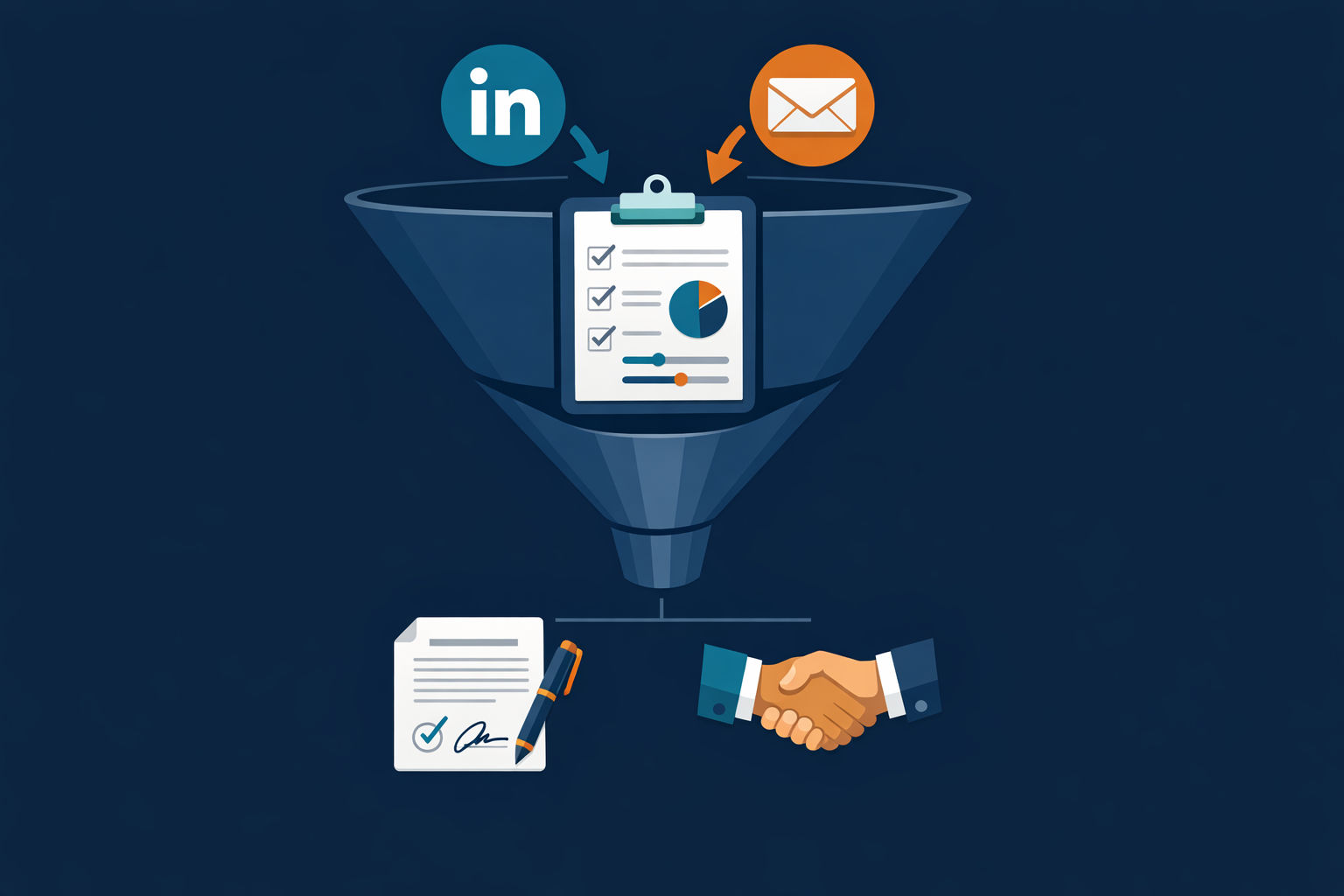
Why Message 3 matters most: The diagnostic offer is the conversion mechanism. It's not a sales call disguised as a consultation. It's a structured assessment that gives the prospect genuine clarity about their AI readiness. And that's what lowers friction to nearly zero.
When someone says yes to a free 20-minute diagnostic, they're not committing to buy anything. They're accepting value. Which is exactly why AI consulting case studies that reference diagnostics close at higher rates.
The AI Readiness Diagnostic: Your Best Weapon for Getting in the Door
The diagnostic isn't just a lead magnet. It's the entire sales strategy.
Here's why it works so well for selling AI services without an audience: it flips the dynamic. Instead of you pitching, the prospect is being assessed. Instead of asking for trust upfront, you're demonstrating expertise in real time. Aaron Reich, CTO at Avanade, has publicly described AI readiness assessments as sitting squarely "in the sales-funnel bucket" — structured entry points that build trust and reveal needs simultaneously.
Interactive assessments convert at 38.5% for B2B professional services, according to recent lead magnet benchmarks. That's nearly 4 in 10 prospects who engage with your diagnostic becoming qualified leads. Compare that to a cold pitch, where you're lucky to get 2-5%.
A strong AI readiness diagnostic covers:
- Current AI usage — What tools are already in play? What's working, what isn't?
- Data readiness — Do they have clean, accessible data that could feed AI workflows?
- Process bottlenecks — Where are the manual, repetitive tasks bleeding time and money?
- Team readiness — Does the team have the appetite and baseline skills for AI-assisted workflows?
- Strategic alignment — Does leadership actually care, or is this a one-person curiosity project?
The output is a clear, scored snapshot of where the business stands — and more importantly, where the gaps are. Those gaps are your engagement scope.
The most effective diagnostics aren't improvised conversations — they're structured frameworks that produce a buyer profile before you ever get on the phone. Tools like ConsultKit let you build and deliver AI readiness assessments that score prospects across these dimensions automatically, giving you a complete picture of their needs and readiness level before the first live conversation. That means when you do get on a call, you're already talking solutions — not running discovery from scratch.
From First Reply to Signed Engagement: The Fastest Path
You've got a reply. They've agreed to the diagnostic. Now what?
Here's where most consultants fumble — they either over-deliver for free (turning the diagnostic into a full strategy session) or under-deliver (making it feel like a sales pitch with a survey wrapper). The sweet spot is a structured process that creates genuine momentum toward a paid engagement.
The path looks like this:
Reply Received
Diagnostic Completed
Readout Call
Proposal Sent
Engagement Signed
From First Reply to Signed Engagement: The Fastest Path
You've got a reply. They've agreed to the diagnostic. Now what?
Here's where most consultants fumble — they either over-deliver for free (turning the diagnostic into a full strategy session) or under-deliver (making it feel like a sales pitch with a survey wrapper). The sweet spot is a structured process that creates genuine momentum toward a paid engagement.
The path looks like this:
Once the readout call is done, the proposal you send needs to be tight. The AI consulting proposal framework that wins deals shows how to translate diagnostic findings directly into a three-tier proposal structure — so the prospect isn't reviewing a generic deck, they're reviewing a plan built from their own data.
The Numbers: What a Realistic First 30 Days Looks Like
Let's put the full pipeline together with conservative assumptions:
| Activity | Volume | Conversion | Result |
|---|---|---|---|
| Targeted outreach messages | 100 (5/day × 20 days) | — | 100 prospects contacted |
| Positive replies | — | 8–12% | 8–12 conversations |
| Diagnostic offers accepted | — | 40–50% | 3–6 diagnostics completed |
| Readout calls → proposals sent | — | 80% | 3–5 proposals sent |
| Proposals → signed engagements | — | 25–30% | 1–2 signed clients |
Conservative 30-day pipeline projection for outbound AI consulting
One to two signed clients in your first month of outbound. With a typical first AI consulting engagement ranging from $5,000–$15,000 (depending on scope and whether you're doing agentic AI work for SMB clients), that's meaningful revenue from zero audience.
And here's what compounds: those first clients become case studies, testimonials, and referral sources. The referral engine you build from happy clients eventually supplements your outbound — and eventually replaces much of it.
Before any of this works, you need a niche. Sending 5 targeted messages a day to anyone and everyone is spray-and-pray with extra steps. Choosing your AI consulting niche is what makes your outreach personal — and your close rate defensible.
Once you're booking those first calls, make sure you have the tools to deliver efficiently. The AI tools stack for consultants covers the exact workflow stack that lets you run multiple client engagements without hiring — so your first clients don't become your last ones due to capacity burn.
When your first SMB clients start asking about workflow automation specifically, having a ready pitch matters. The playbook on selling AI workflow automation to SMBs — with fixed-price scoping, ROI framing, and objection scripts — slots directly into the outbound process you've built here.
Once you've won your first engagements and delivered results, consider building the case studies that turn those early client wins into your most powerful sales asset — pre-selling the next deal before you even get on the call.
But it starts with outbound. Not followers.
One to two signed clients in your first month of outbound. With a typical first AI consulting engagement ranging from $5,000–$15,000 (depending on scope and whether you're doing agentic AI work for SMB clients), that's meaningful revenue from zero audience.
And here's what compounds: those first clients become case studies, testimonials, and referral sources. The referral engine you build from happy clients eventually supplements your outbound — and eventually replaces much of it.
Before any of this works, you need a niche. Sending 5 targeted messages a day to anyone and everyone is spray-and-pray with extra steps. Choosing your AI consulting niche is what makes your outreach personal — and your close rate defensible.
But it starts with outbound. Not followers.
