
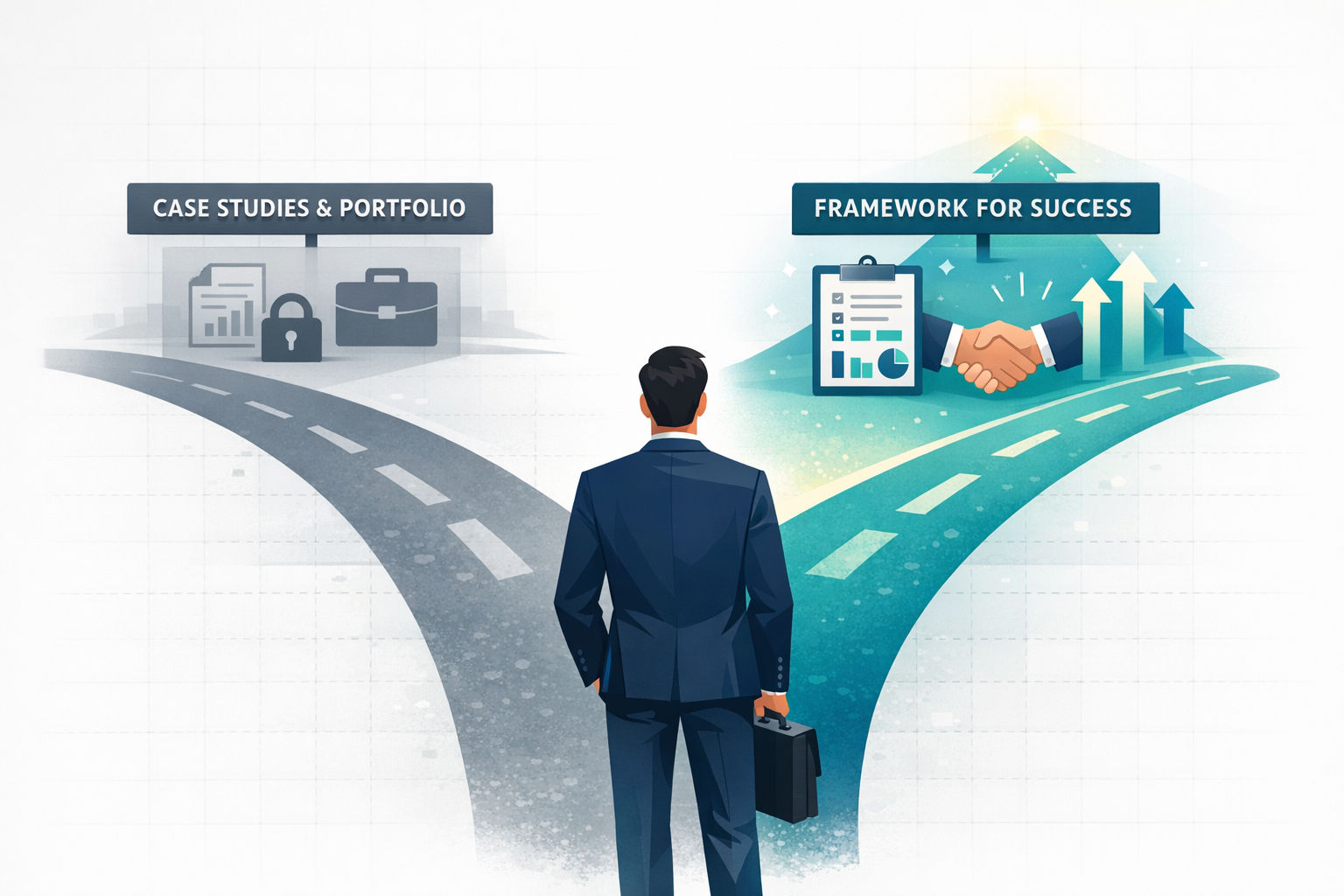
You know the catch-22. Every prospect wants to see case studies before they'll hire you. But you can't get case studies without clients. So you sit there, qualified and capable, stuck at zero.
Here's what most people won't tell you: the case study problem isn't actually a credibility problem. It's a positioning problem. And it's entirely solvable — if you understand how buyers actually make hiring decisions.
The data backs this up. According to research from Trusted Advisor Associates, consulting buyers evaluate trust through a formula: Credibility + Reliability + Intimacy, divided by Self-Orientation. Notice what's not in that equation: a portfolio of past logos. Buyers hire for confidence and process as much as track record. And Insivia's buyer psychology research puts it bluntly — buyers "do not reward whoever publishes the most. They reward whoever reduces uncertainty."
That's your opening. If you want to know how to get AI consulting clients before you have a single case study, you need to stop thinking about proof of past work and start thinking about proof of competence. Here's the playbook.
The Market Is Begging for Help — Even From You
Before we get tactical, understand the landscape you're stepping into. It's dramatically in your favor.
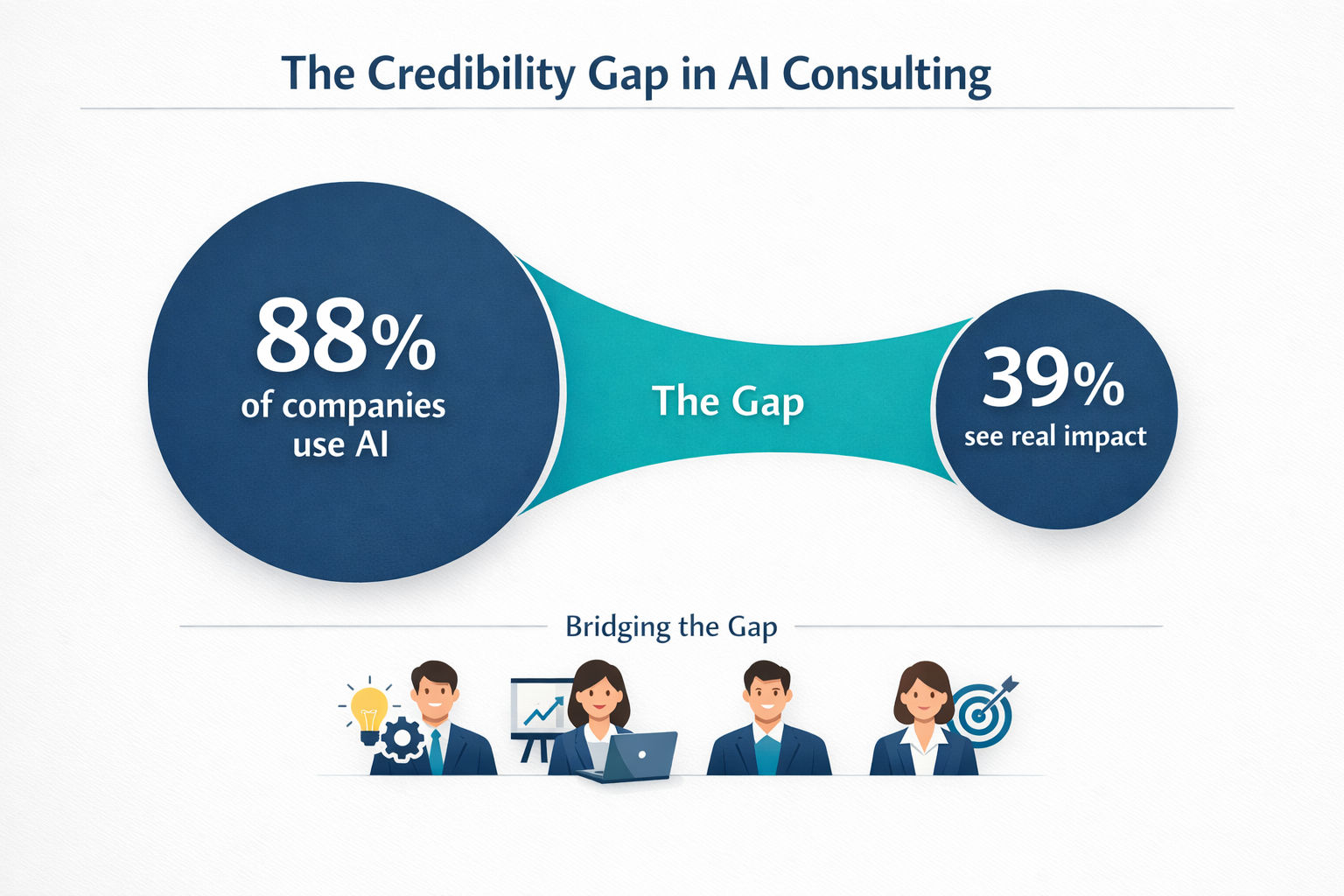
McKinsey's 2025 State of AI report found that 88% of organizations now use AI in at least one business function — up from 78% the year before. But here's the critical gap: only 39% report any enterprise-level financial impact from their AI investments. BCG's global AI survey found that 74% of companies struggle to achieve and scale value from AI, with roughly 70% of implementation challenges being people- and process-related — not technology problems.
Translation: most companies have bought the tools. They just can't make them work. They don't need someone with ten years of AI case studies. They need someone who can diagnose what's broken and fix it.
Meanwhile, the AI consulting market itself is growing at 26–35% annually, depending on which analyst you trust (Technavio, Market Data Forecast, Business Research Insights all converge on this range). And Orion Policy research found that 77% of non-adopting small businesses cite lack of knowledge as their primary barrier — not lack of budget.
They're not looking for a consultant with a case study library. They're looking for a guide.
Your Adjacent Experience Already Counts — Frame It
The most common mistake new AI consultants make: they treat everything before this moment as irrelevant. It isn't.
If you spent five years in marketing operations, you understand workflow optimization. If you ran a finance team, you understand data quality and process governance. If you managed product, you know how to scope solutions and measure impact. These are the exact skills that BCG identified as the bottleneck for AI success — change management, workflow optimization, and governance.
Here's how to convert that experience into AI consulting credibility:
- Reframe past projects as proto-case studies. You don't need the client's permission to describe outcomes from your career. "Led a 6-person operations team through a process automation initiative that reduced reporting time by 40%" is a credibility signal. It shows you've done the work — just not under a consulting banner.
- Map your industry knowledge to AI use cases. If you came from accounting, you already know the pain points that AI solutions can address for accounting firms. If you came from legal, you understand contract review workflows. That domain expertise is what separates you from a generic "AI consultant."
- Use the Situation / Action / Result format. Alan Weiss, author of Million Dollar Consulting, recommends framing "typical results" rather than formal case studies — e.g., "Clients in this situation typically see 25–35% reduction in manual processing time." You don't need to name a specific client.
This is about honest reframing, not fabrication. Never invent case studies, misrepresent your role in past projects, or imply you have consulting experience you don't have. Buyers see through it, and one caught lie destroys your credibility permanently. Be transparent about your transition — most prospects will respect it.
Use Process as a Credibility Proxy
Here's a buyer psychology insight that changes everything for new consultants: 70% of the buying experience is based on how the buyer feels they're being treated, according to research compiled by Apher Consulting. Buyers evaluate you based on how professional, structured, and competent you seem during the sales process itself.
That means your discovery call, your proposal, and your assessment framework aren't just lead-up to the engagement. They are the audition. And if you nail them, case studies become secondary.
Three process signals that build instant credibility:
A Rigorous Discovery Process
Don't walk into a prospect conversation and ask "so what do you need?" Instead, run a structured diagnostic. Ask about their current tech stack, their biggest time sinks, their data maturity, and where they've already tried AI and failed. A prospect who walks out of your discovery call thinking "that was the most structured conversation I've had about AI" will hire you — case studies or not.
A Professional AI Readiness Assessment
A white-labeled, data-backed readiness report is one of the most powerful credibility tools available to a new consultant. It gives you something tangible and professional to put in front of a prospect before you have outcomes to show. It says: "I have a methodology. I have a framework. I can diagnose where you are and tell you exactly what to do next." That's what buyers are paying for.
A Structured Proposal
Don't send a generic PDF. Build a proposal that references the prospect's specific situation, includes a clear scope, timeline, deliverables, and pricing — framed around the problem you diagnosed in discovery. When you're building your AI data strategy deliverables, this structure becomes your competitive advantage.
The market is not suffering from a content shortage. It is suffering from a credibility shortage. Buyers do not reward whoever publishes the most. They reward whoever reduces uncertainty.
— Insivia, Visibility, Reach & Buyer Psychology Research
Borrow Credibility From Those Who Have It
You may not have your own case studies yet — but McKinsey, BCG, Deloitte, and Gartner have plenty. Use them.
When you're on a prospect call or building a proposal, anchor your recommendations in third-party data:
- "McKinsey's 2025 data shows that 88% of organizations are using AI, but only 39% are seeing bottom-line impact. Based on what you've told me, you're in that gap — here's what we'd need to do to close it."
- "BCG found that 70% of AI implementation failures are people and process issues, not technology. That's exactly what I'm hearing from your team — and it's fixable."
- "Deloitte's latest research shows worker access to AI tools rose 50% this year. Your competitors are moving. The question isn't whether to adopt AI — it's whether you do it with a plan or without one."
This isn't name-dropping. It's contextualizing your prospect's situation within a well-documented market reality. It positions you as someone who operates with data, follows established frameworks, and thinks at a strategic level. You're not just "an AI guy" — you're a practitioner aligned with the same methodologies the big firms use, at a fraction of the cost.
Outreach That Works When You're Unknown
Here's where most new consultants waste months: they blast generic LinkedIn messages to hundreds of people. "I help businesses leverage AI to unlock growth." Delete.
The approach that actually works when you have no reputation is specificity over volume. Target one vertical, one pain point, one message.
For example, instead of "I help businesses with AI," try:
"I noticed your firm is hiring for a data entry role. Based on the job description, it looks like you're spending 15+ hours a week on invoice processing. I've been working with [industry] companies on automating exactly this workflow using AI — typically cutting processing time by 60%. Would a 20-minute call to walk through what that looks like be useful?"
That message works because it:
- Shows you've done research on this specific company
- Identifies a real, quantifiable pain point they already feel
- Offers a specific outcome, not vague AI hype
- Asks for a small commitment (20 minutes, not a contract)
The Consulting Success methodology recommends spending 30 extra minutes per prospect to personalize outreach rather than sending 100 generic messages. When you're unknown, that investment is what separates "replied" from "ignored."
Pick one niche to start. If you need inspiration on verticals that convert well, look at how consultants are selling AI agents to SMB clients — the specificity of the pitch is what closes deals, not the breadth of your experience.
Document everything from day one
Negotiate documentation rights upfront
Deliver a formal results summary at project close
Ask for a specific testimonial
Ask for exactly one referral
The Fastest Path From Zero to One
If you've read this far, you're not looking for motivation. You're looking for the most efficient path from "no clients" to "first paying engagement." Here it is:
Start with a structured AI readiness assessment. It's the single best entry point for a new AI consultant because it solves the credibility problem from both sides. For you, it's a low-risk engagement that doesn't require a portfolio to sell — you're offering diagnosis, not surgery. For the prospect, it's a low-commitment way to test your thinking before signing a larger contract.
A professional readiness report — white-labeled, data-backed, and structured around a proven framework — gives you something to put in a prospect's hands that immediately communicates: this person has a methodology. It's the thing that gets you in the door when you have nothing else.
ConsultKit's AI readiness assessment is built specifically for this use case. It gives new consultants a structured, white-labeled report they can deliver under their own brand — no need to build a framework from scratch. You get a professional deliverable that signals competence, and the prospect gets actionable insights about their AI readiness. That's a trade both sides can say yes to, even on a first engagement.
When you don't have case studies, stack these credibility signals instead:
- Adjacent experience reframed as proto-case studies
- A rigorous discovery process that demonstrates expertise in real time
- A professional AI readiness assessment that gives you a deliverable before you have outcomes
- Third-party data (McKinsey, BCG, Deloitte) anchoring your recommendations
- Vertical specificity that shows you understand one industry deeply
- One testimonial from your first engagement that compounds into referrals
You don't need all six to start. You need two or three to get your first client, and five or six to build momentum.
Stop Waiting. Start Positioning.
The AI consulting market isn't waiting for you to accumulate case studies. Companies are spending — the market is growing at 26%+ annually — and most of that money isn't going to McKinsey. It's going to the solo consultant or small firm who shows up with a structured process, speaks the client's language, and makes the risk of hiring feel low.
You don't need ten case studies. You need one vertical, one clear offer, and one professional deliverable that proves you know what you're doing. Get the positioning right, and the case studies will follow.
If you want to see how a structured AI readiness assessment can get you through the door on your first engagement, look at how to QA your AI deliverables before they reach the client — because the quality of that first deliverable determines whether you get a testimonial, a referral, or radio silence.
