

Your next prospect — the mid-size RIA managing $500M in assets — has advisors spending 11 hours a week on compliance paperwork. They're only spending 39% of their time actually talking to clients, according to Salesforce's 2025 Connected Financial Services report. They know AI exists. They're probably already experimenting with ChatGPT on the side.
But here's what they haven't figured out: how to deploy AI in a way that doesn't get them sideways with the SEC.
That's your opening. AI for financial advisors isn't about chatbots or robo-advisory platforms. It's about three specific, high-value use cases that solve compliance and admin pain — and a consultant who can walk them through the regulatory minefield to get there.
Before you walk into your first RIA meeting, make sure you're prepared on how to run the AI readiness assessment that will serve as your entry point — the structure that surfaces compliance gaps and builds the roadmap that sells the implementation.
Let's break down exactly what to sell, what to charge, and how to land these deals.
The 3 AI Use Cases Financial Advisors Actually Buy
95% of wealth and asset management firms are already deploying GenAI across at least three use cases, according to EY's Spring 2025 survey. But most of that adoption is messy — individual advisors using random tools without governance. The firms that are buying consulting help are the ones who want to do it right.
Here's what closes.
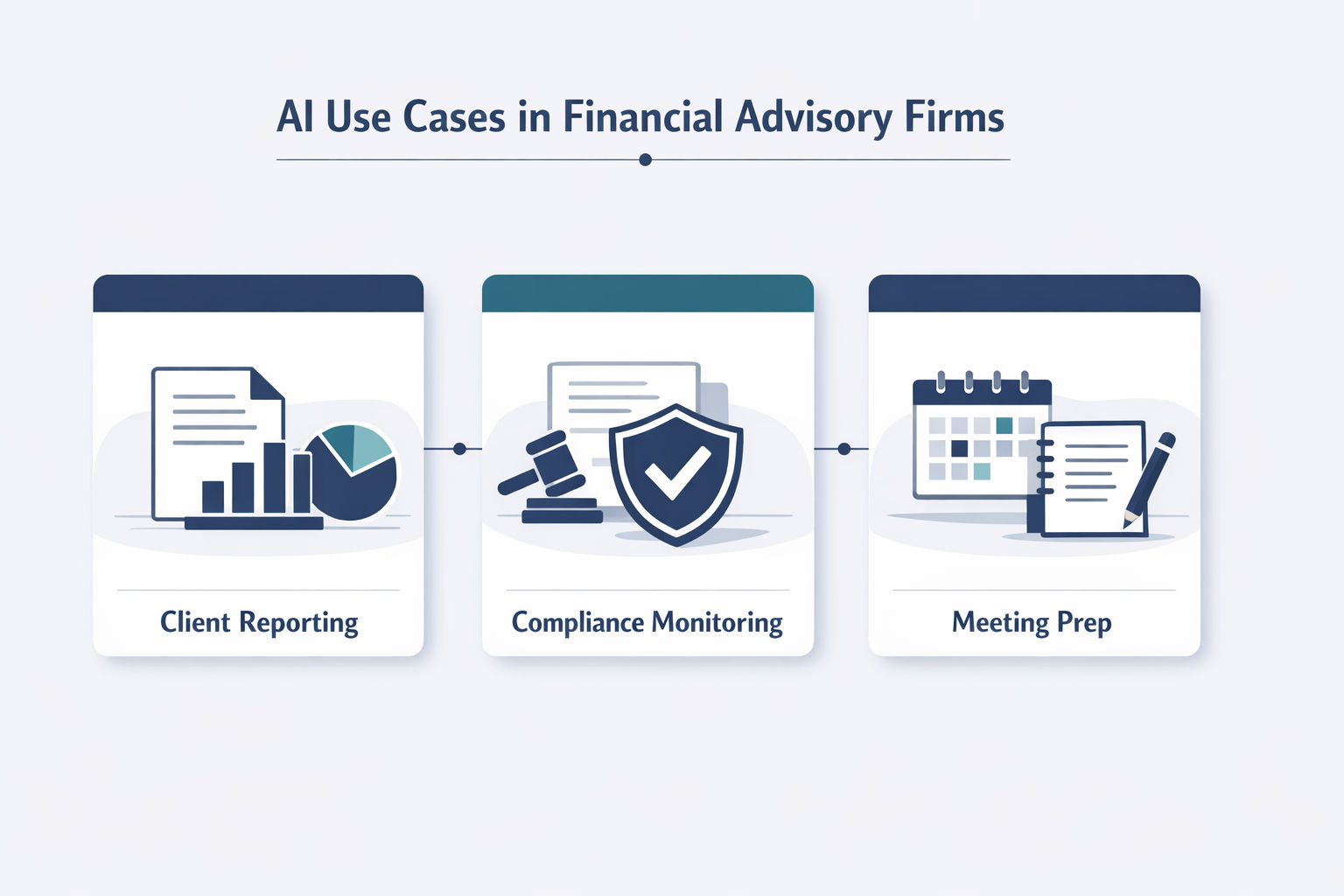
1. Client Reporting Automation
Financial advisors generate hundreds of performance reports, portfolio reviews, and quarterly summaries every year. Most of it is manual assembly — pulling data from custodians, formatting it, writing narrative commentary, and running it past compliance before it goes to the client.
AI can automate 70-75% of this workflow within the first few months. One 200-advisor wealth management network cut suitability report creation from 105 minutes to 15 minutes per report, saving 15,000 hours annually (worth roughly £450K), according to Aveni's 2025 case study.
What you're selling: An AI pipeline that pulls custodial data, generates compliant narrative summaries, and queues reports for human review before delivery. Integration with their existing CRM (Redtail, Wealthbox, Salesforce Financial Services Cloud) is the technical moat here.
2. Compliance Monitoring
This is the one that gets the Chief Compliance Officer leaning forward. FINRA's Regulatory Notice 24-09 made it clear: firms must supervise AI like they supervise human activities. Written supervisory procedures, testing, audit trails — all required.
But here's the flip side: AI-powered compliance monitoring can cut compliance costs by 30-50% and reduce manual review time by up to 70%, according to Luthor AI's research on RIA overhead. Tools that flag prohibited language in client communications, monitor for suitability violations in real-time, and auto-generate audit-ready records are in high demand.
What you're selling: A compliance automation layer — real-time monitoring of advisor communications, automated flagging of regulatory violations, and structured recordkeeping that satisfies SEC Rule 204-2 and FINRA Rule 4510. If you can also build the governance framework around it, that's a premium add-on. (If you haven't read our guide on selling AI governance to SMB clients, start there — the principles transfer directly.)
3. Meeting Prep and Follow-Up Summarization
Advisors run 15-25 client meetings per week. For every hour of face-to-face time, they spend 2+ hours on prep, notes, and follow-up. AI meeting assistants (Jump AI, Zocks, Focal) now join calls, transcribe conversations, generate structured notes by financial category, draft follow-up emails, and push tasks back to the CRM.
This is the easiest entry point because it's low-risk and the ROI is visible in week one. Advisors immediately get hours back. But the consulting value is in the implementation and compliance wrapper — making sure transcription tools meet recordkeeping requirements, that consent protocols are in place, and that the firm has written supervisory procedures covering AI-generated notes.
What you're selling: Implementation, configuration, and compliance integration of meeting AI tools into the firm's existing workflow and tech stack. Not the tool itself — the safe, governed deployment of it.
Do not walk into an RIA and pitch a chatbot for client-facing interactions. Only 38% of affluent investors are comfortable with AI in financial advice (Cerulli Associates, 2025), and that number drops to 16% for clients over 70. Client-facing AI is a political minefield inside advisory firms. Stick to back-office and advisor-facing use cases where the ROI is clear and the risk is contained.
Position AI as Risk Reduction, Not Disruption
Financial advisors are risk-averse buyers. Full stop. Their entire professional identity is built around protecting clients from downside risk. If you walk in talking about "digital transformation" and "AI-powered innovation," you'll see their eyes glaze over.
Here's the reframe that works: AI reduces the risks you already have.
Every RIA already faces these risks daily:
- Compliance violations from manual oversight gaps (SEC settled a $90 million case against an advisory firm in 2025 for algorithmic trading and compliance failures)
- Key-person dependency on a compliance officer who manually reviews communications
- Documentation gaps that become liabilities during audits
- Advisor burnout from admin overload (McKinsey projects a shortfall of 100,000 financial advisors by 2034)
AI doesn't add risk. It addresses the risks that are already bleeding the firm. Your pitch should sound less like "Let me show you what AI can do" and more like "Let me show you the compliance gaps AI can close before your next SEC exam."
This framing also unlocks the compliance budget — which is separate from (and often larger than) the technology budget. Average compliance costs run 19% of annual revenue for advisory firms. If you can position your engagement as compliance risk mitigation, you're accessing a different budget line entirely.
What to Charge: Pricing That Works in This Vertical
Financial advisory firms are used to paying for professional services. They already write checks for compliance consultants, technology vendors, and outsourced operations. Your pricing doesn't need to be apologetic — it needs to be justified.
Here's what's working in the market right now, based on industry data and typical RIA technology budgets of $8,000-$20,000 per advisor per year:
| Engagement Type | Typical Price Range | Scope | Best Entry Point |
|---|---|---|---|
| AI Readiness Assessment | $3,500 - $7,500 (one-time) | 2-3 week audit of data, tech stack, compliance gaps, and AI opportunity mapping | First meeting — this IS your foot in the door |
| Single Use Case Implementation | $8,000 - $25,000 (project) | Deploy one AI solution (e.g., meeting summarization) with compliance wrapper and training | After readiness assessment identifies priority |
| Monthly AI Retainer | $3,000 - $8,000/month | Ongoing optimization, compliance monitoring, new use case rollout, vendor management | Post-implementation — where the real revenue lives |
| Full AI Strategy + Multi-Use Case Rollout | $25,000 - $75,000 (project) | Enterprise-wide AI strategy, governance framework, 2-3 use case implementations over 3-6 months | Mid-size to large RIAs ($500M+ AUM) |
Realistic pricing for AI consulting engagements with financial advisory firms (2025 market rates)
The sweet spot for most independent consultants is the readiness assessment into monthly retainer pipeline. You charge $3,500-$7,500 to walk in, audit their situation, and deliver a prioritized roadmap. That roadmap naturally leads to a $3K-$8K/month retainer where you implement and manage the AI stack.
A mid-size RIA with 10 advisors has a technology budget of roughly $100K-$150K per year. A $5K/month retainer is $60K annually — well within budget, especially when you're saving them 10+ hours per advisor per week.
For a deeper breakdown of how to structure the retainer transition, check out our guide on transitioning AI consulting clients onto a retainer.
Don't expect $50K projects from a solo advisor managing $50M. The deal size scales directly with firm size. Solo advisors ($0-$100M AUM) have tech budgets of $6K-$10K/year total. Your target should be firms with 5+ advisors and $250M+ AUM — that's where the budget and pain are both big enough to justify a consulting engagement.
Compliance Landmines: What to Know Before You Walk In
If you sell AI consulting to financial advisors without understanding their regulatory environment, you will lose credibility in the first meeting. These firms live and breathe compliance. Here are the five things you absolutely must know:
FINRA Regulatory Notice 24-09 (June 2024)
SEC Recordkeeping Rules (Rules 17a-3/17a-4, Rule 204-2)
FINRA Rule 2210: Communications Standards
SEC 2025/2026 Examination Priorities
Data Handling and Breach Notification
Most wealth firms are flying blind on AI. Firms are deploying AI tools faster than they can govern them. Advisors are using AI their compliance teams don't know about. Client data is flowing through systems with no audit trail.
— John O'Connell, Founder & CEO, The Oasis Group (wealth management AI consultancy)
This quote from one of the leading wealth management AI consultants captures why this vertical is so ripe. The governance gap between what advisors are already doing with AI and what their compliance infrastructure can support is massive — and it's exactly the gap you fill as a consultant.
Once you've delivered the implementation, the next challenge is keeping the client confident through the early months before hard ROI data arrives. For regulated industries like financial advisory, knowing how to prove AI ROI before results fully materialize is especially critical — and the leading indicators framework in that guide maps cleanly onto the compliance and efficiency metrics financial advisors actually care about. When results do come in, turning them into a structured case study gives you the proof that wins the next RIA conversation.
How to Run an AI Readiness Assessment for a Financial Advisory Firm
The readiness assessment is your entry point. It's how you get a paid engagement before you ever pitch an implementation project. It positions you as a trusted advisor (the same role they play for their clients), and it generates a roadmap that naturally leads to ongoing work.
Here's the framework, adapted from The Oasis Group's AI Readiness Index and RSM's assessment methodology — both built specifically for fiduciary wealth management firms.
Week 1: Discovery and AI Inventory
Week 1-2: Governance & Compliance Gap Analysis
Week 2: Technology Capability Assessment
Week 2-3: ROI Modeling and Prioritization
Week 3: Deliverable — Readiness Report + Implementation Roadmap
Structure your readiness assessment deliverable so the implementation roadmap maps directly to your service offerings. Each prioritized use case should include the scope, timeline, and investment required — effectively making the assessment a self-selling proposal. For a detailed walkthrough of how to structure proposals that convert, read how to write an AI consulting proposal that actually wins the deal.
Putting It All Together: Your First RIA Meeting
You now have the playbook. Here's what your first meeting should look like:
- Lead with their pain, not your capabilities. "Your advisors are spending 11 hours a week on compliance admin. That's two months a year not spent with clients."
- Present the three use cases as risk-reduction solutions, not technology plays.
- Propose the readiness assessment as a low-risk, paid discovery engagement ($3,500-$7,500).
- Reference the regulatory pressure — SEC exam priorities, FINRA 24-09, the governance gap.
- Let the assessment sell the implementation work downstream.
The firms that invest 4.2-5% of revenue in technology are seeing 16.6% AUM growth versus 12.1% for those that don't (Schwab 2025 RIA Benchmarking Study). That's the business case in one stat. You're not asking them to gamble on AI — you're showing them that their competitors already are.
This vertical rewards consultants who show up prepared, speak the language of compliance, and sell outcomes over technology. If you can do that, the $3K-$8K/month retainer clients are waiting.
For a step-by-step approach to scoping the project properly once the assessment converts — so you don't underprice the implementation — make sure your scope document is airtight before you start.
