

Your SMB clients are hearing about AI agents everywhere — from their SaaS vendors, their LinkedIn feeds, their competitors. But most of them have no idea what to actually buy.
That gap between awareness and action? That's where you make money.
Agentic AI for small business is the hottest conversation topic in B2B right now, and for good reason. Gartner projects that AI agents will intermediate $15 trillion in B2B spending by 2028, with 90% of B2B purchases executed through autonomous agent systems. Meanwhile, 58% of U.S. SMBs already use generative AI — but only 12% have a dedicated AI strategy (U.S. Chamber of Commerce, 2026).
The math is simple: massive demand, almost zero supply of consultants who can translate agent hype into scoped, deliverable work. If you can do that, you win big deals while everyone else is still explaining what a large language model is.
This isn't a primer on what agentic AI is — we covered that in our piece on how agentic AI is changing what consultants deliver. This is the sales and delivery playbook. What to sell, how to scope it, what to charge, and how to handle the objections that kill deals.
Why "Agentic AI" Is a Client Conversation Starter Right Now
Let's be honest: most technology trends don't get your client's CEO texting you on a Saturday. Agentic AI does.
Three forces are colliding that make this moment different from every other AI hype cycle:
The economics finally work for SMBs. API costs for language models have dropped over 90% since 2023. A customer service agent that would have cost $50K to build two years ago can now be deployed for under $10K. The average SMB spends $18,000 per year on AI — that's squarely in the range of a well-scoped agent engagement.
The awareness gap is enormous. BCG studied 1,250 firms and found that only 5% achieve measurable AI value at scale, while 60% see no return despite active investment. The problem isn't technology — it's implementation. SMBs that are experimenting with AI tools but not seeing results are the perfect consulting clients. They need someone to bridge the gap.
The competition is coming. Gartner's prediction isn't abstract: they forecast that AI agents will build vendor shortlists based on citation authority in retrieval data, bypassing traditional sales outreach entirely. SMBs who don't deploy agents for their own operations will be invisible to the agents doing the buying. That's a compelling urgency message for your sales conversations.
91% of AI-using SMBs report positive year-over-year ROI (Salesforce, 2026) — but most got there through embedded AI in existing SaaS, not dedicated agent strategies. The consultant who helps an SMB move from passive AI adoption to intentional agent deployment captures the highest-value engagement.
The 3 Agentic AI Use Cases SMBs Actually Buy in 2026
Forget the enterprise use cases. Forget multi-agent orchestration, autonomous supply chains, and AI-powered M&A due diligence. Your SMB clients don't need that. They need agents that solve one painful, specific, measurable problem.
Here are the three agentic AI use cases for SMBs that are actually closing deals right now — and what "done" looks like for each.
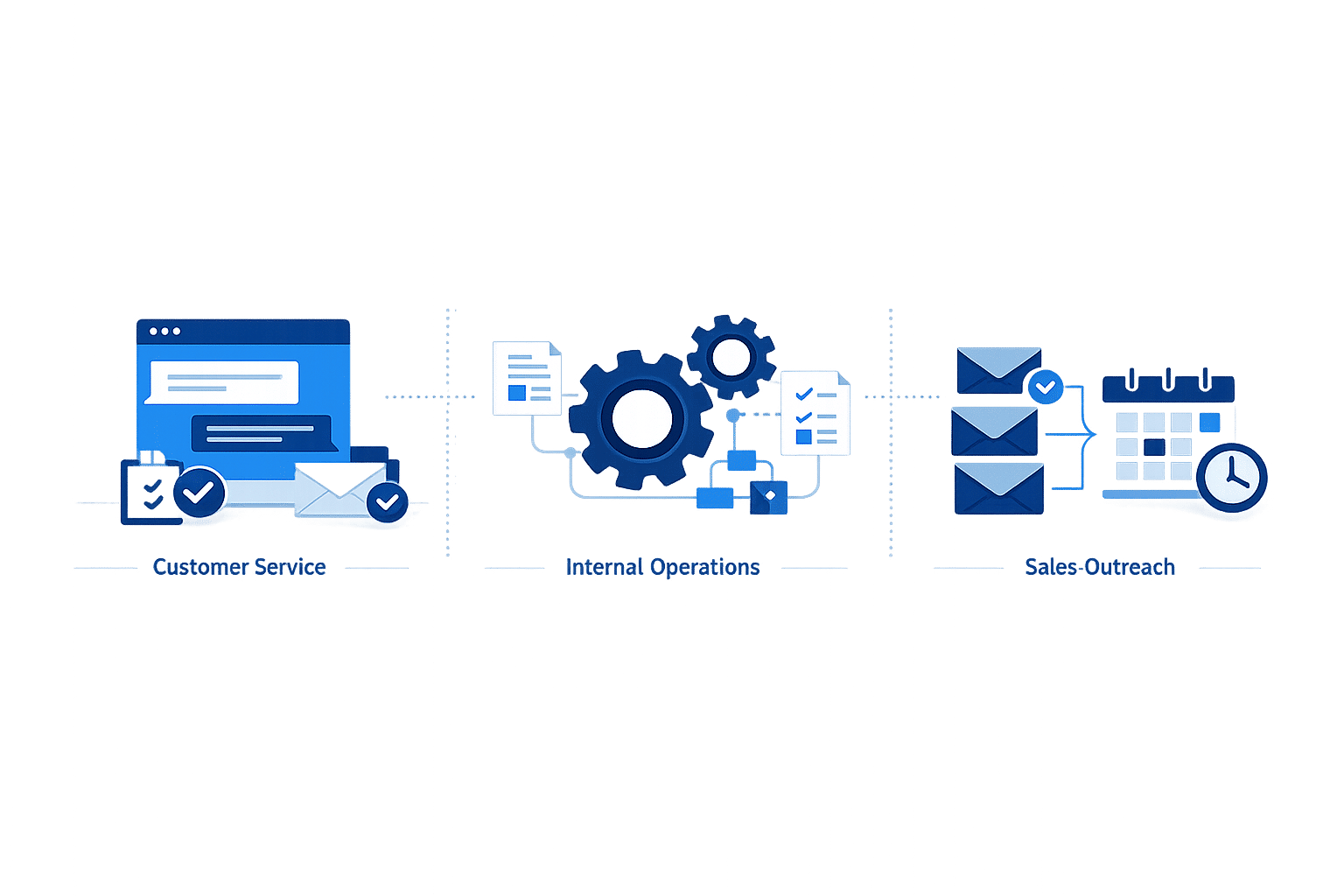
1. Customer Service Agents
Why it sells: SMBs using AI for customer service see 23% higher satisfaction scores. Your client already has a support bottleneck — missed calls, slow email responses, or a team drowning in repetitive tickets. This is the lowest-risk, highest-visibility agent deployment.
What "done" looks like:
- Agent handles tier-1 support queries (order status, FAQs, appointment scheduling) with 80%+ containment rate
- Human escalation triggers for anything the agent can't resolve with high confidence
- Integrated with the client's existing CRM/helpdesk (Zendesk, Freshdesk, HubSpot)
- Response time drops from hours to seconds
- Monthly performance report with resolution rates, escalation rates, and CSAT delta
Typical timeline: 3-6 weeks from kickoff to production.
2. Internal Operations Agents
Why it sells: The SMB owner who spends Sunday triaging 340 emails doesn't need a pitch deck — they need their life back. Internal ops agents handle email triage, document classification, invoice processing, employee onboarding workflows, and internal knowledge retrieval.
What "done" looks like:
- Agent classifies and routes inbound communications by type and urgency
- Automated task creation in project management tools (Asana, Monday, ClickUp)
- Standard operating procedures surfaced on demand for team queries
- Weekly digest of actions taken, escalations triggered, and time saved
- Clear human-in-the-loop rules for anything financial or compliance-sensitive
Typical timeline: 4-8 weeks depending on integration complexity.
3. Sales Outreach Agents
Why it sells: Immediate inbound response boosts conversion rates dramatically, and global coverage without extra headcount is irresistible. An outreach agent that responds to leads in seconds — not hours — while personalizing follow-up sequences is a revenue story, not a cost story.
What "done" looks like:
- Inbound lead response within 60 seconds, 24/7, across web form and email channels
- Lead qualification based on predefined criteria (budget, timeline, decision-maker)
- Personalized follow-up sequences triggered by prospect behavior
- Qualified leads booked directly onto the sales team's calendar
- CRM updated automatically with interaction history and qualification data
Typical timeline: 2-4 weeks for the core workflow; ongoing optimization.
For a deeper look at how agentic AI is changing what you actually deliver — and what to charge for it — see how agentic AI is reshaping consulting deliverables and pricing.
How to Scope an Agentic AI Project So You Don't Get Burned
Here's where most consultants selling AI agents to businesses lose money: they scope like it's a strategy engagement but deliver like it's a software project. Agent implementations have moving parts — APIs, integrations, prompt engineering, testing, edge cases — and if you don't define "done" with surgical precision, you'll be doing free work for months.
We've written a deep dive on scoping AI consulting projects — but here's the agent-specific framework:
Define the single workflow
Set measurable success criteria before you start
Document every exclusion explicitly
Build escalation-first, not automation-first
Include a 2-week tuning window in every contract
Never scope an agent project as 'build an AI agent for [department].' That's not a scope — it's a blank check. Every successful agent engagement starts with a single, named workflow and a defined handoff point. If the client can't tell you what happens when the agent doesn't know the answer, you're not ready to start.
Pricing Frameworks for AI Agent Implementation Consulting
Pricing agent implementations for SMBs is different from pricing strategy work. You're not selling hours of thinking — you're selling a working system. That changes the economics.
Here's what's working in the market right now:
| Engagement Type | Price Range | What's Included | Best For |
|---|---|---|---|
| Pilot / MVP Agent | $5,000 – $15,000 | Single workflow agent, basic integration, 2-week tuning, performance report | New clients, first engagement, proof of value |
| Production Agent Deployment | $15,000 – $35,000 | Production-ready agent with full CRM/helpdesk integration, testing, documentation, training | Clients who've validated the pilot and want to scale |
| Monthly Optimization Retainer | $2,000 – $5,000/mo | Ongoing monitoring, prompt tuning, performance reports, escalation rule updates | Post-deployment — this is where your recurring revenue lives |
| Agent + Strategy Bundle | $20,000 – $50,000 | AI readiness assessment + first agent deployment + 3-month retainer | Best-fit clients who are ready to commit |
Typical pricing ranges for SMB agentic AI consulting engagements in 2026. Rates vary by complexity, integrations, and geography.
The smart play is the pilot-to-retainer motion. Start with a $5K-$15K pilot that proves value in 4-6 weeks, then transition the client onto a monthly retainer for ongoing optimization. This gives you predictable revenue and gives them continuous improvement.
A few pricing principles that protect your margins:
- Always separate API/platform costs from your fees. LLM API costs are variable and unpredictable. Pass them through at cost or have the client pay directly. Your fee covers strategy, implementation, and optimization — not token usage.
- Price the outcome, not the hours. A sales outreach agent that books 20 qualified meetings per month is worth far more than the 40 hours it took to build. Frame your pricing around the ROI story, not your time sheet.
- Build the retainer into the initial proposal. Don't wait until post-deployment to pitch ongoing work. Include a "Phase 2: Optimization & Expansion" section in every proposal. It normalizes recurring revenue from day one.
Handling the "Can't We Just Use Off-the-Shelf Tools?" Objection
You'll hear this on almost every deal. The client's IT person just watched a Salesforce Agentforce demo, or someone on the team spun up a ChatGPT workflow over the weekend. Their question is reasonable: Why pay a consultant when we can just buy a tool?
Here's how to handle it without getting defensive:
Acknowledge the tools are real. Don't dismiss off-the-shelf platforms — they're genuinely powerful. Your credibility depends on being honest about what they can do.
Then reframe what they actually need. Off-the-shelf AI tools solve generic problems well. They don't know your client's refund policy, their escalation hierarchy, their CRM field structure, or their brand voice. The tool is 30% of the work. The other 70% — configuration, integration, training data, escalation logic, testing, and ongoing optimization — is what you sell.
Use the hybrid argument. The best agent implementations often use off-the-shelf platforms as the foundation and layer custom configuration on top. You're not competing with the tool — you're the person who makes the tool actually work in their business.
Quantify the cost of doing it themselves. Ask: "Who on your team is going to maintain this? What happens when it breaks at 2 AM? Who's monitoring accuracy and updating the training data?" The average SMB doesn't have that person. You are that person — and a $3K/month retainer is cheaper than a half-time hire.
Clients are no longer asking whether AI matters. They're asking who can make it useful, safe, and profitable inside their business. That's the opening.
— Ryan Drof, Viirtue, 2026
Pre-Qualifying: Which Clients Are Actually Ready for Agent Deployment?
Not every SMB client who's excited about AI agents is ready to buy one. And selling an agent to a client who doesn't have clean data, defined workflows, or internal buy-in is a recipe for a project that drags on for months and ends in a refund request.
Before you scope a single engagement, you need to qualify whether the client has:
- A defined, repeatable workflow the agent will handle (not "make us more efficient")
- Existing tools the agent needs to integrate with (CRM, helpdesk, email)
- A point of contact who will own the agent internally post-deployment
- Realistic expectations about what an agent can and can't do autonomously
- Budget alignment — at minimum $5K for a pilot, ideally $15K+ for production
This is where running an AI readiness assessment before the engagement pays for itself. Tools like ConsultKit let you send a structured assessment to prospects that surfaces their data readiness, tool stack, workflow maturity, and decision-making authority — before you ever get on a scoping call. The clients who score well become high-confidence pipeline. The ones who don't get a nurture sequence until they're ready. Either way, you stop wasting discovery calls on clients who aren't there yet.
Once a client clears this bar, the real work begins — and the first 30 days of an AI consulting engagement are where agent deployments get made or broken. That checklist covers the Week 1-2 alignment and data access work that determines whether an agent project stays on track.
For a broader primer on the mechanics and market behind agentic AI, see Agentic AI for Business: What Every Consultant Needs to Know Right Now — it covers the terminology distinctions and use-case landscape you'll want to have fluent before your first client pitch.
The Bottom Line
Selling agentic AI to SMB clients isn't about being the smartest technologist in the room. It's about being the clearest communicator.
The consultants winning these deals in 2026 follow a simple formula:
- Lead with the workflow, not the technology. Name the broken process. Quantify the cost.
- Scope ruthlessly. One agent, one workflow, measurable KPIs, explicit exclusions.
- Price for outcomes and build toward retainers. The pilot is your foot in the door. The retainer is the business.
- Handle objections by embracing the tools — and positioning yourself as the person who makes them work.
The $15 trillion shift that Gartner is projecting doesn't happen overnight. It happens one SMB at a time, one scoped engagement at a time, one consultant at a time who knows how to turn a first engagement into an ongoing relationship.
That consultant should be you.
