

The easiest sale you'll ever make is the next one to a client who already trusts you.
This isn't motivational fluff — it's math. Selling to an existing client converts at 60–70%. Selling to a new prospect? 5–20%. Acquiring a new client costs 5–25x more than expanding an existing one. And a 5% increase in client retention can boost profits by 25–95% (Bain & Company).
Yet most AI consultants close an engagement, send the final deliverable, and immediately start hunting for new leads. They treat every project as a one-off. No follow-up system. No expansion pathway. No plan to learn how to upsell AI services into the accounts they've already earned.
The result? They leave tens of thousands on the table per client — and stay stuck on the revenue treadmill of constantly chasing new logos.
Here's how to fix that.
The Natural Upsell Sequence in AI Consulting
AI consulting has a built-in expansion path that most service businesses don't. Unlike generic marketing or design work, every AI engagement naturally leads to the next one — if you structure it right from the start.
The sequence looks like this:
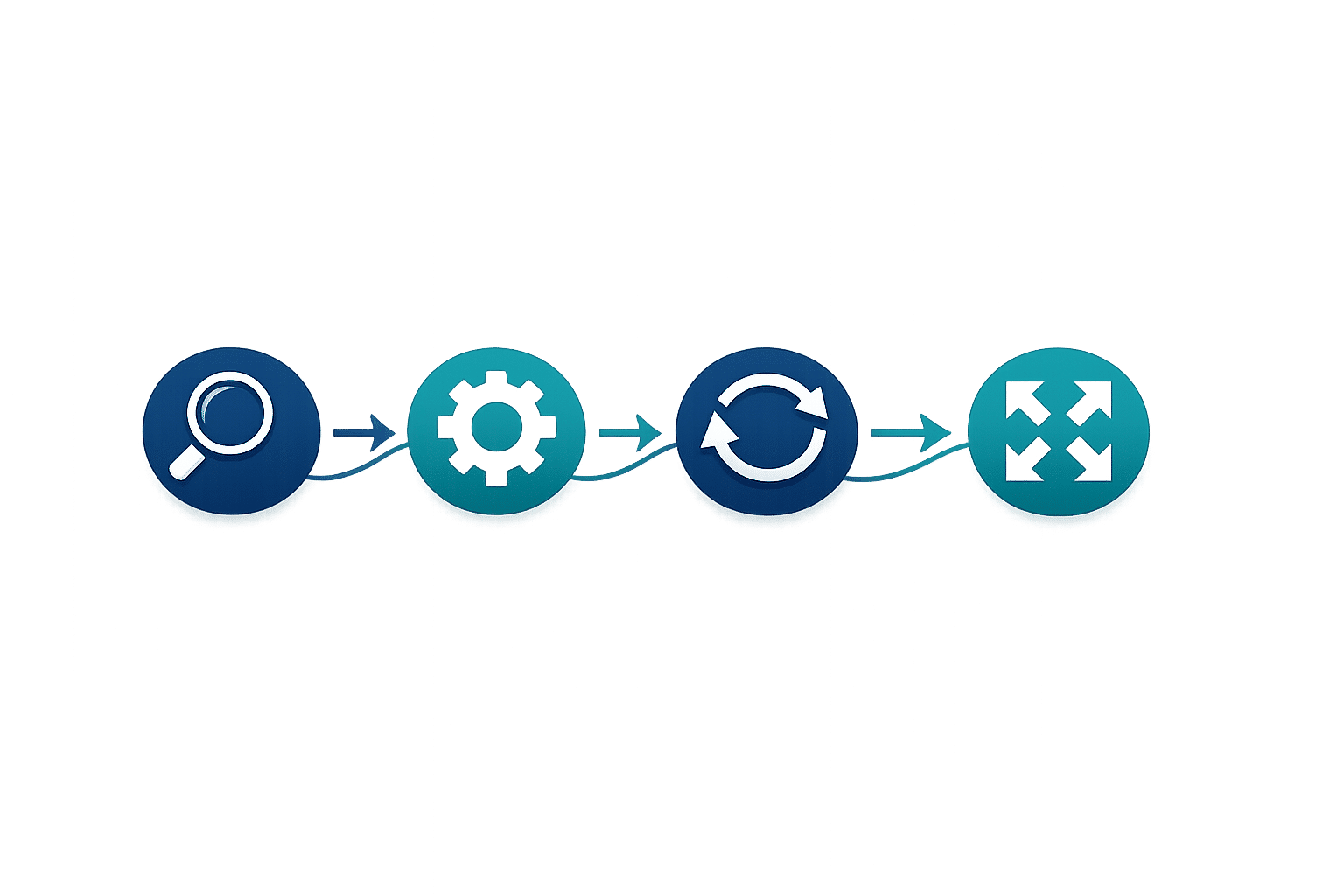
AI Readiness Audit ($2,500–$10,000)
Pilot Implementation ($15,000–$50,000)
Ongoing Retainer ($3,000–$10,000/month)
Multi-Department Expansion ($25,000–$100,000+)
The key insight: your audit is a scoping tool disguised as a deliverable. When you run an audit-first engagement, you don't just assess where the client is — you map where they could go. That map becomes the foundation for every upsell conversation that follows.
A well-structured audit typically identifies 5–10 AI opportunities. You recommend starting with one or two. The others don't disappear — they sit in your roadmap, pre-qualified and waiting.
The Timing That Changes Everything
Here's where most consultants get it wrong: they wait until the engagement is over to think about the next one.
By then, momentum is dead. The client's attention has moved on. The budget window may have closed. And you're competing with every other consultant pitching them cold.
The right time to introduce the next engagement is during delivery — not after.
Specifically, you want to plant the seed when the client is experiencing results from the current work. That's the moment of peak trust and enthusiasm.
In practice, this means:
- Week 2–3 of a pilot: Share early wins. "We're seeing a 40% reduction in processing time for this workflow. The same approach would apply to your invoicing process — want me to scope that as a Phase 2?"
- During a mid-engagement check-in: Review the original audit roadmap. "We identified six opportunities. We're delivering on the first. Here's what the second could look like."
- When a stakeholder from another department asks a question: This is your golden moment. Don't answer it casually — offer to schedule a discovery session.
Gartner research shows that teams using structured QBRs (quarterly business reviews) close expansion deals 2.1x faster than those relying on ad-hoc check-ins. Build the review cadence into your engagement from day one — not as an afterthought.
If the first time you mention a next engagement is in your final deliverable email, you've already lost. The upsell conversation should feel like a natural extension of the value you're delivering — not a pitch tacked onto a goodbye message.
Frame Expansion as Unrealised Opportunity — Not More Work
The fastest way to kill an upsell is to make it sound like you want more billable hours.
Clients don't buy more consulting for the sake of it. They buy outcomes. So every expansion conversation needs to be framed around what the client is leaving on the table — not what you'd like to sell them.
This is the difference:
- ❌ "We could also build an AI solution for your HR team."
- ✅ "Your HR team is spending an estimated 120 hours per month on screening. Based on what we've delivered for ops, we could reduce that by 60% — that's roughly $8,500/month in recovered capacity."
The second version speaks their language. It quantifies the gap. It anchors the expansion in results they've already seen.
Research backs this up: B2B AI deployments show a median ROI of +159.8% over 24 months, with average productivity gains of 25–45% in automated processes within the first year (Denis Atlan, 200 B2B Deployments Study, 2022–2025). When you can point to the ROI you've already delivered and project it onto the next use case, the upsell practically sells itself.
But here's the problem: in most AI consulting engagements, tangible ROI takes months to fully materialise. That's exactly why you need the leading indicators framework — surfacing early measurable wins is what keeps client confidence high enough to have the upsell conversation at all. The guide on how to prove AI ROI before the hard numbers arrive is essential reading before your next expansion pitch.
The formula is simple:
- Quantify what you've delivered — hours saved, error reduction, revenue impact
- Identify the next highest-value opportunity from the original audit
- Project the ROI using real data from the current engagement
- Present it as a recommendation, not a pitch
This framing works because you've already qualified the client's willingness to act. If you're unsure whether a prospect has the budget and authority to expand, revisit the BANT+Data framework for qualifying AI consulting leads — the same signals that qualify a new lead also tell you which existing clients are ready to upsell.
3 Upsell Triggers Every AI Consultant Should Watch For
Not every client is ready for expansion at the same time. But certain signals are near-guarantees that the door is open. Train yourself to spot these three:
What it looks like: The initial AI implementation hits or exceeds its projected KPIs. The client's internal champion is celebrating. People are talking about the results in meetings you're not in.
What to do: Request a results review meeting — not a casual email. Walk through the numbers. Then pull up the original audit roadmap and say: "We identified five more opportunities with similar potential. Based on what we've just delivered, here's which one I'd recommend tackling next and why."
Why it works: You're riding the wave of proven results. The client has zero objection to ROI — they're living it. Agencies using this approach see 67% conversion rates on expansion proposals vs. 23% for cold or manual outreach (SeventeenLabs).
What it looks like: The client hires new staff, opens a new office, launches a new product line, or restructures departments. Any organisational change creates new workflows — and new workflows mean new AI opportunities.
What to do: Proactively reach out. "I saw you're expanding the customer success team. When we built the support automation, we designed it for a team of 8. With 15 people, there are new scaling considerations — and some opportunities to extend the automation to the onboarding process they'll need. Want me to put together a scoping doc?"
Why it works: You demonstrate you're paying attention. You position yourself as a strategic partner, not a vendor waiting for an RFP.
What it looks like: During a retainer check-in or QBR, someone mentions that finance is struggling with reporting, or that the sales team can't keep up with lead qualification. A department you haven't worked with yet is experiencing pain you can solve.
What to do: Don't jump to selling. Say: "That's exactly the kind of problem we solved for [the department you're already working with]. Let me put together a one-page brief on what it could look like for finance — no commitment, just so you have something concrete to share with their team lead."
Why it works: You're lowering the barrier. A one-page brief costs you an hour. But it opens a $15,000–$50,000 implementation conversation. Upsell triggers like these are detectable 30–60 days in advance if you're monitoring systematically (Digital Applied).
How to Package Upsell Offers (With Real Pricing)
Clients don't buy vague proposals. They buy packages with clear scope, clear outcomes, and clear pricing. Here are three upsell packages that convert consistently in AI consulting:
| Package | What's Included | Pricing Range | Best For |
|---|---|---|---|
| **Quarterly AI Review Retainer** | Quarterly strategic review, performance monitoring, model optimisation, roadmap updates, 5–10 hrs/month advisory access | $3,000–$7,500/month | Clients who completed a pilot and need ongoing oversight without a full-time hire |
| **Multi-Vertical Rollout** | Take a proven AI solution from one department and deploy it across 2–3 additional departments or business units, including workflow mapping and training | $25,000–$75,000 per rollout | Clients with successful pilot results who want to scale across the organisation |
| **AI Training & Enablement Package** | Custom training for internal teams on using, maintaining, and extending AI tools you've built — includes playbooks, SOPs, and 30-day post-training support | $5,000–$15,000 per programme | Clients whose teams are adopting AI but lack internal capability to self-serve |
Three proven AI consulting upsell packages with real pricing benchmarks
Notice the pattern: each package addresses a specific stage in the client's AI maturity. The quarterly retainer bridges the gap between project and partnership. The rollout capitalises on proof. The training builds independence — which, counter-intuitively, makes clients more likely to bring you back for the next strategic initiative.
When you transition clients onto a retainer, the retainer itself becomes your expansion platform. Every monthly check-in is an opportunity to identify new use cases. Every quarterly review is a chance to present a roadmap update.
And when it's time to write the proposal for the next phase, you're not starting from scratch. You already know their systems, their team, their data, and their business goals. That context is worth thousands in reduced scoping time.
The Revenue Impact Is Hard to Ignore
Let's run the numbers on a real scenario.
You close a $5,000 AI readiness audit. Good start. Here's what happens if you have a system versus if you don't:
That's a 5.6x difference in revenue from the same client — without spending a cent on acquisition.
This is why consultants who scope their projects with expansion in mind from the beginning end up with fundamentally different businesses than those who treat every engagement as a standalone transaction. And it's also why value-based pricing for AI consultants makes the upsell math so much easier to close — when you're pricing on outcomes rather than hours, every phase of the upsell ladder has a self-evident ROI story attached to it.
The upsell sequence works especially well when your first engagement delivered a discrete automation win — the kind you can quantify cleanly. The AI workflow automation playbook for SMBs maps exactly these use cases (invoice processing, lead qualification, appointment scheduling) with the payback periods and ROI benchmarks that make Phase 2 conversations almost write themselves. If your initial engagement was a structured delivery with named phases and success metrics, the AI implementation roadmap framework gives you the template for expanding that roadmap into new departments — without starting from scratch. And packaging the expansion clearly into tiers is what removes the sticker shock: the AI service tier framework turns your multi-department rollout from a custom pitch into a structured offering the client can compare and choose from.
Once you've maximised the revenue potential from existing clients, your next lever is turning those happy clients into a source of new business. The AI consulting referral engine playbook shows how to build a systematic programme that turns successful upsell outcomes into predictable warm introductions.
And if you want to keep that growing client roster organised without adding headcount, the AI tools stack for solo consultants covers the exact workflow automation tools that let you manage more retainers without burning out.
Build the Upsell Structure Into Your Engagement From Day One
Everything we've covered — the sequence, the timing, the triggers, the packages — only works if you have a system for it. Not a system you'll build "someday." A system that's embedded in how you sell and deliver from the very first conversation.
This means:
- Your audit deliverable includes a multi-phase roadmap — not just a list of findings. Clients should see where they are and where they could go.
- Your proposals include tiered options — so the client is already aware of the expansion path before they sign the first contract.
- Your buyer profiles capture the full account opportunity — not just the immediate pain point, but department-level needs, budget cycles, and growth plans.
- Your delivery process includes scheduled check-ins that double as expansion conversations.
This is exactly the kind of structure that ConsultKit's buyer profiles and tiered service packages are designed for. When you build a buyer profile in ConsultKit, you're not just capturing a lead — you're mapping the full account potential. And when you present tiered packages, you're giving the client a natural ladder to climb from audit to implementation to retainer to expansion.
The consultants who scale aren't the ones closing more first deals. They're the ones who turn every first deal into three more.
