
You closed the deal. The contract is signed, the deposit hit your account, and you're officially an AI consultant with a paying client.
Now what?
Here's the uncomfortable reality: most AI consulting engagements don't fail during implementation. They fail during ai consulting onboarding — the first 30 days when expectations get set, data access gets (or doesn't get) secured, and the entire trajectory of the engagement is locked in.
The numbers are brutal. Between 70-90% of AI projects fail to reach production, according to research from RAND, MIT, and BCG. Gartner predicts that 60% of AI projects without AI-ready data will be abandoned through 2026. And an S&P Global survey found that 42% of companies abandoned most of their AI initiatives in 2025 — up from just 17% in 2024.
These aren't technology failures. They're onboarding failures. Misaligned stakeholders, undiscovered data gaps, fuzzy outcome definitions, and scope that mushrooms before you've delivered a single thing.
I've watched consultants lose five-figure engagements not because they couldn't build, but because they spent Week 1 "getting organised" instead of doing the AI-specific discovery work that actually protects the engagement. This checklist is the playbook that prevents that.
None of this works, of course, if the deal wasn't scoped correctly before signing. The problems you'll face in onboarding are usually symptoms of scoping gaps — that's why how to scope an AI consulting project without getting burned is the essential companion to this guide.
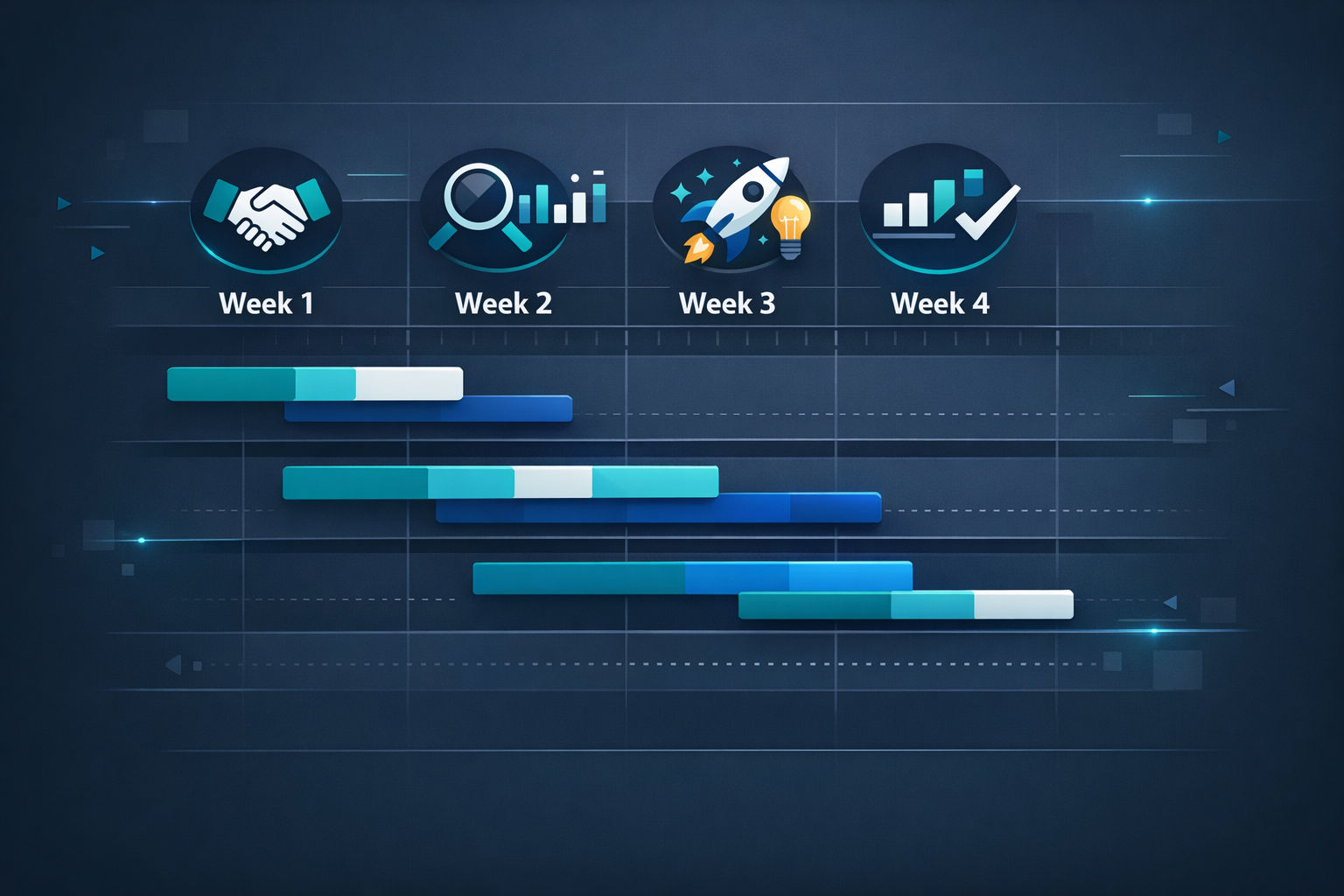
Let's walk through it week by week.
Week 1: Align & Access
Week 2: Assess & Audit
Week 3: Prioritise & Plan
Week 4: Review & Rhythm
Week 1: Stakeholder Alignment, Data Access, and Outcome Expectations
Week 1 is not about building anything. It's about preventing the three things that kill AI engagements: misaligned stakeholders, blocked data access, and fuzzy definitions of success.
Run the Kickoff Meeting Like It's the Engagement
A structured 60-minute kickoff that covers goals, constraints, team roles, and communication preferences prevents 80% of the misalignment issues that derail AI projects. This isn't an optional nice-to-have. It's the single highest-leverage hour of your entire engagement.
Your kickoff agenda should cover:
- Who owns what: The person who signed the contract is almost never the person who grants API access or provides training data. Map the full stakeholder landscape — decision-maker, technical contact, day-to-day project owner, and the person who'll actually use what you build.
- What success looks like — in outcomes, not deliverables: Don't let "build a chatbot" be the goal. The goal is "reduce inbound support tickets by 30%" or "cut proposal turnaround from 5 days to 1 day." Outcome-based framing protects you when implementation details inevitably shift. If you need a deeper framework for this, see how to scope an AI consulting project properly.
- Communication cadence: Set a weekly update rhythm from Day 1. Clients who go five or more days without hearing from you assume the project has stalled. A predictable update schedule — same day, same format — builds the trust that justifies your rate.
Secure Data Access Immediately
This is the one that bites AI consultants hardest. Unlike a marketing engagement where you need a login to their CMS, AI projects depend on data pipelines, API access, CRM exports, and system integrations that often require IT involvement from the client side.
Send your data access request list within 48 hours of kickoff. Include:
- CRM/database read access or export permissions
- API documentation and credentials for relevant systems
- Sample datasets for quality assessment
- Any compliance or data governance policies you need to follow
If you wait until Week 3 to discover their CRM data is a mess, you've burned two weeks of your engagement timeline on work that now needs to be redone or rescoped. This is also the moment to review what's inside your AI consulting contract around client obligations and data access — if those terms weren't defined before signing, address them now before they become disputes mid-engagement.
Never leave Week 1 without a signed-off definition of the outcome you're delivering — not the deliverable, the outcome. "Build an automated email classifier" is a deliverable. "Reduce manual email triage time by 60%" is an outcome. The outcome survives scope changes. The deliverable doesn't.
Week 2: Running the AI Readiness Baseline
Week 2 is where you do the work that separates an AI consultant from a generic project manager. You're not just cataloguing systems — you're assessing whether this client's environment can actually support AI implementation, and documenting the gaps that will blow up your timeline if you ignore them.
If you need a deeper framework for what a professional readiness assessment covers across all five dimensions, see what an AI readiness assessment actually is and why every client needs one.
This baseline work is also what powers your AI consulting deliverables — without a documented Week 2 current state, your readiness score, use case matrix, and roadmap have no foundation to stand on. And it's what gives you the "before" data you'll need to prove AI ROI to your client in month two, before the hard financial numbers have had time to materialise.

The Systems Audit
Document the client's current tech stack with a focus on AI-relevant infrastructure:
- Data sources: Where does their business data actually live? CRM, spreadsheets, email inboxes, accounting software, paper files? For most SMBs, it's scattered across 4-7 systems with zero integration.
- Data quality: Can you actually use what they have? Check for completeness, consistency, recency, and format. A CRM with 12,000 contacts and 80% missing email fields is not an asset — it's a cleanup project.
- Integration readiness: Do their systems talk to each other? Are there APIs available? What's the IT support situation — is there a person who can grant you access, or does the owner manage everything from a single admin login?
- Compliance constraints: Are there industry-specific regulations (HIPAA, SOC 2, GDPR) that constrain where data can go and what you can do with it?
Current-State Documentation
Before you optimise anything, document how work actually flows today. Shadow a process. Watch how the client's team handles the task you're about to automate. You will almost always discover that the process they described in the sales call is not the process they actually follow.
This current-state doc becomes your baseline. Without it, you can't measure improvement — and you can't defend your results at the Day 30 review.
This is also where you confirm or revise the scope. If the data situation is worse than expected, say so now. A scope adjustment in Week 2 is a professional conversation. A scope adjustment in Week 4 is a crisis.
| Assessment Area | What You're Evaluating | Red Flag to Watch For |
|---|---|---|
| Data Quality | Completeness, consistency, format, recency of key datasets | More than 30% of critical fields are empty or outdated |
| System Integration | API availability, existing automations, data flow between tools | No APIs — everything is manual CSV exports or copy-paste |
| Team Readiness | Technical literacy, willingness to adopt, change resistance | Key users weren't told about the AI project before you arrived |
| Compliance | Regulatory constraints, data residency, privacy policies | No existing data governance policy and they handle sensitive data |
| Infrastructure | Cloud vs. on-prem, compute capacity, IT support availability | Single admin login shared across the entire business |
AI Readiness Quick-Audit Framework: Score each area 1-5 to create a baseline
Week 4: First Progress Review and Setting the Delivery Rhythm
Week 4 is where you convert a project into a relationship. The Day 30 review is the most important meeting of the engagement — and most consultants blow it by treating it as a status update instead of a strategic checkpoint.
What the Day 30 Review Should Cover
- Outcome progress: Compare current metrics against the outcome targets you set in Week 1. Not "here's what I built" — but "here's what's changed."
- Scope validation: Has anything shifted? Are the original assumptions still valid? If not, present the scope adjustment formally with a revised timeline and any cost implications. This is your change order moment — handle it cleanly.
- Quick win results: Show the measurable impact of anything you implemented in Week 3. Even small numbers matter. "We automated your invoice data entry and saved 6 hours this week" is concrete proof of value.
- Roadmap confirmation: Walk through the prioritised roadmap and confirm the client's buy-in for the next phase. This naturally opens the upsell conversation without any awkwardness.
Set the Ongoing Cadence
Before you leave the Day 30 meeting, lock in the rhythm for ongoing delivery:
- Weekly async updates (written, same format every week)
- Bi-weekly or monthly live check-ins (depending on engagement size)
- A clear process for how new requests get triaged (hint: through the roadmap framework, not your inbox)
Research from Digital Applied shows that a formal Day 30 review converts one-time AI projects into ongoing retainers at a 60% rate. That number alone makes this the most valuable meeting you'll have all month.
Once you've nailed the Day 30 review, the next challenge is keeping clients confident while early results build. The playbook for how to prove AI ROI before the hard numbers arrive gives you the leading indicators and reporting cadence to hold trust through the gap. For a full playbook on what comes after, see how to upsell AI services after the first engagement closes.
Week 4: First Progress Review and Setting the Delivery Rhythm
Week 4 is where you convert a project into a relationship. The Day 30 review is the most important meeting of the engagement — and most consultants blow it by treating it as a status update instead of a strategic checkpoint.
What the Day 30 Review Should Cover
- Outcome progress: Compare current metrics against the outcome targets you set in Week 1. Not "here's what I built" — but "here's what's changed."
- Scope validation: Has anything shifted? Are the original assumptions still valid? If not, present the scope adjustment formally with a revised timeline and any cost implications. This is your change order moment — handle it cleanly.
- Quick win results: Show the measurable impact of anything you implemented in Week 3. Even small numbers matter. "We automated your invoice data entry and saved 6 hours this week" is concrete proof of value.
- Roadmap confirmation: Walk through the prioritised roadmap and confirm the client's buy-in for the next phase. This naturally opens the upsell conversation without any awkwardness.
Set the Ongoing Cadence
Before you leave the Day 30 meeting, lock in the rhythm for ongoing delivery:
- Weekly async updates (written, same format every week)
- Bi-weekly or monthly live check-ins (depending on engagement size)
- A clear process for how new requests get triaged (hint: through the roadmap framework, not your inbox)
Research from Digital Applied shows that a formal Day 30 review converts one-time AI projects into ongoing retainers at a 60% rate. That number alone makes this the most valuable meeting you'll have all month. For a full playbook on what comes after, see how to upsell AI services after the first engagement closes.
Mistake #1: Treating onboarding as admin, not delivery. If your first two weeks are spent "getting set up" — chasing logins, scheduling meetings, waiting for data — you've already lost momentum. The client is watching. Every day without visible progress erodes the confidence that made them sign. Front-load the hard work. Send the data request list before the kickoff call. Have the access checklist ready on Day 1.
Mistake #2: Skipping the data audit because the client said their data is "fine." It never is. For SMBs, data is almost always messier than described — scattered across systems, incomplete, inconsistent. The consultant who takes the client's word for it and starts building on bad data will spend Week 4 explaining why everything needs to be redone. The consultant who audits first adjusts scope early and delivers on time.
Protect Your Time From Day One
AI consulting engagements with SMBs have a unique scope creep pattern. The client gets excited about AI possibilities (they read an article, their competitor launched something, they saw a demo) and starts adding requests that feel small but compound fast.
Your defence is structural, not conversational:
- Define what's out of scope in your engagement letter — not just what's in scope. List 3-5 specific things you won't be doing. This creates a reference point for boundary conversations later.
- Use the roadmap as a scope shield: Every new request goes through the effort-impact framework. If it's worth doing, it gets sequenced. If it's not, it's documented as deprioritised — not rejected.
- Time-box discovery: Your readiness assessment and systems audit should take 5-7 working days, not expand to fill all available time. Set a deadline for the assessment phase and stick to it.
- Establish your communication boundaries early: Response time expectations, meeting-free days, and async-first communication norms should be set in Week 1, not negotiated after you're drowning in Slack messages.
Poor onboarding costs 3-5x more than structured onboarding when you account for lost client lifetime value, rework, and the reputation damage of a failed engagement. Investing heavily in the first 30 days isn't overhead — it's margin protection.
Before Kickoff
Week 1: Align & Access
Week 2: Assess & Audit
Week 3: Prioritise & Plan
Week 4: Review & Rhythm
Accelerate the Hardest Part
The highest-friction phase of this entire checklist is Weeks 1-2 — stakeholder alignment and AI readiness assessment. It's where most consultants lose time, miss critical gaps, and set themselves up for scope problems down the line.
ConsultKit's AI Readiness Assessment gives you a structured, scored baseline before the engagement even starts. Instead of spending your first week building an assessment framework from scratch, you walk into the kickoff with a client-specific readiness score across data, systems, processes, and team capability — plus a prioritised gap analysis that directly feeds your Week 3 roadmap.
It's the difference between starting the engagement with a blank whiteboard and starting with a clear picture of exactly where this client stands and what needs to happen first.
The consultants who systemise this phase are the ones who scale past a handful of concurrent engagements — because they've turned the most unpredictable part of delivery into a repeatable process. And that's exactly what the first 30 days should give you: not just a successful project, but a system you can run again and again.
