
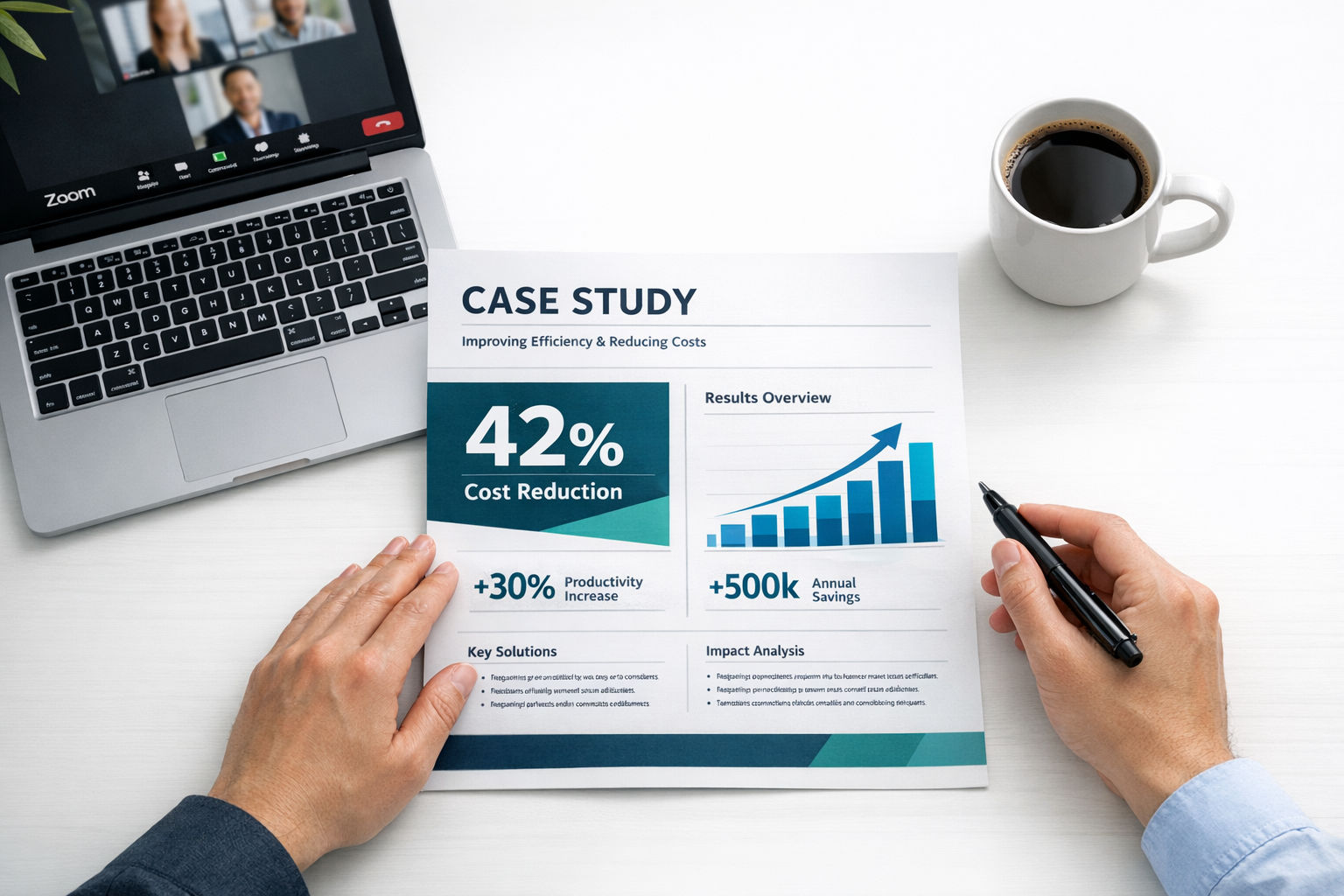
You delivered a great AI consulting engagement. The client's happy. Their team is saving hours every week. Revenue is up, costs are down, or both.
And yet — when you try to win the next client, you're starting from zero. No proof. No credibility shortcut. No asset you can drop into a proposal that makes the prospect think, "This person clearly knows what they're doing."
The problem isn't your results. It's that you never turned them into an AI consulting case study that actually sells.
Here's the uncomfortable truth: 76% of B2B buyers demand concrete proof before engaging with a vendor (SalesRelief, 2026). And 81% have already chosen their preferred provider before they ever talk to you (6sense, 2024 Buyer Experience Report). Your case study is doing the selling in the room you're not in.
So if it reads like a project report — or worse, doesn't exist at all — you're leaving deals on the table.
Case studies with specific metrics drive 43% higher close rates than those relying on qualitative praise alone. Companies that use them strategically see sales cycles shrink from 95 days to 72, and proposal-to-close rates jump from 28% to 39% (SalesRelief; MaryRose Denton Writer).
Why Most AI Consulting Case Studies Fail
Most consultants make the same mistake: they write about what they built instead of what the client gained.
Here's what a typical bad AI consulting case study sounds like:
"We implemented a custom NLP pipeline using GPT-4 with RAG architecture, integrated it with the client's Salesforce instance via REST APIs, and deployed it on Azure with CI/CD pipelines."
That's a project report. It tells the next prospect absolutely nothing about whether you can solve their problem.
Now here's the same engagement, rewritten for outcomes:
"A 40-person accounting firm was losing 22 hours per week to manual document review. We deployed an AI-powered extraction system that cut that to 3 hours — saving $78,000 annually and freeing up two senior staff for client-facing work."
Same project. Completely different impact on a buyer.
Neil Patel reported a 185% sales increase from just three outcome-focused case studies. The difference isn't volume — it's framing. Prospects don't care about your tech stack. They care about whether someone like them got a result they want.
If you've already nailed your AI consulting proposal structure, your case study is the proof that makes that proposal believable. And if you're still in the middle of an active engagement, knowing how to prove AI ROI before the hard numbers arrive is what gives you the leading indicators you'll need to build a credible case study later.
The strongest case studies start with a clear client brief and a scoped deliverable. If you want a real-world example of what that looks like in practice, the AI implementation roadmap structure — with named phases, owners, and success metrics — is exactly the kind of engagement that produces the measurable outcomes case studies are built on.
For SMB automation projects specifically, the AI workflow automation playbook is a rich source of case study material: fixed pricing by automation type, payback periods, and the ROI framing that makes before-and-after numbers land with B2B buyers. The right tool stack also makes case study production faster — the AI tools every consultant needs covers the systems that capture and structure engagement data as you go.

The 5-Part Structure of a Winning AI Consulting Case Study
After analyzing what separates high-performing case studies from the 78% that generate zero pipeline impact, the pattern is clear. The best ones follow this exact structure:
The Client Situation (2-3 sentences)
The Problem Costing Them Money (3-4 sentences)
What You Assessed and Recommended (3-4 sentences)
What You Implemented (3-4 sentences)
Measurable Results (The Headline)
Don't title your case study "AI Implementation for Regional Law Firm." Title it "How a Regional Law Firm Saved $72K/Year and Cut Intake Time by 87%." The result is the headline. That's what gets clicked, shared, and forwarded to the decision-maker.
What to Do When You Don't Have Hard Numbers
This is the objection I hear most from consultants: "My client can't give me exact revenue numbers" or "We just finished — there's no long-term data yet."
Fair. But no data isn't actually your problem. Vague framing is your problem.
Here's how to make qualitative results credible:
Use time-based metrics instead of revenue. Almost every client can tell you how long something used to take versus how long it takes now. "Reduced weekly reporting from 8 hours to 90 minutes" is concrete and believable — no revenue disclosure needed.
Quote the client directly. A specific client quote carries more weight than your summary. "We went from dreading Monday mornings to having reports ready before the team arrives" — that's a qualitative statement that any prospect in a similar role feels in their gut.
Frame outcomes as capacity unlocked. If you can't say "revenue increased 18%," you can say "freed up 15 hours per week of senior staff time, which the firm redirected to business development." The prospect fills in the revenue math themselves.
Use before-and-after snapshots. Document the baseline state (even roughly) and the current state. "Before: 3 staff members spending 2 days per month on manual data entry. After: same output handled in 4 hours by one person with AI assistance." No revenue figures needed. The ROI is obvious.
The key is specificity. "Client was very happy with results" is worthless. "Client renewed for a 12-month retainer within 60 days of pilot completion" is proof.
| Weak Framing | Strong Framing |
|---|---|
| "Improved efficiency" | "Cut invoice processing from 4 hours to 25 minutes per week" |
| "Client was satisfied" | "Client expanded engagement to 3 additional departments within 90 days" |
| "Reduced costs" | "Eliminated $4,200/month in manual data entry labor" |
| "Better decision-making" | "Executive team went from monthly to real-time reporting on key metrics" |
| "Successful AI implementation" | "100% staff adoption within 2 weeks — zero support tickets after day 10" |
The difference between case study language that sells and language that gets skimmed.
Building the case study is half the battle. The other half is putting it where it actually influences deals. Prospects spend an average of 11.3 minutes reviewing case studies during evaluation — more than any other content asset except live demos (SalesRelief). But only if they see them at the right moment.
Here's where your case studies should live:
In every proposal. This is non-negotiable. Your AI consulting proposal should include a 1-page case study summary tailored to the prospect's industry or problem. Not a link to your website — embedded directly in the document they're reviewing.
On sales calls as a pivot tool. When a prospect says "How do I know this will work for us?" — that's your cue. Walk them through a 60-second case study verbally: situation, problem, what you did, result. This is infinitely more persuasive than a features list.
On LinkedIn, broken into micro-content. Take one stat from your case study and turn it into a post: "A 40-person accounting firm was losing $78K/year to manual document review. We fixed it in 4 weeks. Here's what we did..." These posts consistently outperform generic thought leadership because they're specific and results-driven.
On your website's services pages — not buried in a 'Resources' section. Put case study snippets directly on the pages where prospects are evaluating whether to hire you. A "Results" section on your services page with 3-4 case study headlines (linked to full versions) is worth more than a separate case studies page nobody visits.
In follow-up emails after discovery calls. Instead of "Thanks for your time, here's our brochure," send "Here's how we helped a similar firm solve the exact problem you described." This is where upselling from an initial engagement starts.
Case studies also compound your niche authority over time. The more vertical-specific proof you accumulate, the harder it becomes for generalists to compete with you — another reason choosing a tight AI consulting niche and building a referral engine go hand in hand with your case study strategy.
For verticals with high compliance sensitivity — such as law firms or healthcare providers — your case study must also demonstrate how you navigated regulatory constraints. See the AI governance consulting guide for the framing that resonates with risk-averse buyers.
Building the case study is half the battle. The other half is putting it where it actually influences deals. Prospects spend an average of 11.3 minutes reviewing case studies during evaluation — more than any other content asset except live demos (SalesRelief). But only if they see them at the right moment.
Here's where your case studies should live:
In every proposal. This is non-negotiable. Your AI consulting proposal should include a 1-page case study summary tailored to the prospect's industry or problem. Not a link to your website — embedded directly in the document they're reviewing.
On sales calls as a pivot tool. When a prospect says "How do I know this will work for us?" — that's your cue. Walk them through a 60-second case study verbally: situation, problem, what you did, result. This is infinitely more persuasive than a features list.
On LinkedIn, broken into micro-content. Take one stat from your case study and turn it into a post: "A 40-person accounting firm was losing $78K/year to manual document review. We fixed it in 4 weeks. Here's what we did..." These posts consistently outperform generic thought leadership because they're specific and results-driven.
On your website's services pages — not buried in a 'Resources' section. Put case study snippets directly on the pages where prospects are evaluating whether to hire you. A "Results" section on your services page with 3-4 case study headlines (linked to full versions) is worth more than a separate case studies page nobody visits.
In follow-up emails after discovery calls. Instead of "Thanks for your time, here's our brochure," send "Here's how we helped a similar firm solve the exact problem you described." This is where upselling from an initial engagement starts.
As the payoff to a strong deliverable. The better your AI consulting deliverables are, the more your clients have to say in a case study — because they actually implemented what you recommended.
The biggest mistake consultants make is trying to reconstruct results after an engagement is over. By then, the client has moved on and the specifics are fuzzy. Document baseline metrics during your initial assessment and capture results at every milestone. Your case study should write itself by the time the project wraps.
The Baseline Problem (And How to Solve It Before It Starts)
The hardest part of any AI consulting case study is the "before" data. If you didn't measure the baseline, you can't prove the improvement. And most consultants don't think about the case study until the project is already done.
This is why your initial assessment is so critical — not just for scoping, but for future proof of results.
When you run a structured AI readiness assessment at the start of every engagement, you're automatically documenting the "before" state: current process times, manual hours spent, error rates, cost breakdowns, tool gaps. That assessment becomes your baseline document.
Three months later, when the AI solution is live and you re-measure those same metrics, the case study practically writes itself. The before/after comparison is already built in.
ConsultKit's AI readiness reports are designed to give consultants exactly this kind of structured baseline — a professional, data-driven snapshot of where the client started. That means every engagement you run through the platform has a built-in "before" document, making it dramatically easier to capture the measurable results that turn into your best sales asset.
No scrambling for data after the fact. No awkward conversations about metrics nobody tracked. Just a clean before-and-after story that wins the next deal.
