
You're in month two. The workflows are live. The automations are running. But the client's Slack messages have shifted from excited to polite — and you know what polite means. It means they're starting to wonder if they made a mistake.
Here's the uncomfortable truth about how to prove AI ROI: the average AI initiative takes 28 months to deliver full financial payback, according to a 2025 analysis by Risk & Insurance. But your client isn't thinking in 28-month increments. They're thinking about their next board meeting. Their next budget review. The next 30 days.
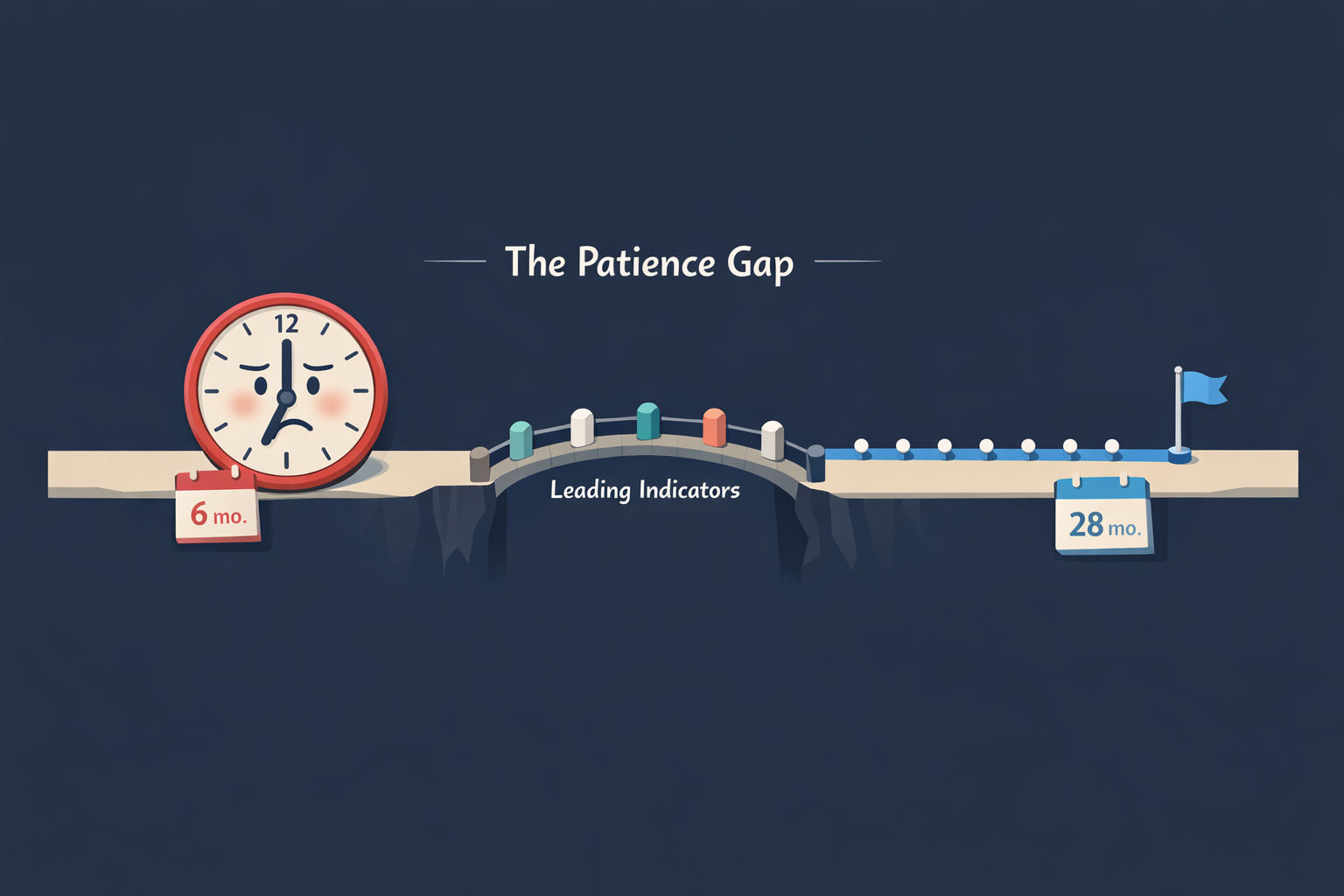
This gap — between when AI actually pays off and when your client expects to see it — is where most AI consulting engagements die. Not because the work was bad. Because the consultant couldn't show the trajectory before the destination arrived.
If you're an AI consultant sitting in this gap right now, this is the playbook for getting through it.
Why "Wait for the Data" Is a Losing Strategy
Let's start with what your client is actually evaluating in the first 60 days — because it's not ROI.
They're evaluating you. Your confidence. Your communication. Whether you seem like someone who knows where this is going, or someone who's hoping it works out.
The data backs this up. 42% of U.S. companies abandoned most of their AI initiatives in 2025, up from 17% in 2024, per S&P Global Market Intelligence. And 67% of AI projects fail to get renewed funding after year one — not because the technology failed, but because teams couldn't translate progress into language that justified continued investment.
That means the majority of AI engagements that get killed are killed by a communication problem, not a results problem.
When you tell a client "the data isn't in yet" or "we need more time to see the impact," you're not being honest — you're being passive. And passivity in a consulting engagement reads as incompetence. The client doesn't hear patience. They hear uncertainty. And uncertainty is contagious.
Client expectation: measurable ROI within 6 months or less (53% of investors expect this, per Teneo's 2026 CEO Survey).
Industry reality: average payback period of 14–28 months for properly scoped AI engagements.
If you don't fill this gap with leading indicators, your client will fill it with doubt.
The consultants who survive month two aren't the ones with better AI models. They're the ones who understood — before the engagement started — that the first 30 days are about building a measurement infrastructure, not just deploying technology.
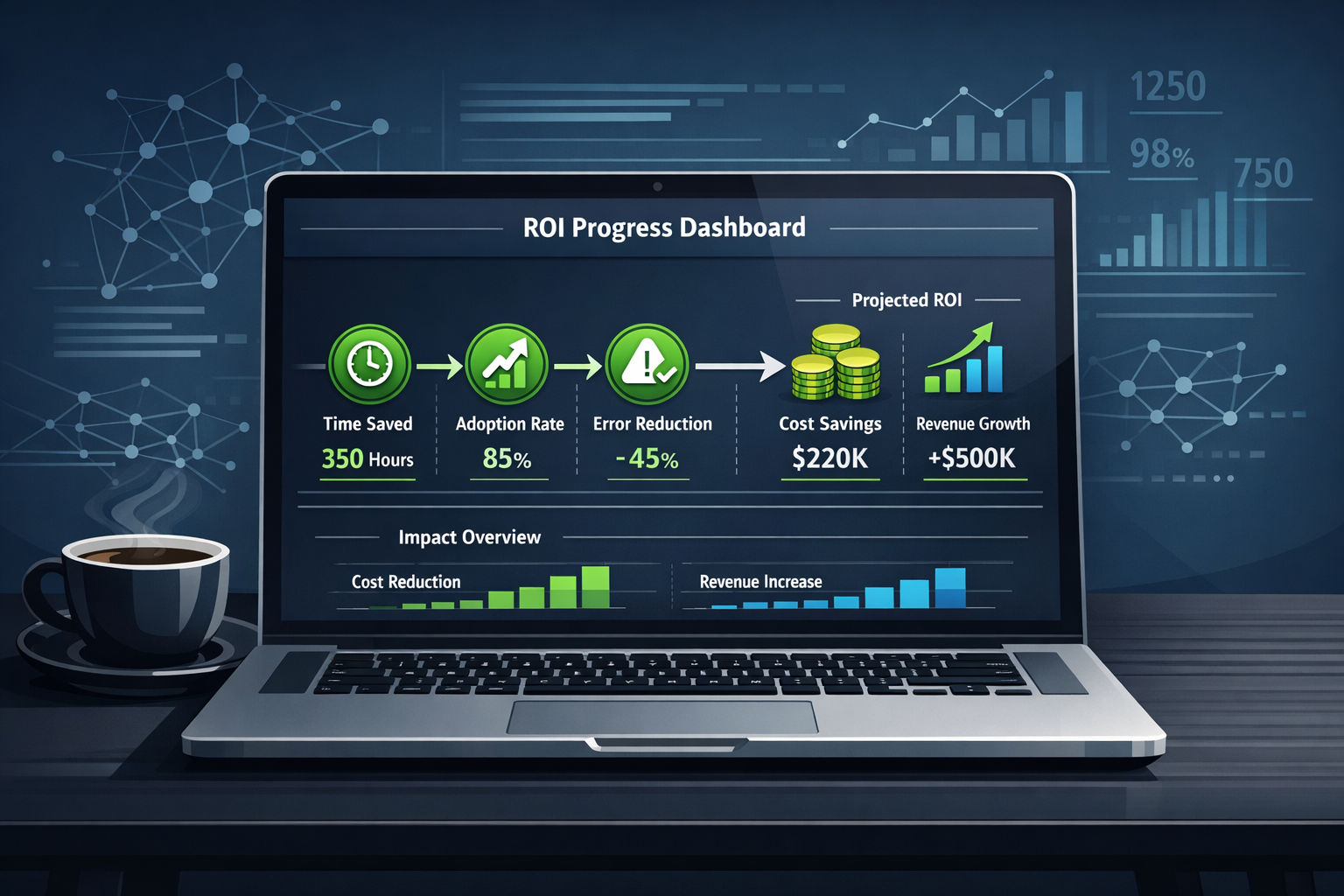
Leading vs. Lagging Indicators: What to Track and Show Right Now
Here's the framework that changes everything: stop reporting on lagging indicators (revenue impact, cost reduction, full ROI) and start reporting on leading indicators — the metrics that predict those outcomes before they arrive.
Leading indicators are forward-looking and actionable. Lagging indicators are backward-looking and confirmatory. Your client needs to see the leading indicators now so they believe the lagging indicators are coming.
This isn't spin. It's measurement discipline. McKinsey's 2025 research found that companies with clearly defined AI KPIs see 2.3x higher returns on AI investment than those without. The act of tracking and showing the right early metrics doesn't just retain client trust — it actually improves outcomes.
| Leading Indicators (Track Now) | Why It Matters | Lagging Indicators (Coming Later) |
|---|---|---|
| Hours saved per workflow per week | Proves operational friction is being removed | Total cost reduction (quarterly) |
| Number of workflows automated or modified | Shows scope of change across the business | Revenue impact from efficiency gains |
| Error rate reduction in targeted processes | Quantifies quality improvement before it hits P&L | Reduced rework/correction costs |
| Team adoption rate (% using new tools daily) | Predicts sustainability and long-term ROI | Productivity per employee (annual) |
| Process cycle time reduction | Shows speed improvements in real-time | Time-to-revenue acceleration |
| User satisfaction / feedback scores | Validates the change is sticking | Employee retention and NPS |
Leading indicators you can report on in weeks 2-8, mapped to the lagging outcomes your client ultimately wants.
The key is specificity. "We're making progress" means nothing. "We reduced invoice processing time from 47 minutes to 12 minutes across your AP team, which at current volume projects to 140 hours saved per quarter" — that's a leading indicator with a lagging projection attached. It's how to prove AI ROI before the hard numbers arrive.
Industry benchmarks give you firepower here. Well-scoped AI implementations in the first 0–3 months typically show 30–50% reductions in admin time, 40–60% query deflection in customer-facing automations, and 30–50% fewer revision cycles in document-heavy workflows, according to data from SFAI Labs and Hashmeta research.
The groundwork for this kind of measurable ROI starts long before month two. A tight AI consulting scope of work that defines success metrics upfront — and an AI readiness assessment that documents the baseline before work begins — are what make leading indicators possible to track at all.
How to Frame ROI Reporting So Progress Feels Inevitable
The difference between a consultant who gets renewed and one who gets replaced isn't the results — it's the narrative arc of the reporting.
Here's what most consultants get wrong: they report on what happened. What you need to report on is what's happening, what it means, and what's coming next.
Every client update should follow this structure:
1. This is what we measured this period. Lead with hard numbers. Hours saved. Workflows changed. Error rates. Adoption percentages. No qualitative fluff first — numbers first.
2. This is what it means in business terms. Translate the metric into their language. "The 12-hour weekly reduction in manual reporting across your ops team is equivalent to $4,200/month in recovered labor capacity at your fully loaded rate."
3. This is what's coming next. Project the trajectory. "Based on current adoption curves, we expect to hit full department rollout by week 10, which will increase the projected savings to $7,800/month."
This three-part structure does something critical: it makes ROI feel inevitable rather than uncertain. The client isn't hoping for results — they're watching results accumulate toward a clear target.
Notice the shift: you're not asking for patience. You're demonstrating momentum.
Avoid these phrases in client updates:
- "We're still in the early stages" (sounds aimless)
- "Results should start appearing soon" (no specificity)
- "We need more data before we can draw conclusions" (reads as avoidance)
- "The ROI will become clear over time" (client hears: never)
Use these instead:
- "Here's what the first 6 weeks of data shows"
- "At current trajectory, we project [X] by [specific date]"
- "The leading indicators are tracking [above/on/below] the benchmarks we set at kickoff"
- "This is the measurable progress this period, and here's what it means for Q3"
Practical ROI Proof: What to Send, When, and How Often
Your consulting deliverables shouldn't just include the final output — they should include a reporting cadence that builds confidence at every stage. Here's the reporting framework that works:
Metric Snapshot (Top of Every Update)
Business Translation
Trajectory Projection
Next Period Focus
Risk/Blocker Flag (Only When Relevant)
Frequency matters. Send these updates every two weeks minimum. Weekly is better if you're in the first 60 days. The worst thing you can do is go quiet — silence in a consulting engagement doesn't signal that you're busy. It signals that you're stuck.
One practitioner framework that works well: "Don't try to justify the whole investment upfront. Build a Phase 1 business case around measurable efficiency gains. Use those gains to fund Phase 2 discovery." Start with quantifiable wins like 30% faster resolution times or 40% fewer manual steps — then use that credibility to expand the engagement. This approach, documented in AI product management practice, turns ROI reporting into a self-reinforcing sales cycle.
When the Numbers Aren't There Yet: Holding Confidence and Trust
Sometimes the leading indicators are soft. Maybe adoption is slow because the client's team is resistant. Maybe the data integration took longer than expected and you're behind schedule. Maybe the first workflow you automated wasn't the highest-impact one.
This is where consultants panic — and panic is visible.
Here's what works instead:
Own the timeline, don't apologize for it. "We're two weeks behind our original projection on the document automation workflow because the data normalization step was more complex than the initial audit showed. Here's the revised timeline, and here's why the outcome is still the same." That's confidence. That's control.
Reframe around what you've learned. Every engagement generates intelligence about the client's operations — even when the metrics are slow. What process bottlenecks did you uncover that they didn't know about? What data quality issues would have derailed a larger initiative later? Frame your discovery work as value, because it is.
Invoke industry context. Remember: 95% of enterprise AI pilots deliver no measurable P&L impact, according to MIT research. Only 25% of AI initiatives deliver expected ROI, per IBM. Your client is already beating those odds if you've got working automations and any measurable improvement at all. Don't be afraid to benchmark your engagement against the industry — it puts your progress in perspective.
Separate effort from outcomes. If adoption is the issue, that's a change management problem, not a technology problem. Name it. "The automation is performing as designed — the gap is in team adoption. Here's our plan to close it." Clients respect consultants who can diagnose honestly, not ones who obscure problems behind vague updates.
The consultants who build case studies from tough engagements are the ones who learned to narrate through difficulty, not around it.
86% of businesses report positive AI impacts on employee productivity even when financial ROI hasn't fully materialized (Risk & Insurance, 2025). If your client's team is working faster, making fewer errors, or spending less time on manual tasks — that is ROI. You just need to quantify it and name it before someone else defines the engagement as unsuccessful.
Here's what separates consultants who fight for ROI proof from those who walk into engagements with it already in hand: pre-engagement intelligence.
If you start an engagement without a baseline — without knowing what the client's current processes cost, where the biggest inefficiencies are, and what realistic improvement looks like — you're building your ROI case from scratch while the clock is already ticking.
The best AI consultants lock in measurement frameworks before the contract is signed. They use readiness assessments and buyer profile data to identify the highest-ROI workflows upfront, set specific targets the client has agreed to, and establish the baseline metrics that every future update will reference.
This is exactly what ConsultKit's readiness scoring and buyer profile data is built for — giving you pre-engagement ROI signals you can reference throughout the entire engagement. When you walk into month two with a baseline that was documented at kickoff, and targets that were agreed to before the work started, you're not proving ROI retroactively. You're confirming a trajectory that was set from day one.
For SMB clients in particular, the ROI case is most concrete when you've scoped the right automation project from the start. The playbook on selling AI workflow automation to SMBs — with ROI benchmarks by automation type and exact pricing ranges — gives you the numbers to build a credible baseline before the engagement begins.
The difference between scrambling to justify your value and calmly demonstrating it comes down to whether you set up the measurement infrastructure before the engagement started — or after the client started asking questions. Once you've proven results, your next move is to turn that ROI story into a case study that closes your next deal before you even get on the call. And the engagement after that? That's where upselling AI services systematically — using the trust you've already built — compounds your revenue without adding new clients.
For clients who stay long-term, proven ROI also becomes the natural bridge into a recurring relationship. The AI consulting retainer transition playbook shows exactly when and how to have that conversation — and why demonstrated ROI makes the ask almost frictionless.
Finally, once those retainer relationships are delivering consistent results, they become the raw material for your most powerful growth channel: building a referral engine that generates pre-sold leads from every successful engagement.
