

Referred leads close at 50–70%. Cold leads? 10–25%. Referrals compress sales cycles by 30–40% and cost you exactly nothing to acquire. If you're selling AI consulting services, there is no higher-leverage growth channel than a strong ai consulting referral strategy.
And yet — almost nobody has a system for it.
Only 30% of B2B firms have a formal referral programme, according to Extole's industry research, despite 60% of consulting revenue coming from referrals. That gap isn't a minor oversight. It's the difference between a pipeline that grows predictably and one that depends on whether a happy client happens to bump into someone at a conference.
This post gives you the system. Not generic networking tips — a referral engine built specifically for AI consulting, tied to the outcome moments, partner dynamics, and deliverable formats that make this business unique. If you're simultaneously looking to build a consulting pipeline while fully booked, referrals are the channel that runs in the background — low-effort, high-conversion, and compound over time.
Of course, a referral engine only fills your pipeline if you're also capable of converting new contacts once they arrive. For consultants without an existing network or audience, the outbound playbook for getting AI consulting clients from scratch pairs naturally with referral systems — outbound builds the initial client base that your referral engine then multiplies.
Why Happy Clients Still Don't Refer You
Here's the uncomfortable truth: client satisfaction and referral behaviour are barely correlated.
Research from ModelFA shows that making a referral requires clients to put their social credibility on the line — and the brain's natural risk-assessment system flags that as a threat. Your client loved your work. They'll happily leave a testimonial. But actively recommending you to a peer? That's a different calculation entirely.
Three things kill referrals even when the work was excellent:
- Social risk with no safety net. AI is still unfamiliar to most SMB decision-makers. Your client might worry about recommending something their peer doesn't understand — or worse, something that fails. They need confidence that the recommendation will reflect well on them.
- They don't know what to say. Ask your best client to describe what you do, and you'll likely hear something vague: "They helped us with AI stuff." That's not a referral — it's a dead end. If your client can't articulate your value in one sentence, they won't try.
- Post-project invisibility. Most referral opportunities arise weeks or months after your engagement ends. If you've disappeared, you're forgotten — no matter how good the work was.
The fix isn't to ask more aggressively. It's to engineer the conditions that make referrals easy, low-risk, and natural.
~80% of satisfied clients say they're willing to refer — but only a fraction actually do. The gap isn't willingness. It's clarity, confidence, and a prompt. If your client doesn't know exactly who you help, how to describe your value, and when to mention you — the referral never happens.
The Outcome Moment: When to Actually Ask
Most consultants make one of two timing mistakes: they ask too early (during onboarding, when trust isn't established) or too late (at contract close, when the client is already mentally moving on).
The right moment is neither. It's the outcome moment — the point where your client experiences a concrete result from your work. In AI consulting, these moments are specific and identifiable:
| Outcome Moment | Why It Triggers Referrals | How to Use It |
|---|---|---|
| First automation goes live | Client sees AI working in their real workflow for the first time — excitement peaks | Share a quick win summary and ask: "Who else in your network is dealing with this same bottleneck?" |
| First ROI report delivered | Hard numbers create confidence — client can now quantify what you did | Send a branded outcome report and say: "Feel free to share this with anyone facing similar challenges" |
| Team adoption milestone | Client sees their people using the tool — the change is real, not theoretical | Ask for a short case study, then request permission to share it with their peers |
| Quarterly business review | Structured reflection on cumulative value — client is primed to talk about results | Include a referral prompt as a standing agenda item |
AI consulting engagement milestones that naturally trigger referral conversations
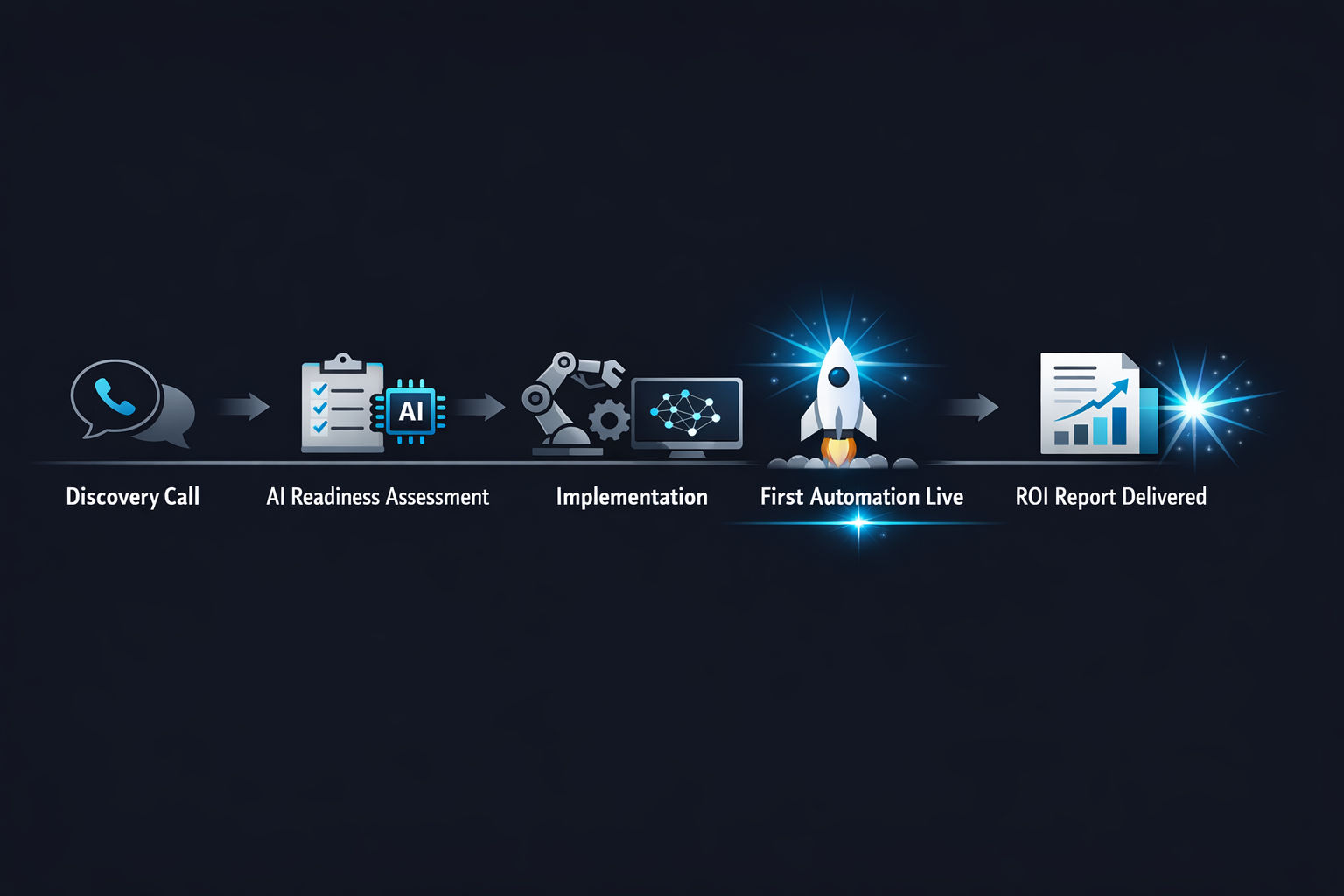
The key insight: you're not asking for a favour. You're capitalising on a moment where the client is already thinking — and likely talking — about the result. The outcome moment is when their enthusiasm is highest and their ability to articulate your value is strongest.
If you've already got a system for upselling AI services after the first engagement, you'll recognise these same inflection points. Referral asks and upsell conversations live in the same window.
The best clients to ask — and the ones most likely to become your referral advocates — are the ones you've niched into serving well. When a client tells a peer "this consultant specialises in AI for firms like ours", that's a far more powerful endorsement than a vague recommendation. Another reason choosing a tight AI consulting niche compounds over time: it makes your referrals more targeted, more credible, and more likely to close.
You'll also want strong proof to back up those referrals. The AI consulting case study framework gives your referred prospects a concrete, data-backed reason to trust you before they've even spoken to you.
Build a Referral Partner Network (Not Just a Client Base)
Client referrals are powerful — but they're limited by the size of your client roster. The real multiplier is a referral partner network: adjacent professionals who serve the same buyers you do, but don't compete with you.
For AI consultants, the highest-value referral partners are:
- Accountants and fractional CFOs. They see operational inefficiency in the numbers before anyone else. When a client's cost-per-transaction is too high or manual data entry is eating margins, the accountant knows. Position yourself as the person they send those clients to.
- IT consultants and MSPs. They handle infrastructure — you handle intelligence. They get asked about AI constantly and most don't have a good answer. Give them one: a co-branded referral page, a one-pager they can share, and a revenue share that makes it worth their while.
- Business coaches and fractional COOs. They're in the room for strategic planning conversations where "How should we use AI?" comes up. If they can't answer it, they need someone who can.
- SaaS vendors and implementation partners. CRM providers, ERP consultants, marketing automation agencies — they touch the same tech stack you'll be building on. A warm introduction from a trusted vendor is worth 10 cold outreach emails.
The model is simple: you make their advice more valuable, and they make your pipeline fuller. Akira Data, an Australian AI consultancy, runs a formal partner programme with fractional consultants offering 15–30% revenue share on closed deals. Their framing is direct: "Your clients are about to ask you about AI. Have the answer."
Don't try to build 20 partnerships at once. Start with 3 professionals who already serve your ideal client. Buy them coffee. Understand their pain points. Then offer a concrete way to collaborate: a co-hosted workshop, a shared lead magnet, or a simple revenue share on introductions. Build depth before breadth.
A Simple Referral Programme Structure
You don't need referral software or a complex tier system. You need clarity and consistency. Here's a structure that works for solo AI consultants and small firms:
What to Offer
For client referrals, the incentive should match the relationship. Cash feels transactional with clients — instead, offer something that deepens the engagement:
- A free AI workflow audit for their next department
- Priority access to your latest tools, templates, or workshops
- A credit toward their next retainer month
For partner referrals, be direct about economics. Partners are making a business decision. Offer:
- 10–15% of the first engagement value (paid on close, not on lead)
- A reciprocal referral commitment
- Co-branded deliverables that make both of you look good
How to Formalise It
Keep the programme simple enough to explain in 30 seconds:
- One-page agreement covering referral fee, payment terms, and scope
- A shared tracking doc (even a simple spreadsheet) logging who referred whom, status, and payout
- Quarterly check-ins with active partners to review pipeline and refine the approach
How to Track It
Tag every lead source in your CRM. If you don't use a CRM, a spreadsheet column marked "Source" works. The point is to know — at any given time — what percentage of your pipeline came from referrals, which partners are producing, and which clients are your best advocates.
This data becomes your growth lever. When you know that accountant partnerships produce 3x the close rate of LinkedIn outreach, you allocate accordingly.
Make Your Work Inherently Referable
The best ai consulting referral strategy isn't about asking more. It's about making your work so visible, professional, and outcome-clear that clients reference it naturally.
Three things make AI consulting work referable:
1. Branded Deliverables
When your client shows a peer that polished, white-labeled AI readiness report with your logo, a clear score, and specific recommendations — that's not just a deliverable. It's a referral asset. It says: "This is the kind of work this consultant produces."
Compare that to a consultant who delivers recommendations in a plain email or a generic Google Doc. Same advice, completely different perception. The branded deliverable makes your work shareable by design — something your client can forward, screenshot, or reference in a board meeting.
2. Clear Outcome Reporting
Every engagement should produce a summary your client can understand and repeat. Not "we fine-tuned the NLP model" — but "we automated 12 hours of weekly manual data entry, saving $2,400/month."
When a client can quote a specific number, they have referral ammunition. When they can't, they have a vague memory of "some AI thing that went well."
Knowing how to surface and frame those numbers — especially early in an engagement before final results are in — is a skill in itself. The guide on how to prove AI ROI to a client before results arrive gives you the leading indicators and reporting language that make your progress quotable at every stage, not just at project close.
If you're already scoping your AI projects properly, your outcome metrics are baked in from the start. If not, this is another reason to start.
3. A Professional Client Experience
From the first 30 days of the engagement to the final handoff — every touchpoint signals whether you're a premium consultant or a freelancer who happened to learn AI.
Professional experiences are memorable. Memorable experiences get mentioned. Mentioned experiences become referrals.
Identify your outcome moments
Arm clients with language
Recruit 3 referral partners
Launch a minimal referral programme
Make your deliverables referable
Here's what changes when you treat referrals as a system instead of a side effect: your pipeline stops depending entirely on content marketing, cold outreach, or paid ads. You build a growth channel where every successful engagement has a non-zero chance of producing another one.
The maths is straightforward. If you complete 20 AI consulting engagements this year and even 25% of those clients refer one qualified lead — that's 5 warm prospects who arrive pre-sold, close faster, and cost you nothing. At a 50–70% close rate, that's 3–4 new clients from a channel you weren't even working.
Now add partner referrals on top. And then consider that referred clients themselves become referral sources.
That's not linear growth. That's a referral engine.
The AI consultants who build this system now — while the market is still forming and most competitors are running on hope — will have a structural advantage that compounds every quarter. If you're serious about transitioning clients onto retainers, a referral engine is what keeps the front of the funnel full while you deepen existing relationships. And if you're already at capacity with client delivery, our guide to building a consulting pipeline while fully booked shows how to keep business development running without burning out.
When referred prospects do land on your calendar, make sure you're ready to convert them — the AI consulting discovery call framework that closes gives you the exact structure to turn a warm introduction into a signed next step without giving away free consulting.
